

A judicial visit that quickly takes on a political dimension
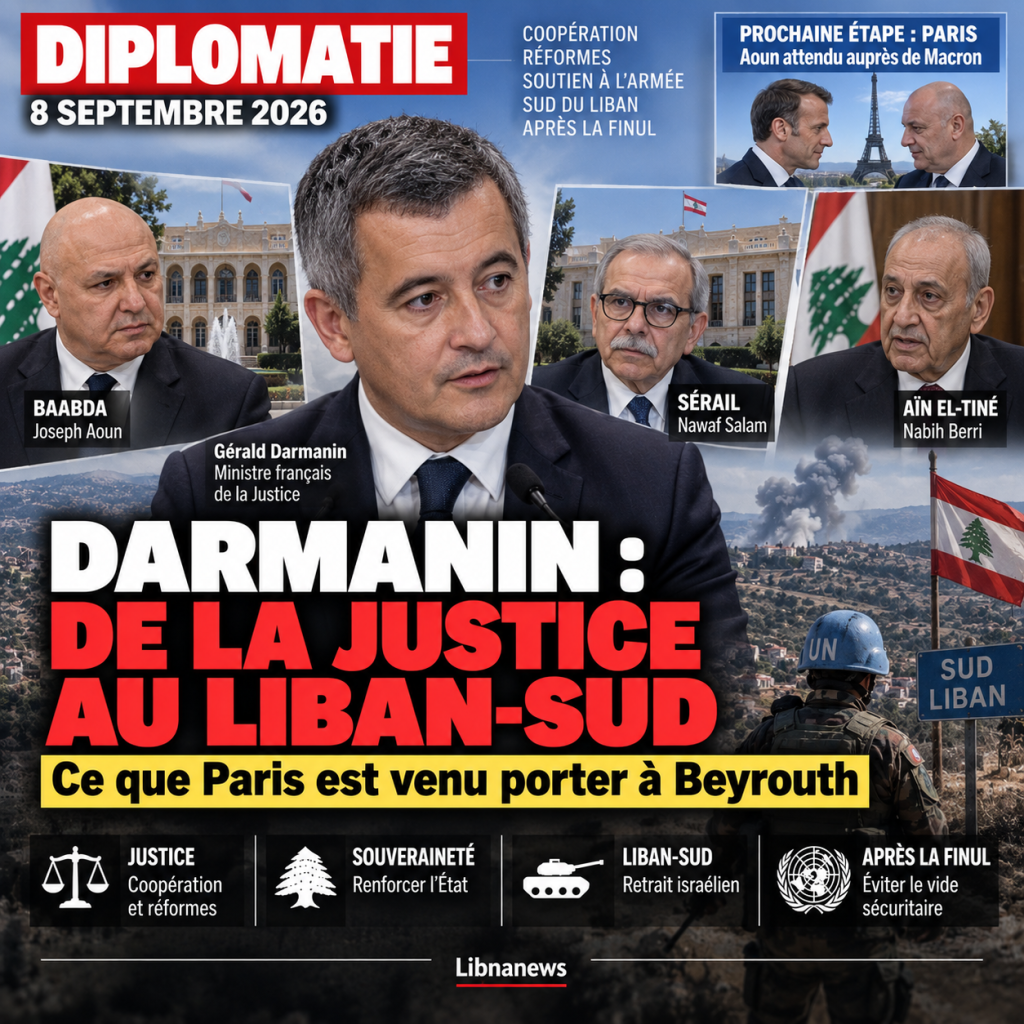
Gerald Darmanin was officially expected in Beirut to talk about justice. However, his move on September 6 and 7, 2026 quickly exceeded that framework. The French Minister of Justice met with President Joseph Aoun, Prime Minister Nawaf Salam and Speaker of Parliament Nabih Berri. He also worked with his Lebanese counterpart Adel Nassar. Anadolu, 6 September 2026, reports that Darmanin had presented his displacement as a mission to develop judicial cooperation and support Lebanese reforms. The French minister mentioned several specific areas. He had mentioned, inter alia, the fight against economic and financial crime, the fight against terrorism, civil affairs and the training of legal professionals. He also included his visit in the continuity of the action led by French President Emmanuel Macron in favour of Lebanon. The announced programme provided for meetings with the three main Lebanese institutional leaders. This organization already gave the move a wider scope than a simple meeting between two departments. The 7 September talks confirmed this dimension. The situation in South Lebanon, Israeli attacks, the future of the international presence and support for the Lebanese army have joined the judicial agenda. France used a sectoral ministerial visit to maintain a political dialogue with all the poles of Lebanese power.
The first concrete announcement came from cooperation between the Ministries of Justice. LBCI, on 7 September 2026, reports that Adel Nassar and Gérald Darmanin signed a judicial cooperation agreement in Beirut between Lebanon and France. The text aims to strengthen relations and coordination between the two ministries. On that occasion, Darmanin reaffirmed French support for Lebanon’s sovereignty and stability. Nassar stressed French support for his country. The signature gives an operational dimension to a relationship already fuelled by several exchanges. Anadolu, on 6 September 2026, recalled that Darmanin’s visit took place after two trips by Adel Nassar to Paris. The device therefore does not start from scratch. It seeks to transform political contacts into more regular administrative and judicial cooperation. For Paris, the stakes are multiple. Financial issues are important in the relations between the two countries. The fight against terrorism is another old field of cooperation. The training of judges and legal professionals complements this set. Behind these technical dossiers, however, appears a French political priority: strengthening Lebanese institutions so that the State can exercise its functions more effectively. Justice thus became one of the instruments of French politics in Lebanon.
Judicial reforms at the heart of French support
Gérald Darmanin’s speech in Beirut associated judicial reforms with Lebanon’s sovereignty. Anadolu, September 7, 2026, reports that the French minister assured Joseph Aoun that Lebanon could continue to rely on France. Darmanin welcomed the reforms carried out by the Lebanese authorities. Among other things, it highlighted the abolition of the death penalty. He also promised continued cooperation with the Lebanese Ministry of Justice. For the French official, the reform is not only a technical project. It participates in the capacity of the State to exercise its authority. This reading joins the French line defended for several years. Paris combines its political and financial support with institution-building. Darmanin’s visit made it possible to apply this principle to the judicial sector. The message to the Lebanese authorities remains positive, but it also contains a requirement. France welcomes the measures already taken while awaiting the continuation of the process. The question of the independence of justice was thus one of the topics discussed with Nawaf Salam. The Presidency of the Council on 7 September 2026 stated that the meeting focused on supporting judicial reforms and strengthening the independence of the judiciary. The government of Nawaf Salam is therefore encouraged to pursue a project presented by Paris as a component of institutional reconstruction.
This cooperation comes at a time when a number of sensitive cases continue to affect Lebanese justice. France itself has direct judicial interests in Lebanon. French nationals were victims of the explosion at the port of Beirut on 4 August 2020. Paris also monitors cases related to financial crime and terrorism. Cooperation between the two ministries can facilitate the exchange of information and assistance between judicial authorities. It can also strengthen training and technical capacity. Darmanin’s choice to insist on economic and financial crime is therefore not insignificant. Lebanon is still trying to resolve a financial crisis that has revealed weaknesses in its control and accountability mechanisms. In this context, justice reform is directly linked to trust in institutions. It also addresses the country’s ability to handle complex financial issues. The French visit thus places justice in a broader set that includes sovereignty, reform and state credibility. This link explains why displacement was able to move naturally from judicial issues to political and security issues.
In Baabda, South Lebanon sets itself on the agenda
The meeting with Joseph Aoun marked the clearest shift towards diplomacy. MTV Lebanon, September 7, 2026, reports that the President devoted a significant part of his interview with Darmanin to Israeli escalation in South Lebanon. Joseph Aoun denounced attacks, deaths among civilians and destruction. He considered that these operations threatened the process of the framework agreement. For the Lebanese President, they also undermine efforts to stop the escalation. This declaration comes in a period of high military tension in the South. The battle around Ali al-Taher and the strikes against several localities have put the risk of an extension of the conflict at the centre of concern. The presence of a French minister in Baabda therefore offered the President an opportunity to convey this message directly to Paris. France remains one of the European partners most involved in the Lebanese issue. It also has troops within the Finul and maintains contacts with the main regional actors. The contents of the interview thus show that Darmanin was not only received as a seal guard. He also served as a political relay with Emmanuel Macron and the French government.
Joseph Aoun also reaffirmed before Darmanin his choice of diplomatic route. Al-Sharq, on 7 September 2026, reports that the Lebanese President insisted on the need for Israel to comply with the framework agreement. He recalled that the text had received Arab and European support and had been signed under American sponsorship. This reference places France in a broader international framework. Paris is not the only mediator between Lebanon and Israel. The United States continues to play a key role. However, France is seeking to preserve its own capacity for action, particularly on the issue of security in the South and support for Lebanese institutions. Joseph Aoun’s message is precisely that function. Beirut wishes to mobilize Paris to prevent further military degradation. The President also seeks to maintain an international framework around the stabilization of the South. The Darmanin visit therefore comes at a time when France is being asked both as a bilateral partner and as a permanent member of the Security Council.
After Finul becomes a major Franco-Lebanese case
The issue of the international presence in South Lebanon had been particularly prominent in the discussions. MTV Lebanon, September 7, 2026, reports that Joseph Aoun reaffirmed his commitment to the renewal of the international presence. He reported working with Emmanuel Macron on this file. The Lebanese President also welcomed a Franco-Italian initiative to prepare a European force capable of avoiding a vacuum after the departure of the Finul. This question is far beyond the competence of the French Ministry of Justice. Its presence in the interview therefore confirms the political nature of the visit. It also shows the urgency given to the future of the international arrangement in the South. For Beirut, a withdrawal without an alternative would create an additional security risk. The Lebanese army must strengthen its deployment, but it needs financial, material and human resources. An international presence can accompany this rise and provide a monitoring framework.
The Council Presidency on 7 September 2026 confirms that Nawaf Salam also discussed with Darmanin the future of the international presence in the South. The interview focused on the need to avoid any vacuum after the end of the Finul mission. Support for the Lebanese army to extend State authority throughout the territory was also mentioned. The convergence between Baabda and Serail on this point is notable. Joseph Aoun and Nawaf Salam both used the French visit to defend a security architecture based on the Lebanese state, its army and international support. France appears to be an essential partner of this mechanism. She has an ancient experience in the Finul. It also maintains a close military relationship with the Lebanese army. After Finul, therefore, became a dossier where the military, diplomatic and institutional dimensions joined together.
Paris is already preparing the next sequence with Joseph Aoun
Darmanin’s visit is also part of a broader diplomatic calendar. MTV Lebanon, September 7, 2026, reports that Joseph Aoun announced his trip to Paris the following week. The President is to participate with Emmanuel Macron in the opening of a preparatory meeting for an international conference in support of the Lebanese Army and the Internal Security Forces. The question of the international presence in South Lebanon must also be included in the discussions. This announcement gives Darmanin’s visit a preparatory function. The French minister arrives a few days before a new stage in the dialogue between the two presidents. The subjects discussed in Beirut are therefore likely to be taken up at the presidential level in Paris.
Support for the Lebanese army is an ancient axis of French policy. However, it takes on new importance in the current context. The Lebanese State wants to extend its authority in the South. This ambition requires an army capable of occupying the ground and ensuring security. It also requires resources. The international conference announced is aimed precisely at mobilizing external support. France thus seeks to articulate two dimensions of its action. The first is to accompany institutional reforms. The second is aimed at strengthening instruments of sovereignty, including the army and the security forces. Darmanin’s speech on justice shares this logic. Effective sovereignty requires credible judicial institutions, functional security forces and an army capable of performing its role.
With Nawaf Salam, the Israeli withdrawal entered into discussions directly
The Serail interview further expanded the agenda. The Council Presidency on 7 September 2026 reported that Nawaf Salam and Gérald Darmanin discussed developments in South Lebanon in the context of Israeli escalation. Diplomatic efforts to secure Israel’s withdrawal from Lebanese territories were discussed. The return of stability to the South was also among the objectives mentioned. MTV Lebanon, September 7, 2026, reports the same elements. The official communiqué thus directly associates France with the discussions on the Israeli withdrawal. It does not mention a new specific French initiative. On the other hand, it shows that Beirut considers Paris one of the interlocutors to whom this dossier is to be presented.
This sequence also measures the place of Nawaf Salam in the Franco-Lebanese relationship. The Prime Minister leads the government reforms while participating in the management of the Southern issue. Darmanin thus met through him the two main dimensions of the French message: state reform and security stabilization. France supports the reform process, but it knows that it also depends on the regional situation. A new war in the South would reduce the government’s ability to pursue its economic, administrative and judicial endeavours. Conversely, Paris considers institution-building as a condition of sovereignty. The visit thus highlights a circular reasoning: stability allows reforms, while stronger institutions must enable the State to better ensure stability.
Ain al-Tiné completes the turn of the institutions
Gerald Darmanin finally met Nabih Berri in Ain al-Tinah. The Presidency of the Parliament on 7 September 2026 reported that the two men had reviewed the general situation in Lebanon and the region and the Franco-Lebanon relations. The press release gives little details on the precise content of the interview. Nevertheless, the meeting remains politically significant. Through Baabda, Serail and Ain al-Tinah, the French minister met with the three main Lebanese presidencies. Paris thus maintains its dialogue with officials who represent different political balances. This method allows France to preserve its channels with the entire institutional system.
The meeting with Berri is also of particular importance because of its political role in the South. The President of Parliament remains a major interlocutor in the discussions concerning Hezbollah and Shiite balances. A French visit on the regional situation would therefore have been incomplete without a visit to Ain al-Tiné. The sobriety of the press release does not allow the meeting to be given announcements that have not been made public. However, it confirms that Darmanin has been used as a vehicle for political dialogue beyond its ministerial portfolio.
Judicial cooperation becomes an instrument of sovereignty
The displacement of 6 and 7 September left several concrete results. The agreement signed between Adel Nassar and Gérald Darmanin first formalises the strengthening of judicial cooperation. The priorities announced are economic and financial crime, terrorism, civil law and training. France then renewed its support for the Lebanese reform process. Darmanin explicitly associated this project with the strengthening of the country’s independence and sovereignty. Discussions with Nawaf Salam also focused on the independence of justice. These elements give the judiciary a political dimension.
At the same time, the visit allowed the Lebanese leaders to place three strategic demands in front of Paris. The first concerns the reduction of Israeli escalation and Israel’s withdrawal from Lebanese territories. The second concerns the future of the international presence in South Lebanon and the need to avoid a vacuum. The third is aimed at strengthening the Lebanese army and the Internal Security Forces. These cases must be taken over during Joseph Aoun’s next visit to Paris. The Darmanin sequence has thus served as a bridge between precise ministerial cooperation and broader diplomatic negotiations. The French minister arrived to sign an agreement between two ministries of justice. He left Beirut after hearing the three Lebanese presidencies outline their priorities on sovereignty, the South, Israel and the future international machinery.




