

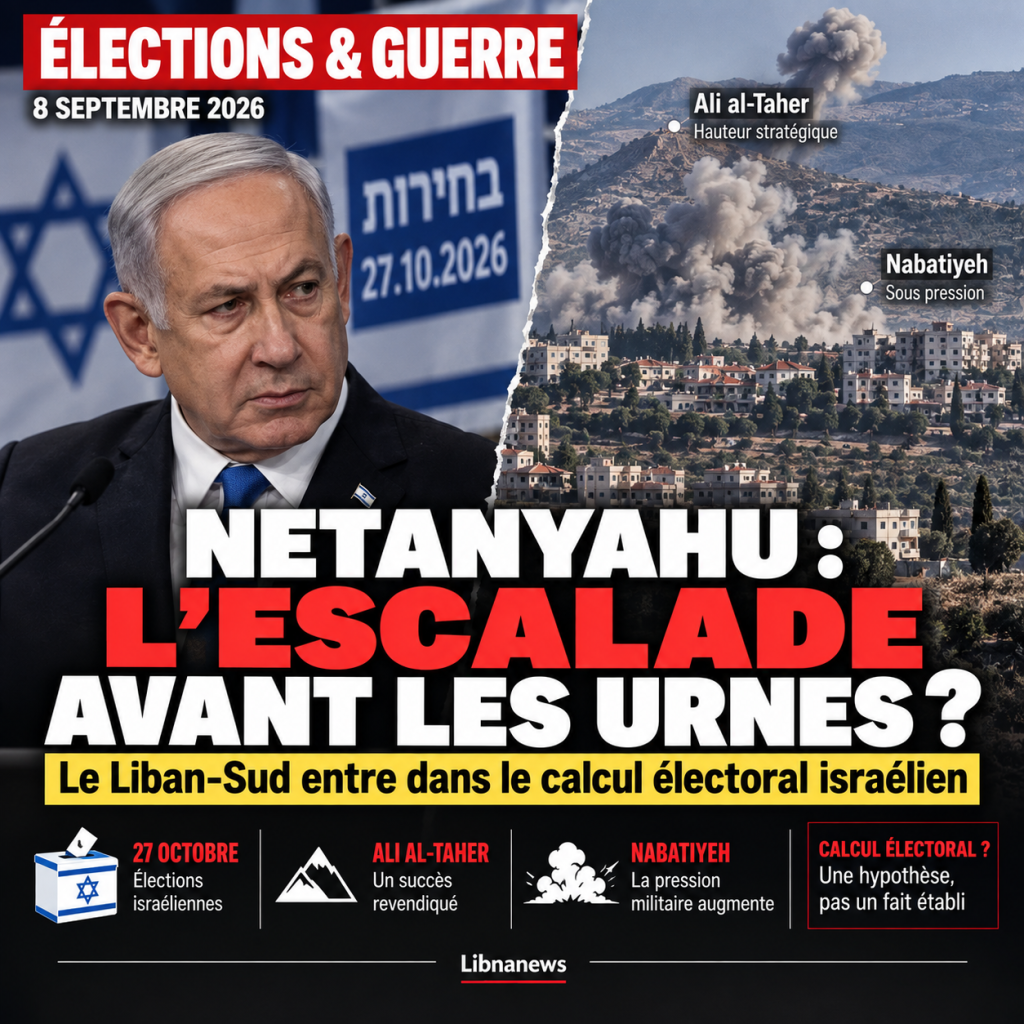
South Lebanon enters Israeli electoral calendar
Less than two months before the Israeli elections on 27 October, the situation in South Lebanon takes on a particular political dimension. Benjamin Netanyahu sought to retain power in a ballot where his majority remained uncertain. At the same time, the Israeli army is intensifying its operations in Lebanon. It claims to have taken operational control of Ali al-Taher. Strikes spread around Nabatiyah. This simultaneity feeds the hypothesis of a link between military imperatives and the electoral calendar. However, there is no evidence to suggest that Benjamin Netanyahu ordered an escalation in order to strengthen his campaign. On the other hand, several sources indicate that the elections are a factor in Israeli calculations. Reuters, September 3, 2026, reports that former Lebanese general Hassan Jouni believes that a victory in Ali al-Taher could be an important success for the Israeli government before the election. However, he stressed the political risk of heavy military casualties. This dual issue allows us to understand part of the current strategy. Netanyahu can benefit from a success presented as an improvement in security in northern Israel. At the same time, it must prevent costly operations from producing the opposite effect. The battle of the South is therefore taking place in a context where the military outcome has an obvious internal political value, even if that value is not sufficient to establish direct electoral motivation.
Associated Press, September 3, 2026, describes precisely the electoral difficulties that Netanyahu is facing. The danger is not just from opposition. It also comes from the fragmentation of its own camp. A number of small right-wing parties in favour of the Prime Minister risk running separately. Some may not reach the necessary threshold to enter Parliament. The resulting voices would then be lost for the Netanyahu block. This mechanism had already contributed to his loss of power in 2021. The Prime Minister therefore seeks to maintain a coalition capable of obtaining a majority. In this context, security remains a central element of his political discourse. The wars against Hamas, Hezbollah and Iran occupy an important place in the electoral record. A military success in Lebanon can thus be integrated into a broader narrative. It is a demonstration that Israel has repelled threats far from its borders and restored a deterrent capacity. But this strategy has a limit. A war that simmers or causes new losses can also fuel criticism against the government. Political calculation therefore does not automatically push towards maximum escalation. On the contrary, it can promote limited operations with visible results without overly costly terrestrial engagement.
Ali al-Taher, a military success that can become a political argument
The Battle of Ali al-Taher illustrates this logic. Reuters, September 3, 2026, describes this nearly 600-metre height as a strategic position about 15 kilometres from the border. It dominates several axes of the South Lebanon and links the southern sectors to Iqlim al-Tuffah. Israel also claims that it is home to Hezbollah underground facilities. It can therefore be presented to Israeli opinion as a concrete result. It offers a simple picture: a position used to threaten northern Israel would now be under Israeli control. This presentation is part of the Government’s security speech. Israeli Defense Minister Israel Katz linked Ali al-Taher’s capture to the disarmament of Hezbollah and the protection of the people of Galilee. Al Jazeera, on 5 September 2026, reports that he presented this operation as an important step towards this objective. The formulation clearly places the battle in a strategy for Israeli public opinion as well as for Hezbollah and the Lebanese government. The height control thus becomes a proof of determination. It can also be presented as a consequence of a policy that refuses to withdraw as long as the threat of Hezbollah remains.
The reality of the ground is more nuanced. Reuters, 4 September 2026, reports that a Lebanese military official could not confirm the exact extent of the Israeli presence in the tunnels. According to him, Israel controlled the southern entrances and monitored northern access by drones. Associated Press, September 5, 2026, also points out that the scope of the « operational control » claimed by Israel remains difficult to establish. This difference between military reality and political presentation is important. A government in the countryside does not need a complete occupation to claim a victory. It is enough to be able to present an operation as a change in the balance of power. For Netanyahu, Ali al-Taher offers precisely this possibility. The height is identifiable. Its strategic value is recognized. It is directly linked to Hezbollah’s capabilities. Its announced take can therefore be integrated into the Prime Minister’s security record. However, a further progression could change the calculation. The more the Israeli forces advance, the more they expose. Reuters, September 3, 2026, reports that Hassan Jouni links Israeli prudence to the risk of losses before the elections. The electoral interest of a victory can thus lead to action, while the electoral risk of losses can curb a deeper offensive.
A campaign built around security
The Israeli political situation gives additional weight to these arbitrations. Associated Press, September 3, 2026, says Netanyahu is trying to convince the small right-wing parties to unite before the election. The Israeli electoral system makes this issue essential. Training must obtain at least 3.25% of the votes to enter Parliament. If several lists in favour of the Prime Minister remain below this threshold, Netanyahu may lose a majority even if the right-wing has more votes overall. The electoral battle is thus played on both the mobilization of the nationalist camp and the confrontation with the opposition. In this context, the security discourse reminds right-wing voters of the issues that bring them together. Netanyahu emphasizes Israel’s defence, the refusal of a Palestinian state and the fight against regional opponents. Military operations can reinforce this narrative when they give the image of a controlled initiative. They become more problematic when they reveal an inability to achieve the stated objectives.
Al Jazeera, 6 September 2026, reports that recent polls place the opposition bloc before the Netanyahu coalition. The Prime Minister therefore approached the election in a position that did not guarantee victory. Its political longevity is largely based on its image as a leader capable of managing security issues. This image has been deeply tested since the attacks of 7 October 2023 and the subsequent wars. The 2026 campaign is thus taking place on paradoxical terrain. Netanyahu can highlight operations against Hamas, Hezbollah and Iran as evidence of his determination. On the other hand, opponents can blame him for the failures that preceded these conflicts or their duration. In this context, a successful operation in South Lebanon can serve the government. An uncontrolled extension could harm him. The hypothesis of a calculated escalation rests precisely on this border. It would not necessarily be a general war. Rather, it could be to maintain military pressure strong enough to produce visible results, while limiting the risk of significant Israeli losses.
Galileo at the heart of the electoral equation
South Lebanon also has a particular electoral dimension because of the situation in northern Israel. The protection of the inhabitants of Galilee has become a major political objective since the beginning of the clashes with Hezbollah. Evacuations, shooting and the long interruption of daily life have created a strong expectation for the government. Al Jazeera, 5 September 2026, quotes Israeli analyst Ori Goldberg, who believes Netanyahu has an electoral debt to the northerners. This assessment helps to understand the political value of a position like Ali al-Taher. If the government can convince voters that the threat has been repelled, it can present its strategy as effective. If the fire resumes or if Hezbollah retains a visible capacity for action, this promise becomes more difficult to defend.
Israeli policy in Lebanon, however, cannot be explained solely by the elections. Israel claims to pursue a strategic objective that goes beyond the election: to prevent Hezbollah from rebuilding a military capability threatening its northern localities. This concern existed before the opening of the campaign and will continue after 27 October. Reducing all operations to an electoral calculation would therefore produce too simple a reading. The timing can influence the pace, presentation and level of risk accepted. It does not create military objectives alone. This distinction is reflected in Israeli statements. Israel Katz links the maintenance of forces in Lebanon to the disarmament of Hezbollah. This requirement is broader than a campaign need. It affects the future balance of power between Israel, Hezbollah and the Lebanese state. But the proximity of the elections gives the government an additional incentive to show results before the vote. The military and the electorate can therefore be strengthened without confusion.
An escalation that remains under control as long as the losses allow
The recent strikes illustrate the possibility of increased pressure without a massive ground offensive. Reuters, September 7, 2026, reports that at least 12 people were killed in Kfar Rumman, including two children. A strike hit a residential building. Another attack killed a rescuer. Associated Press, September 8, 2026, reports that the Israeli army presented these operations as a response to drone attacks against its soldiers and as strikes against Hezbollah members. These operations occur a few days after the announcement of Ali al-Taher’s control. They show that military activity did not stop after the claimed success on the height. On the contrary, pressure shifted to its immediate environment and to Nabatiyah district.
For Netanyahu, this type of operation has a different political profile from a deep ground offensive. Air strikes and drones limit the direct exposure of Israeli soldiers. They also allow the government to show that it is responding quickly to Hezbollah attacks. The human cost is borne mainly on the Lebanese side, while the domestic political risk depends more on the response of Hezbollah. A response capable of killing several soldiers or hitting Israeli cities could change this equation. The government would then face the choice between further escalation and the risk of appearing low. This is one of the limits of a controlled pressure strategy. An operation can be decided with a limited objective and then produce a reaction that imposes another level of commitment. South Lebanon offers many precedents for this mechanism. In the run-up to the elections, therefore, the margin between demonstration of force and military gear becomes particularly narrow.
The electoral calendar can also push Netanyahu to caution
The idea of electoral escalation must not mask the opposite scenario. Netanyahu may have an interest in avoiding a wider war before October 27. Reuters, on 3 September 2026, highlights the risk of Israeli military casualties in an attack on Ali al-Taher. A land operation to Nabatiyah or Iqlim al-Tuffah would be even more complex. It would expose Israeli forces further and could lead to prolonged fighting. Such a situation would be difficult to control politically during an election campaign. Images of killed soldiers, new mobilizations and a massive resumption of fire on the north could weaken the story of restored security.
This constraint may explain a preference for operations giving a military advantage without making too much progress. The rise of heights, the destruction of infrastructure, air strikes and drone surveillance are more consistent with this logic. They help to maintain the initiative and to claim results. They also limit the immediate risks to ground forces. In this reading, the elections would not push Netanyahu towards a total war. Rather, they would favour selective escalation. The government should maintain pressure on Hezbollah while avoiding the level of loss that would turn Lebanon into an electoral problem. This hypothesis remains analytical. There is no document or public policy to establish that such a strategy has been formally adopted.
Diplomatic blocking leaves more room for balance of power
The weakness of diplomatic progress, however, increases the military’s position. Reuters, 1 September 2026, reports that a high Western diplomat sees little chance of significant progress before the Israeli elections in late October. More than ten European countries say they are ready to contribute to a mission to support and train the Lebanese army. This initiative should help the State extend its authority and be part of the Hezbollah disarmament agenda. Yet the Israeli political calendar is slowing down the prospects. If important decisions are delayed after the election, the weeks preceding the election may become a period of military management of the status quo.
This blockage creates a favourable situation for the consolidation of existing positions. Israel can seek to improve its balance of power before a new phase of negotiations. Ali al-Taher then takes an additional value. A position won before the election remains an asset after the election. Associated Press, September 5, 2026, quotes researcher Nasser Khdour, who believes that height control strengthens Israel in future discussions on a withdrawal. Military logic here joins diplomatic logic. Getting more ground or reducing Hezbollah’s capabilities before a negotiation can make it possible to claim more in exchange for a withdrawal. The electoral calendar can speed up this search for benefits without necessarily being its origin.
A political hypothesis that the facts do not yet allow to transform into certainty
The Lebanese public positions show that the suspicion of an electoral calculation already exists. Associated Press, 5 September 2026, reports that Deputy Prime Minister Tarek Mitri stated that the Lebanese army was ready to take control of Ali al-Taher. He considered that the problem had come from the Israeli position and referred to political considerations related to the elections. This accusation places the Israeli calendar directly in the Lebanese debate. However, it is not evidence of Netanyahu’s intentions. It reflects the analysis of an official of the Government of Nawaf Salam confronted with the continuation of Israeli operations despite negotiated arrangements.
Al Jazeera, 5 September 2026, reports an even more direct analysis of Ahron Bregman, an Israeli security specialist. According to him, the situation in Lebanon can become important for Netanyahu as he approaches an election where polls are unfavourable. This reading joins that of other observers on the political importance of security. However, it must face military constraints. A useful electoral escalation assumes that it remains controllable. It must produce visible results, avoid heavy Israeli casualties and not trigger an uncontrolled regional response. These three conditions do not depend solely on Netanyahu. They also depend on Hezbollah, Iran, the United States and the dynamics of fighting.
The coming weeks therefore place the South in a particularly sensitive period. The Israeli elections are scheduled for 27 October 2026. Reuters, September 1, 2026, indicates that some Western diplomats do not expect major progress before this appointment. Meanwhile, Israel has a new advantage around Ali al-Taher and continues its strikes in the Nabatiyah district. Hezbollah retains response capabilities and refuses general disarmament north of Litani. The Lebanese army is seeking to extend its authority in the areas covered by the agreements. This configuration leaves much room for limited operations and demonstrations of force. Every success can be exploited politically in Israel. Each loss can also change the election calculation. The calendar does not prove the existence of a war designed for the ballot box. However, it adds an internal variable to all decisions taken on a front where the border between controlled pressure and further escalation remains narrow.




