

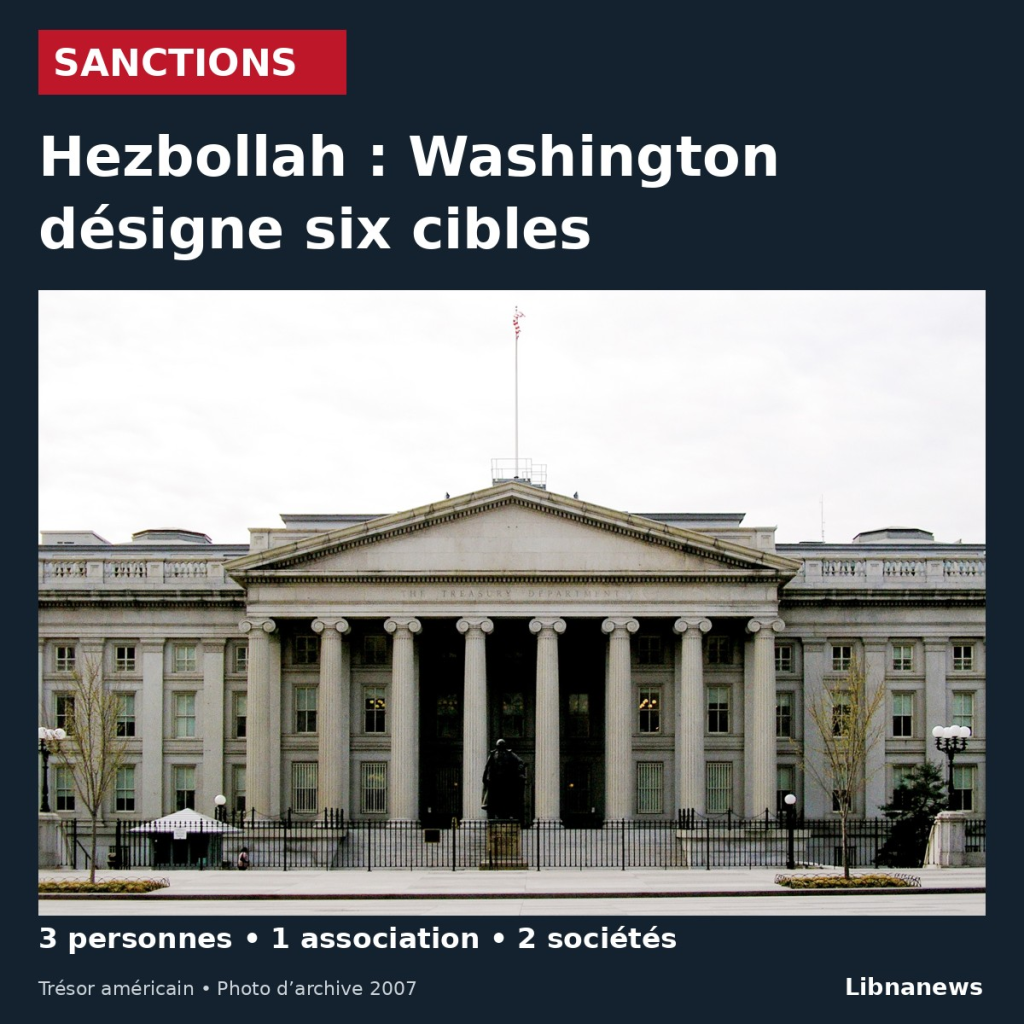
The United States added three Lebanese nationals and three organizations to its list of counter-terrorism sanctions on Wednesday, 18 November. The Treasury Department accuses the individuals and structures concerned of supporting Hezbollah through a charitable association and a financial network linked to the gold trade. The decision concerns activities in Lebanon and Turkey. It does not constitute a general sanction against both countries.
The official update of the Office of Foreign Assets Control, OFAC, confirms the six new entries. The designated individuals are Afif Abdel Rida Chouman, Hassan Khechen and Ibrahim Khechen. The organizations are Wa Ta的awanu Association, Gold Global Company and Sankari Gold Kuyumculuk Ticaret Limited Sirketi.
An association and its leader
The Treasury is presenting Wa Tawanu as an association based in Lebanon that provides emergency relief in the South. He also accuses him of diverting donor funds to Hezbollah’s activities and of providing cover for its military activities.
According to the US press release, its founder and leader, Afif Abdel Rida Chouman, coordinates its activities under the leadership of the movement. Washington states that this organization is hampering disarmament efforts in areas where the Lebanese army must provide security.
These claims constitute the grounds put forward by the US administration to justify the sanctions. Publication of the decision confirms inclusion on the OFAC list; it does not constitute a criminal judgement establishing the facts alleged. The press release does not contain a response from the association or its leader.
Two companies related to gold trade
The second part concerns Hassan Khechen and his brother Ibrahim. The Treasury accuses them of having participated in transfers of funds from the Al-Quds Force of Iranian Revolutionary Guards to Lebanon on behalf of Hezbollah.
Gold Global Company, based in Lebanon, belongs according to Washington to Hassan Khechen. Sankari Gold, based in Turkey, would also be under his control. The US administration presents both companies as components of the same financial network. The official list links them to Hassan Khechen, while the three people and Wa Ta Whoaawanu are designated for their alleged support of Hezbollah.
The press release does not specify the total value of the flows it assigns to this network. Nor does it provide the amount of assets actually blocked as a result of the new entries. Therefore, no record of seizures can be deducted from the number of sanctioned individuals and organizations.
What asset freeze means
The measures are based on United States Presidential Decree 13224, as amended. They block the property and property interests of designated persons in the United States, or under the possession or control of American persons. These assets must be reported to OFAC.
The scheme also covers entities owned, directly or indirectly, at least 50 per cent by one or more blockers. Transactions involving the subject goods are generally prohibited for U.S. individuals and in U.S. jurisdiction, unless authorized or exempted.
The Treasury also warns foreign financial institutions of the risk of secondary sanctions for certain significant transactions knowingly carried out for the benefit of designated persons. This international scope does not mean that all the property of the persons concerned, anywhere in the world, has been confiscated.
With these six entries, Washington targets two forms of support that it attributes to Hezbollah: the use of a charitable structure and that of commercial companies. The decision makes the new designations public, but does not at this stage document the execution of blockages in each country or their measured financial effect.





Comments