

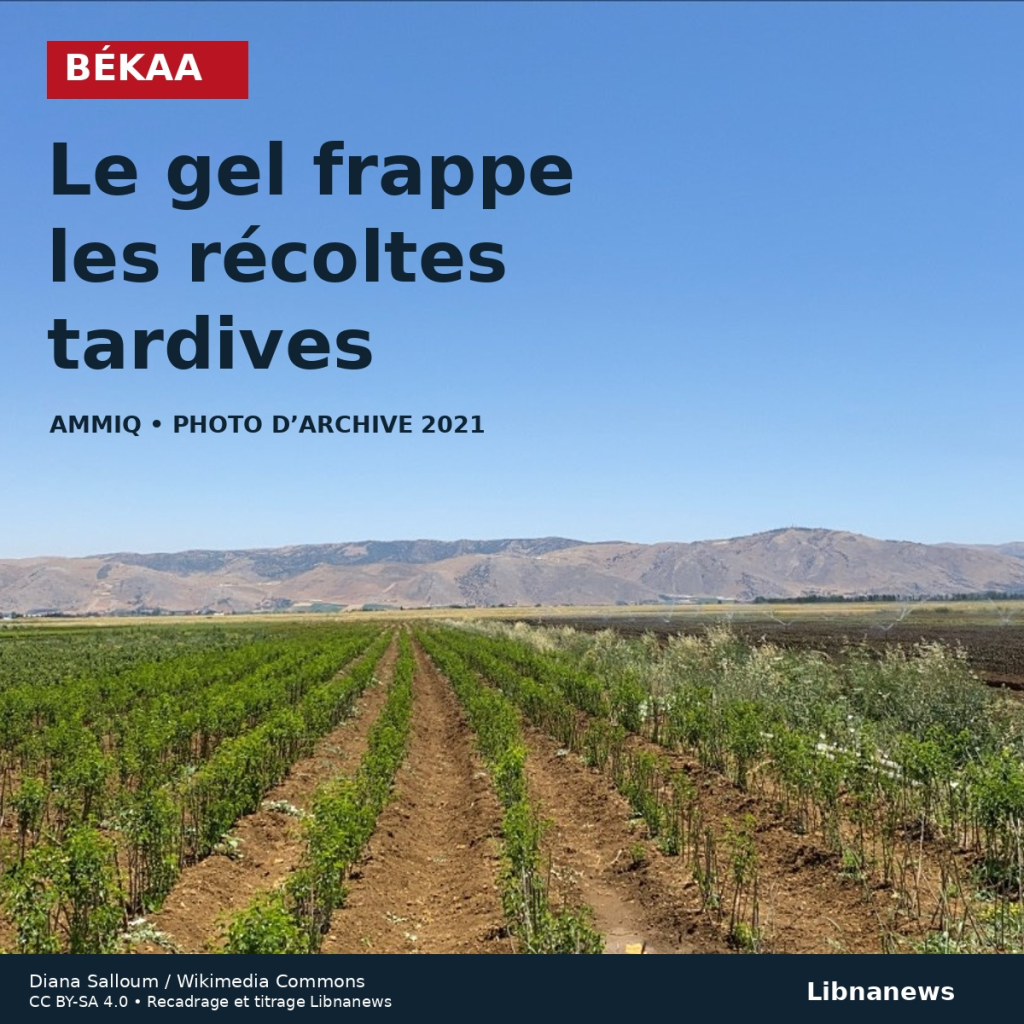
Freezing in Bekaa damaged field crops and late potato harvest. Farm officials describe significant losses after several cold nights in November. They also warn about a decrease in vegetable arrivals. The estimates available remain those of professionals, without a consolidated national balance sheet.
Late potatoes among affected crops
Ibrahim Tarshishi, an agricultural trade union leader, estimates that losses exceed 30% of the expected production of late potatoes, known as « laqis ». In his statements reported on 13 November, he mentions about 15,000 tons lost. This figure relates to the expected yield of this campaign, not to all Lebanese annual production.
It describes five successive days of freezing, for three to four hours a day, which reduced the yield of plots at the time the producers were waiting for their harvest.
The gel in the Bekaa weakens the end of the season
In an interview published on November 10, Tarshishi already reported destruction among the crops exposed: zucchini, cucumbers, tomatoes, beans and eggplants. It described entirely damaged plants, as well as a decrease in the expected volume of potatoes.
This alert comes as the field gardening campaign approaches its end in the Bekaa. Greenhouse producers may extend certain crops. However, Tarshishi believes that the volumes available under shelter, in the plain and on the coast, will not be sufficient to replace lost crops.
The agricultural manager also highlights the burden of pre-freezing expenses: seeds, fertilizers, treatments, irrigation and pump fuel. The destruction of a crop thus deprives the producer of an expected revenue after several months of expenditure. It does not remove the costs already incurred.
Reduced arrivals to Qab Elias market
Omar Hatoum, representing fruit and vegetable wholesalers, also describes a sharp contraction of arrivals in Qab Elias. Some products become difficult to find, including beans, zucchini, cabbages and peppers. This decline in deliveries concerns a distribution centre where traders are supplied.
The pressure on prices now depends on the quantities that can be supplied by other production pools. Tarshishi pointed out that the previous marketing difficulties had discouraged some of the producers from expanding their areas. Crops already planted on the coast cannot therefore be increased immediately to meet this shortage.
Agricultural organisations call for protection
In a press release on 12 November, Antoine Hoyeck, president of the Lebanese Farmers Association, also denounced the losses caused by the freeze. He called for compensation for agricultural disasters and criticized the inadequacy of public protection. Its organisation advances important disaster areas, without providing in this press release a detailed inventory by municipality and by culture.
These demands involve two distinct needs: anticipating dangerous episodes and supporting farms after a loss of harvest. An alert is used to prepare measures adapted to the crops and facilities available. Indemnification responds to lost income and expenses already incurred.
An important fall supply campaign
The LEBTRADE public portal places the late Lebanese potato harvest between October and December. It identifies the Bekaa and Akkar as one of the main production areas, with different calendars depending on the region. This diversity makes it possible to spread the supply, without making agricultural basins interchangeable in the short term.
Potatoes are used primarily for fresh consumption. They also feed into regional markets, including Kuwait, the United Arab Emirates, Oman, Turkey and Qatar. For farmers affected by the freeze, the immediate issue remains the marketable quantity at the end of this harvest.





Comments