

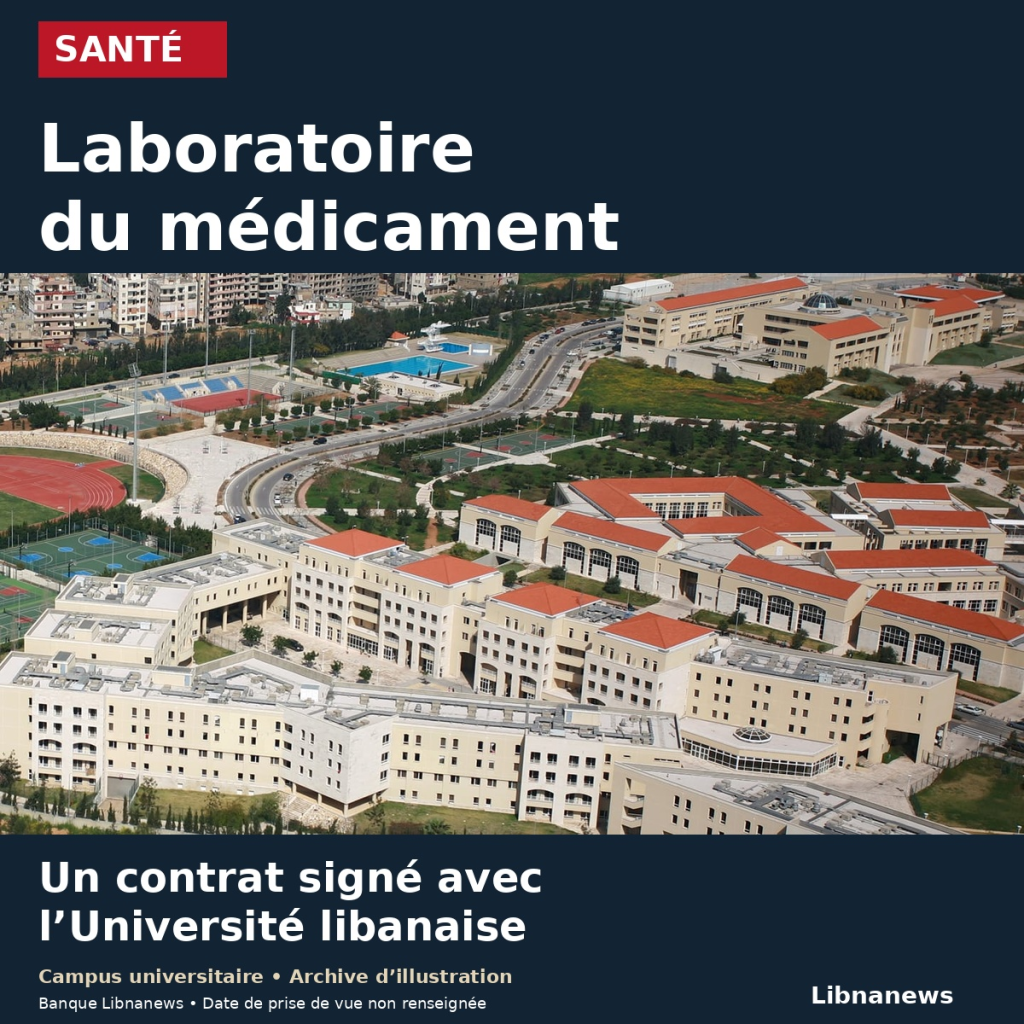
The drug’s central laboratory project is entering a new phase in Lebanon. Minister of Health Rakan Nassereddine and President of Lebanese University Bassam Badran signed a cooperation agreement on 12 November 2026 to create a reference laboratory for the safety, quality and efficacy of pharmaceutical preparations. The minister planned to open in early 2027 in the Rafic-Hariri University City in Hadath.
On Friday 13 November, at a forum on the quality of care, Rakan Nassereddine again mentioned this contract signed the previous day. He presented him as one of the instruments of his drug control policy, along with new evaluation rules and suspension decisions concerning certain products.
From the announcement to the convention with the University
On 5 November, the minister announced the forthcoming signing of an agreement with the Lebanese University. Both institutions had already reviewed the administrative and technical preparations for the project on 2 November. The convention of 12 November therefore gives concrete expression to an institutional stage which remained to be achieved.
At the signing, Rakan Nassereddine indicated that a donation from the World Bank would be mobilized to equip the laboratory in a first phase. No amount was specified in this announcement. The timetable announced concerns the beginning of the year 2027: it does not correspond to an opening already made, nor to a precise date for starting the analyses.
The Minister attached the draft to Council of Ministers Decision No. 8, dated October 29, 2025. It assigns it a role in the analysis and registration of medicines and in the verification of their quality. It intends to provide technical support to the Ministry and the National Medicines Agency for both local and imported products.
A laboratory backed by university skills
For Bassam Badran, cooperation must involve researchers, doctors and specialists from the Lebanese University in the service of public health. The president of the institution affirmed the university’s commitment to make its scientific and human resources available and to develop a sustainable tool capable of following technical developments.
The signing ceremony included officials from the faculties of medicine, pharmacy, public health and science, as well as representatives from the pharmaceutical professions and the Parliamentary Health Committee.
On 13 November, Rakan Nassereddine recalled that the country had been deprived of its central pharmaceutical laboratory for more than 30 years. In his view, the creation of the new tool should enable the quality and effectiveness of medicines to be monitored. Its commissioning remains the next stage of the project.
Evaluation rules and suspended products
At the Friday forum, organized by the Ministry on the occasion of World Quality Day, Rakan Nassereddine detailed two other measures. He announced the updating of the guidelines and criteria for each drug entering Lebanon to be evaluated in accordance with World Health Organization standards.
He also reported decisions to suspend certain pharmaceutical products pending their review according to the criteria. The Minister did not give any trade names or product lists in this speech. Therefore, this announcement does not refer to an entire category of treatments as dangerous.
The quality of hospitals under budgetary constraints
The Minister extended this priority to hospitals. He announced his department’s willingness to cover the cost of any public hospital choosing to engage in an accreditation and classification process. This approach remains voluntary. The prospect of making it compulsory was raised, without announcing a new obligation applicable immediately.
Rakan Nassereddine also mentioned the strengthening of medical control, with more medical controllers, a new division of their missions and rotation among them. It estimates the health coverage requirement at approximately $1 billion, for an envelope available to the department not exceeding $300 million. These amounts are those advanced by the Minister at the forum.
In this context, the Hadath laboratory must provide additional technical capacity for pharmaceutical control. The agreement is signed and an opening horizon has been announced; the equipment of the site and the actual launch of the analyses will determine the operational translation of this partnership.





Comments