

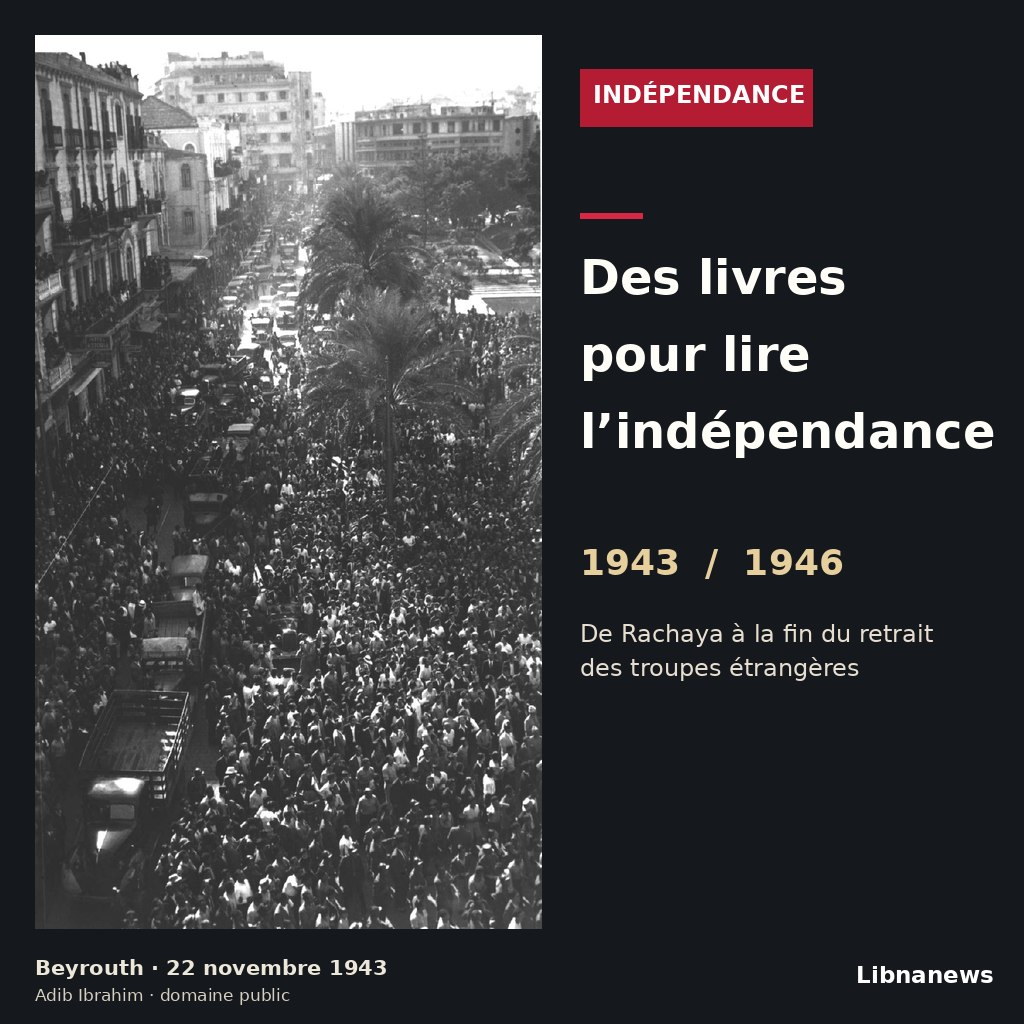
On 22 November 1943, the release of Bahara al-Khury, Riad al-Solh and other Lebanese officials detained in Rashaya marked the political victory that remained in the national calendar. But neither the birth of Greater Lebanon in 1920 nor the departure of the last French troops in 1946 were confused with that day. To understand what has been played between these dates, the best books do not all tell the same story: one follows the actors of the crisis, another goes back to the mandate, a third examines the compromise that was to bring about the new state.
November 1943: the date that gives their thread to these readings
In early November, the Chamber abolished the mandate provisions from the Constitution. The French authorities arrest the President, the Head of Government and several officials on the night of 10-11 November. Outside the citadel, the protest is on the street. The crisis also binds the Allies: London intervenes while the Levant still counts in the war apparatus. On 22 November, detainees returned to freedom and leaders resumed their duties. The French military presence did not end until 1946.
Denise Ammoun: from November 22nd to the term of office
History of Contemporary Lebanon, Volume 1: 1860–1943(Fayard) is the book to choose from to follow the sequence of events in French. The title covers more than eight decades, but the story gives a central place to the last years of the Ottoman Empire, to the creation of Greater Lebanon and to the evolution of political life under the mandate. The year 1943 thus appears at the end of negotiations and reconciliations which took years, rather than a break without a past.
It can be read with a question: when does the claim change in nature? Defining the territory, organizing its institutions and removing its constitutional prerogatives from the proxy power are three different stages. To continue beyond the day of Rachaya, the second volume took over in 1943; It does not replace the first if one seeks the story of the march towards independence.
Patrick Seale: Follow Riad el-Solh from inside
InThe struggle for Arab independence(Fayard, 2010), Patrick Seale chose the biography. Riad al-Solh did not enter into the narrative with his appointment to the presidency of the Council in 1943: his commitments, exiles and relations in the Arab world shed light on the alliances he later established in Lebanon. This is the most narrative reading of the selection.
The focal change is useful. The reader sees how a politician engaged in debates that transcend Lebanese borders comes to defend the country’s independence and govern with Bechara al-Khoury. The biography naturally favours its main character. Reading with Ammoun, it allows to distinguish its trajectory from the wider movement that carries independence.
Selim Takla: finding a less well-known actor from 1943
VolumeSelim Takla, 1895–1945. A contribution to Lebanon’s independence, led by Gérard D. Khoury (Karthala), moves the gaze towards an actor less present in commemorations. Minister of Foreign Affairs of the government of Riad al-Solh, Takla is one of the officials imprisoned in Rashaya. The book makes it possible to find, alongside the two best known leaders, a man who took part in the construction of the foreign policy of the new state.
This is a more specialized choice than Ammoun synthesis. It is particularly useful for those who want to understand what was to follow the November crisis: to exercise diplomatic powers and to have the State recognized in its relations with other governments.
Georges Corm: What changes independence in society?
InContemporary Lebanon. History and society(La Découverte), Georges Corm succeeded one chapter on the mandate and another on the society of independence, from 1943 to 1975. He is less interested in reconstructing each of the November days than in understanding how the country works after the breakup: who can access the state, how economic life evolves and what political tensions owe to internal dynamics as well as foreign influences.
It is a good second book so as not to stop at the release of prisoners. Where a biography follows the negotiation between leaders, Corm invites us to look at what the new political order allows and the problems it does not solve.
Fawwaz Traboulsi: another reading of the transition to independence
InA History of Modern Lebanon(Pluto Press, second edition, 2012, in English), the chapter on the transition from mandate to independence takes place between the formation of Greater Lebanon and the first years of the Republic. Traboulsi gives particular weight to social groups, the economy and the interests that meet in institutions. We can start with this chapter, without reading the whole synthesis.
Comparison with Seale reveals two approaches. In the biographer, the relationships and choices of an actor give their rhythm to events. In historians, alliances also read through the circles and interests that make them possible. It’s a complement, not a second account of the only detention in Rachaya.
What book to start with?
If you only read one, start with Denise Ammoun to follow the story until November 1943. Add Patrick Seale to read the crisis through Riad el-Solh, or the volume on Selim Takla to find another Rachaya actor. Georges Corm and Fawwaz Traboulsi move the question to institutions and society: what changed independence after the leaders were released from prison?
Find editions on Amazon.fr
As an Amazon Partner, Libnanews makes a profit on qualifying purchases. The affiliate links below launch an ISBN search in the Amazon.fr Books section. No price or stock is confirmed; check the format, status and seller before ordering.
- Denise Ammoun,History of contemporary Lebanon, Volume 1(1997):search the Fayard edition on Amazon.fr.
- Patrick Seale,The struggle for Arab independence(2010):search for the French edition on Amazon.fr.
- Gérard D. Khoury (ed.),Selim Takla, 1895–1945(2004):search the Karthala edition on Amazon.fr.
- Georges Corm,Contemporary Lebanon(2012):search pocket edition on Amazon.fr.
- Fawwaz Traboulsi,A History of Modern Lebanon(2012):look for the second edition in English on Amazon.fr.





Comments