

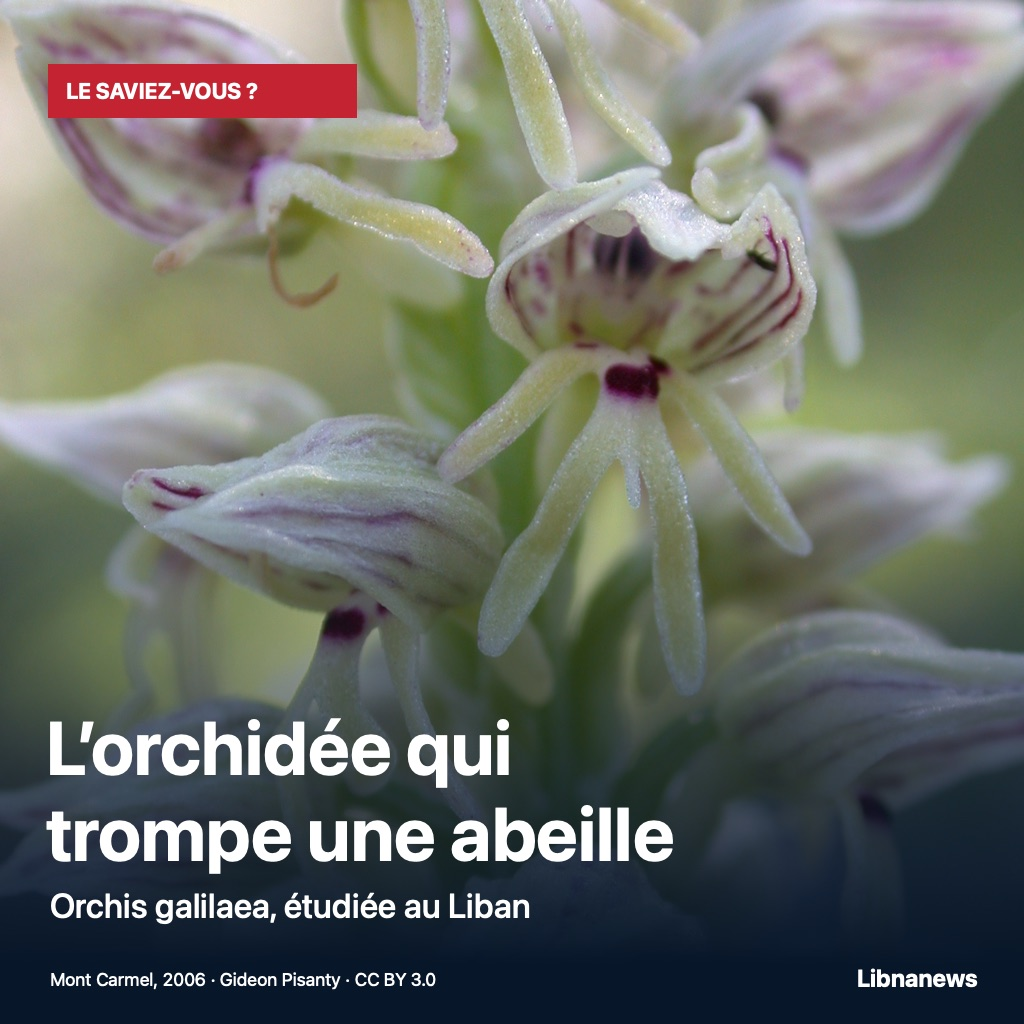
On the slopes of Mount Lebanon, the flowers of the Orchis of Galilee mimic the smell of a female bee. Two seasons of observation showed how much this strategy depends on rare visits.
The male approaches the flower, poses and sometimes leaves with small masses of pollen glued to the head. He does not come for nectar: the orchis of Galilee,Orchis galilaea, does not produce any. Her musk fragrance mimics a signal of mating the female of a wild bee,Lasioglossum marginatum. If the insect then visits another orchid, it can deposit this pollen.
Nine pollen samples observed on 68 visits
Researchers from Saint Joseph University, Lebanon American University, the American University of Beirut and Worcester University studied thirteen populations, mostly on the western slope of Mount Lebanon. Their observations covered two field seasons, in 2011 and 2012, in garrigues, oak woods and mixed oak and pine stands.
In 75 hours of video, the team counted 117 approaches and 68 visits. Only nine visits resulted in pollen masses attached to the insect; The images do not show nine fertilizations. The only pollinators observed were males of the same bee species. Contacts lasted an average of fourteen seconds per flower.
What the net test shows
Researchers compared open-air flowers, others protected by a net to remove insects, and a third group pollinated by hand with pollen from another plant. Nearly 29% of the open-air flowers produced fruit, compared with 89% of those pollinated by hand. Under net without intervention, only one out of 36 plants produced fruit. The team did not interpret this exception as evidence of self-fertilization.
These proportions describe the experience, not a rate applicable to all orchids in Lebanon. In observed populations, fruit formation increased where males were more numerous, with no clear differences between the three types of medium studied. Protecting the plant therefore requires the conservation of habitats where the pollinator can maintain itself.
FlowersOrchis galilaeaphotographed at Mount Carmel in 2006 :Gideon Pissey (Gidip) / Wikimedia Commons,CC BY 3.0. Boxing and dressing Libnanews.






Comments