

The European Union applies Euro 7 to new types of cars and light trucks from 29 November 2026. Models already approved generally have an additional one year. The standard also covers brake particles and sets durability thresholds for traction batteries.
From Sunday, 29 November, the approval authorities in the European Union will have to refuse new types of passenger cars and light commercial vehicles which do not meet the Euro 7 standard. The first deadline concerns manufacturers submitting a vehicle type for approval. It does not correspond to an immediate change for all new concession vehicles.
Two deadlines, separated by one year
Type-approval shall validate the characteristics of a model or family of vehicles prior to marketing. It differs from the registration of a precise copy. It is this difference that explains the two-date timetable provided for in European Regulation 2024/1257.
On 29 November 2026, the rule applies to new approvals for passenger cars (category M1) and light-duty vehicles (N1). For new vehicles of these categories whose type has already been approved, the general milestone is 29 November 2027. From that second date, the authorities will no longer be able to accept certificates of conformity for new vehicles not conforming for the purposes of registration. The Regulation also prohibits their sale or entry into service, subject to the exceptions provided for in the text.
A vehicle already registered shall not be reapproved by 29 November 2026. Nor does the European standard mean that used vehicles become unsold by that date. The traffic rules that may apply in some cities are covered by other schemes.
Braking enters the approval perimeter
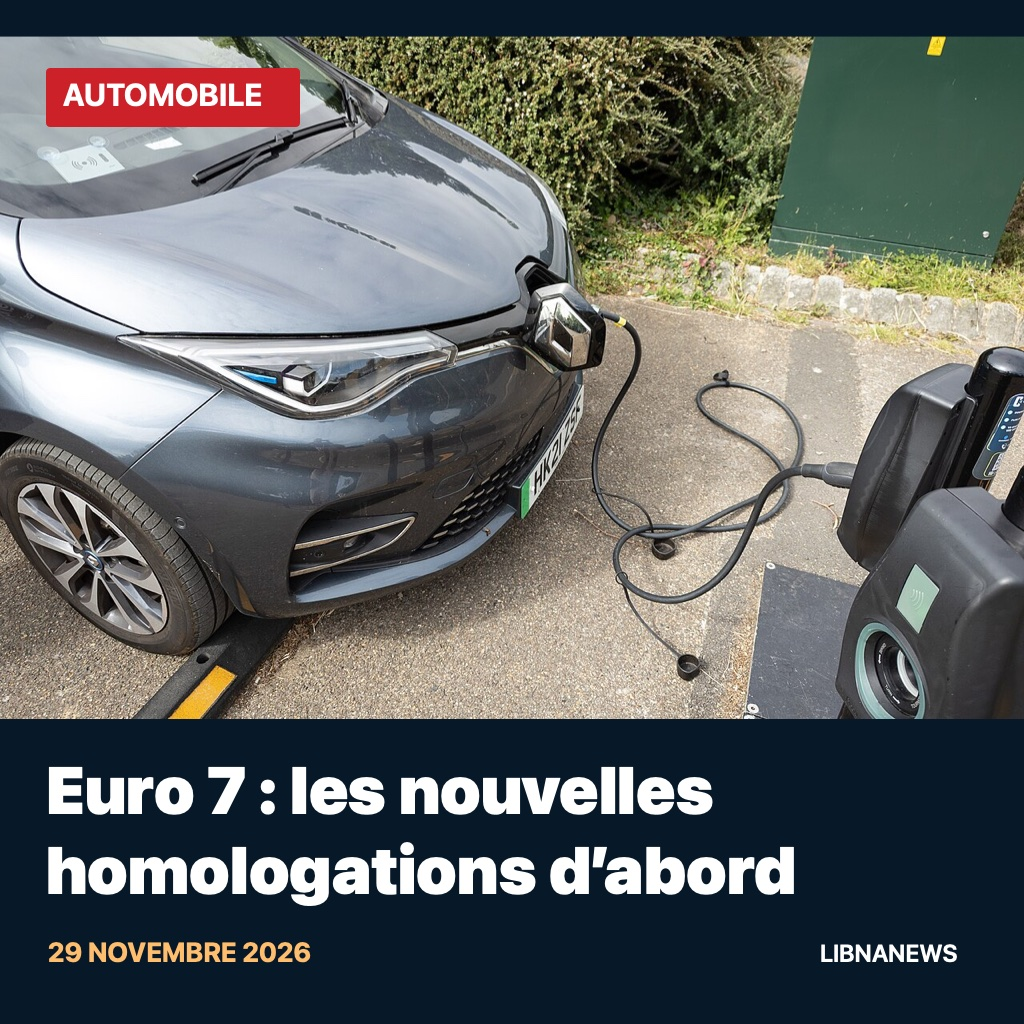
Euro 7 does not stop at what comes out of the exhaust. The Regulation also sets ceilings for particulate emissions due to braking, measured over a test cycle. These limits vary, particularly depending on the category of vehicle and its motorization. Electric cars are therefore involved even if they do not emit exhaust gas while driving.
The text also covers tyre abrasion. This measure follows provisions specific to tyre categories and test methods. The date for new cars does not mean that all new tire wear limits apply indiscriminately on the same day.
Sustainability thresholds for batteries
For rechargeable electric and hybrid cars, Annex II sets at 80 % the minimum level of energy that the battery must be able to supply up to five years or 100 000 kilometres, whichever is the first time. The threshold rises to 72% over the next period, up to eight years or 160,000 kilometres. These values relate to the energy of the battery and not to the number of kilometres that a driver can travel at each charge. The actual range also depends on the temperature, speed and use of the vehicle. Light utilities have their own thresholds.
These requirements are subject to registration. They do not replace the manufacturer’s commercial warranty conditions. The Regulation also provides for a digital environmental passport. It includes information on consumption, emissions and, where relevant, battery durability.
Heavy goods vehicles and buses follow another schedule
For new types of heavy trucks, buses and coaches covered by the Regulations, the first general deadline is May 29, 2028. On November 29, 2026, therefore, opened the timetable for cars and light trucks, without triggering an equivalent obligation on the same day for all road vehicles.





Comments