

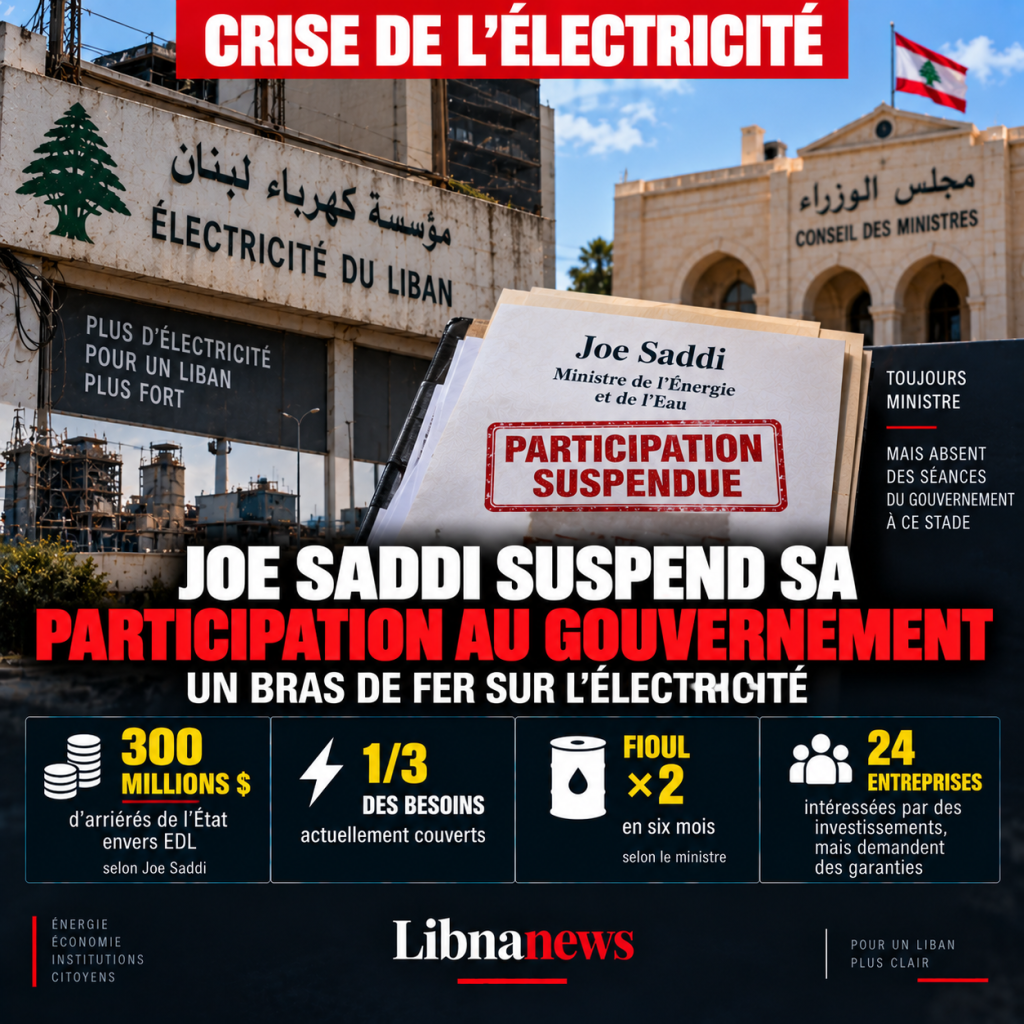
The Lebanese Minister of Energy and Water, Joe Saddi, announced Tuesday, 6 October 2026 that he was suspending, « at this stage », his participation in the meetings of the Council of Ministers. It is a condition for its return to government decisions on the electricity crisis, including the settlement of sums due to electricity in Lebanon, the taking over of certain exemptions and the consideration of measures to maintain supply without imposing new burdens on households.
The arm of iron on electricity crossed a new threshold within the Lebanese government. At a press conference held on Tuesday in Beirut, Joe Saddi announced that he would no longer participate in meetings of the Council of Ministers.
The Minister of Energy does not, however, present this decision as a resignation or as a withdrawal from office. He states that he will continue to carry out his ministerial responsibilities. His suspension concerns his attendance at government meetings.
Joe Saddi conditions his return to a political and financial response on the electricity issue. It calls on the Government to assume its responsibilities to the energy sector and to consider proposals already submitted.
This decision comes at a time when electricity in Lebanon (EDL) must finance its fuel purchases in an environment marked by rising energy prices. It reveals above all a disagreement on how to finance the public service without returning to the mechanism of advances from the Treasury.
Joe Saddi links his decision to the electricity crisis
The Minister explained his temporary withdrawal from the sessions because there were no decisions that met the immediate needs of EDL. It considers that its participation in the Council of Ministers is no longer sufficient if the electricity proposals remain unanswered.
In particular, Joe Saddi claims the payment of invoices and arrears owed by the public authorities and institutions to Electricité du Liban. According to the figures he put forward on Tuesday, the State’s arrears to EDL would reach about $300 million.
The minister pointed out a contradiction which he considered difficult to maintain: individuals had to pay their bills while some public institutions did not pay theirs in full. EDL needs these revenues to finance its fuel purchases.
Joe Saddi also asks the state to bear the cost of exemptions granted in the context of war and aid to affected populations. According to him, EDL supplied electricity without receiving in return all the corresponding amounts.
The stakes are immediate. Without sufficient resources, the public enterprise has a limited margin to buy oil and maintain or increase feeding hours.
The Minister thus states that his decision does not constitute a waiver of responsibility. On the contrary, he presents it as a means of pushing the government to decide.
A production which covers only one third of demand
The financial crisis is taking place on a network already unable to meet national demand. Joe Saddi indicated that the capacity currently available covers about one third of the country’s electricity needs.
The problem is therefore not limited to the cost of fuel. Lebanon also lacks sufficient productive capacity and investment in new infrastructure.
The Minister indicated that 24 companies had shown interest in investments in the Lebanese energy sector. These investors would, however, ask for guarantees, including financial and security guarantees, before committing.
This constraint complicates the Ministry’s strategy of attracting private capital and gradually reducing the sector’s dependence on public financing.
In particular, Joe Saddi advocates increased involvement of the private sector in the production and operation of electrical installations. The Regulatory Authority of the sector is working in parallel with the preparation of licences to enable the private sector to produce and distribute electricity.
The Minister also recalled the appointment of a new board of directors for Electricity of Lebanon and the establishment of the Regulatory Authority, which was long delayed despite its inclusion in the legislation.
However, these structural reforms remain distinct from the urgency behind its decision of 6 October to find resources to enable EDL to continue to purchase fuel and power the network.
Rising fuel oil weighs on feeding hours
Joe Saddi attributed some of the current difficulties to increasing the cost of fuel imported by Electricity from Lebanon. According to his statements, the price of fuel oil purchased by the public company has doubled in the last six months.
This increase mechanically reduces the amount of fuel that EDL can acquire at constant resources.
The minister recalled that public food reached about seven hours a day in February. Increasing energy costs have since made it difficult to maintain this level.
The consequence for households is double. A decrease in the hours provided by EDL increases the use of private generators, whose kilowatt hour is usually more expensive. At the same time, families support the public bill and the private bill.
Joe Saddi therefore defends the principle of variable pricing of public electricity, adapted to fluctuations in fuel prices. According to its estimate, this mechanism could reduce the overall consumer bill by approximately $240 million.
However, this proposal requires a government decision. It also raises the question of the level of tariffs in a country where a large part of the population remains vulnerable by several years of economic and monetary crisis.
Public arrears and tax of £300,000 at the centre of the dispute
Several financial demands lie at the heart of the conflict that now openly pits Joe Saddi against the rest of the executive.
In addition to the payment of the sums owed to EDL, the Minister and the Lebanese Forces are calling for a revision of the tax of 300,000 Lebanese pounds on fuel. Prime Minister Nawaf Salam had requested the formation of a ministerial commission to examine a possible suspension of the tax and its impact on government revenues.
The file contrasts several budgetary imperatives. On the one hand, the Ministry of Energy seeks to reduce the pressure on the cost of electricity and to guarantee the resources of EDL. On the other hand, any abolition or suspension of a tax reduces the revenue available for public finances.
Joe Saddi refuses, above all, that the increase in electricity production requires further advances from the Treasury or a new debt.
The Lebanese electricity sector has long depended on massive public transfers to finance its operation, including the purchase of fuel. The Minister said he wanted to break with this model and put EDL on a more autonomous financial path.
Its suspension of participation in the Council of Ministers is aimed precisely at obtaining arbitrations on these applications before the energy situation deteriorates further.
Non-technical losses estimated at approximately 30%
The financing of EDL is not the only problem raised on Tuesday. Joe Saddi also insisted on the non-technical losses of the network, which he estimated at about 30%.
These losses include electricity consumed but not properly billed or collected, as well as illegal connections. Their reduction is one of the conditions for a sustainable consolidation of the EDL accounts.
An increase in tariffs without improved collection could move the problem rather than solve it.
At the same time, the Ministry is seeking to reorganize the distribution and collection of invoices. For Joe Saddi, the financial viability of EDL must ultimately be based on its own revenue rather than on repeated advances from the state.
This strategy explains why the payment of government bills is central to its current claims. The Minister considers that the state cannot impose payment discipline on individuals without applying it to its own institutions.
Gas and regional imports remain under study
In the longer term, the Ministry is also seeking to diversify the sources of energy supply in Lebanon.
Joe Saddi indicated that work was underway to rehabilitate the pipeline to Deir Ammar. The switch from fuel oil to gas would, according to the department, reduce the cost of production.
Gas purchase agreements with Jordan, as well as transit and exchange mechanisms involving Jordan and Syria, have also been prepared. The Minister indicated that he had forwarded the relevant contracts to the General Secretariat of the Council of Ministers.
Lebanon is also exploring the possibility of importing electricity from Syria or Turkey via Syrian territory. Joe Saddi spoke about this last scenario with his Turkish counterpart at a meeting in New York in September.
However, these projects do not constitute an immediate response to Lebanon’s lack of electricity liquidity. They require technical, political and financial agreements before they can have an effect on the network.
The urgency therefore remains the one raised on Tuesday by the Minister: to allow EDL to finance its fuel and determine who should bear the accumulated expenses.
A suspension without departure from the government
The announcement of Joe Saddi creates an unusual political situation, but it does not mean that he leaves the government.
The Minister remains in office and says he wants to continue to carry out his responsibilities in the Ministry of Energy and Water. His decision specifically concerns his presence at the meetings of the Council of Ministers.
The Lebanese Forces, a political formation with which it is affiliated, support its approach. The party had already expressed its dissatisfaction with the government’s financial arbitrations and the draft budget for 2027.
The announcement, however, transforms this political disagreement into institutional pressure. The issue now becomes one of the conditions for the minister to return to government meetings.
Joe Saddi has set several claims: payment of arrears due to EDL, coverage of exemptions decided by the State, review of variable pricing and response to proposals to preserve supply.
No date for resumption of participation was announced on Tuesday. The duration of the suspension will therefore depend on the Government’s decisions on the financing of electricity in Lebanon and on the measures requested by the Ministry to maintain power supply hours.





Comments