

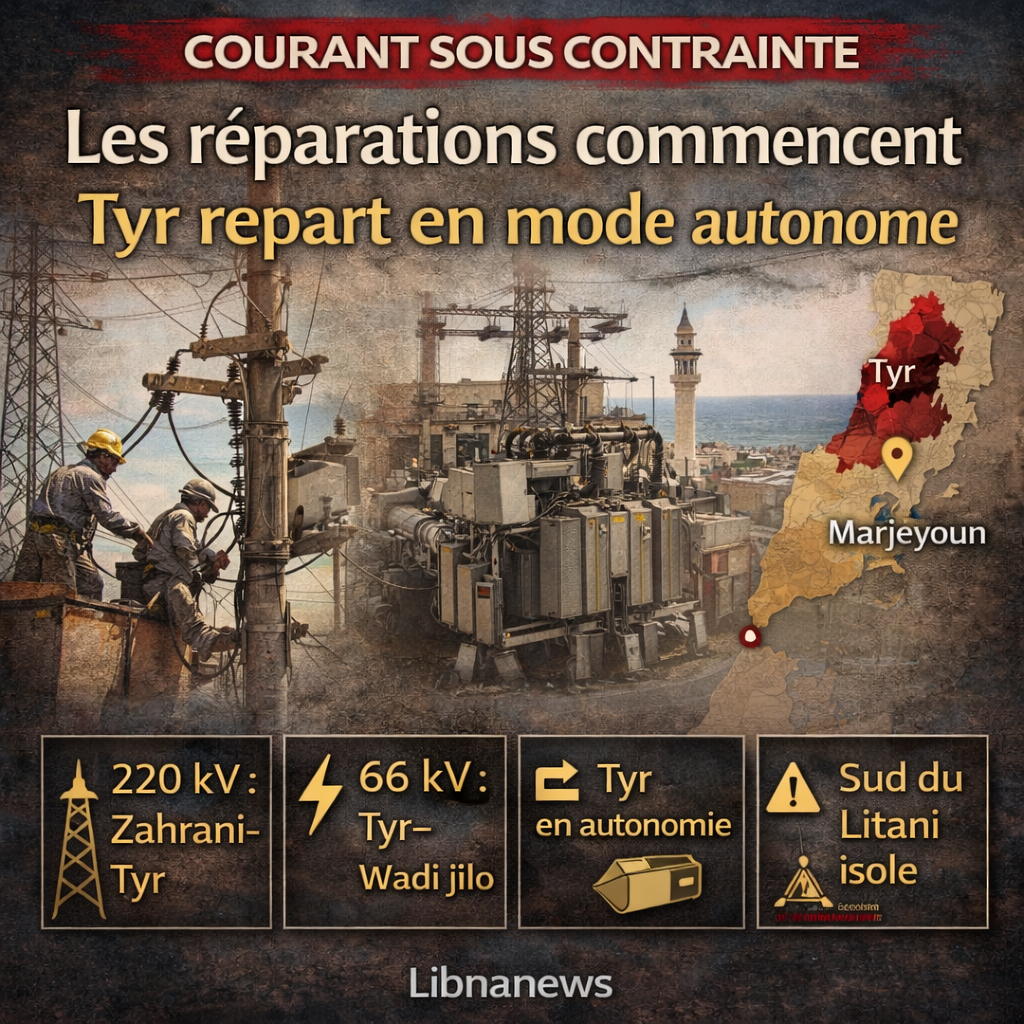
Electricity in South Lebanon became one of the first concrete post-treve tests this morning. In a press release issued by an official press agency, the public institution responsible for the sector announced the start of repairs on several damaged transmission and distribution lines, while preventing that this work would depend on available means and security conditions. The observation is heavy: all the large processing stations south of the Litani have been isolated, with the exception of Marjeyoun, and the areas fed by these stations remain without electricity. To limit the total collapse of the service, the Tyre power plant has been re-launched autonomously to power the areas connected to the main station of the city.
Electricity in South Lebanon: an immediate test
The official communiqué has the merit of clarity. The damage does not concern a single section of the local network, but several major high and medium voltage transport lines. The Zahrani–Tyr axis is explicitly mentioned at 220 kilovolts, the Tyre–Wadi Jilo line at 66 kilovolts and the Nabatiyah–Tyr link, also at 66 kilovolts. In other words, it is not only damaged cables that need to be replaced, but a current transport architecture that has been reached in its regional spine.
This technical detail is essential to understand the scope of the announcement. A transport line is not a wire among others. It conditions the ability to deliver electricity to processing stations, then to distribution networks that supply neighbourhoods, villages, utilities, shops and pumping facilities. When several axes of this size are cut at the same time, the failure ceases to be local. It becomes territorial.
The southern Litani is thus in a situation of near-insularity. According to the same press release, all the main stations south of the river were isolated, except Marjeyoun. This means that much of the regional grid is no longer normally connected to the rest of the national grid. The consequence is not only a decline in the quality of service. It is a pure and simple interruption for areas dependent on these stations.
Repair under limited means and stress
The choice of the public institution to start repairs immediately says a lot of urgency. It’s not about announcing a multi-day pre-assessment, or promising a distant plan. The technical teams were sent to the affected lines and distribution networks, with the aim of beginning the rehabilitation as soon as possible. But this will is immediately framed by two limits: the means available and the security conditions.
This formula deserves to be taken seriously. First, it means that the public institution does not operate in a normal environment. Repairing a high-voltage line in peacetime is already a heavy operation. Doing so in an area just out of a sequence of bombings, with damaged roads, areas still at risk and sometimes uncertain accesses, completely changes the equation. The stakes are no longer limited to parts, cables and teams. It includes even the possibility of reaching the works, working there and staying there long enough to put them back into service. Images taken in Tyre a few days ago already showed workers working on electrical installations damaged after strikes.
The second obstacle is capacity. The term « according to available means » refers to the chronic situation in the Lebanese electricity sector. Even before the war, the network already suffered from structural fragility, sustainable underinvestment and often delayed maintenance. Prolonged cuts and intermittent public service were part of the national daily. In this context, strikes on the transport lines do not add a difficulty to a healthy system. They hit an already vulnerable network.
This gives this morning’s announcement a wider scope than just a technical bulletin. In South Lebanon, the return to service of the lines is not only a condition for the return of light to the homes. It also affects the resumption of a minimum life: water pumping, the preservation of medicines and foodstuffs, the operation of workshops, the activity of shops, the recharge of communications equipment, the return of local administrations and the stabilization of daily life. Recent analyses of the Lebanese electricity crisis also point out that poor access to electricity directly affects water, health, power supply and economic life.
Tyre in autonomous mode
The most concrete decision of the communiqué concerns Tyre. The public establishment reported that it had set up the city’s factory independently, independently of the national network, to feed the areas served by the main post in Tyre. Technically, this amounts to creating a form of local electrical island. In simple language, the objective is to provide a minimum of current at a defined perimeter without waiting for the complete restoration of the large transport backbone.
This choice reveals both the ability to react and the extent of the rupture. If the Tyre power plant is to operate alone, it is precisely because normal connections with the rest of the network can no longer fulfil their role. This solution does not replace a reconstruction of the system. It serves as a shock absorber, an emergency response, an attempt to prevent a city and its surroundings from tipping into total darkness while heavier repairs are organised.
We must also measure what this means for the inhabitants. An autonomous diet of part of Tyre does not mean an immediate return to a stable, continuous and homogeneous dessert. This means first that a priority was set around the main station of the city. The other sectors in the south of the Litani River remain dependent on the real progress of repairs on damaged transport lines and distribution networks.
In plain terms, the current can return by plates before returning by system. This is often the way a war-stricken network is re-launched. First we restore service pockets, we recreate partial continuitys, we secure certain axes, then we try to gradually reconnect the whole. The return of electricity is therefore not a switch that is being raised. It is a technical, logistical and security sequence.
What the affected lines say
In this perspective, electricity becomes one of the first markers of the post-crash reality. An area may cease to be bombed without becoming habitable again in the full sense of the term. Without current, a return takes place under more than normal survival conditions. Houses can be standing, but without pumps or refrigeration. Shops can reopen, but without usable equipment. Schools and clinics can accommodate, but are difficult to operate.
This explains the importance of the public institution’s reference to areas fed by the main stations south of Litani. The text is not just about damaged infrastructure. He’s talking about territories without power. War often strikes buildings first. Here, it is also read in the invisible infrastructure that allows to hold a city and a village on a daily basis.
The lines mentioned in the press release also draw a precise map of the network’s impact. The Zahrani–Tyr axis at 220 kilovolts does not have the same function as a local line. Its voltage level shows that it is a structural link in the transmission of electricity. The Tyr-Wadi Jilo and Nabatiyah-Tyr 66 kilovolt links are also crucial for regional feeding and distribution from processing stations. When these three axes are affected, the problem goes beyond the city of Tyre. It concerns the ability of a whole southern assembly to be reconnected.
The mention of Marjeyoun as the only non-insulated main station south of the Litani also deserves attention. It does not mean that everything works normally, or that the region escapes from the crisis. Rather, it indicates that within the current transformation system in this part of the country, this item remains the only exception to the generalized isolation described in the press release. In a breaking landscape, this exception measures the extent of the rest.
An already fragile network before the strikes
Lebanon has already experienced periods of severe rationing and increased dependence on private generators. But the present moment adds an additional dimension: war acts on the network at the very level of its transport. This changes the scale of the problem. When the electrical crisis is linked to lack of fuel or insufficient production, households and businesses often fall back on parallel, expensive but known solutions. When lines and posts are themselves affected, the breakdown becomes deeper, more territorial and more difficult to bypass.
This data also has an immediate economic cost. The southern Litani is not only a residential area. It is a territory of shops, small businesses, workshops, services, agricultural operations, cold chains, pumping and distribution. Delaying the return of power is therefore also delaying the resumption of activity. This morning’s communiqué, even if it remains technical in its form, carries in reality a very heavy economic message: as long as the main lines are not restored, productive life will only return in part.
Images of recent days already showed workers working on damaged electrical installations in Tyre. They gave a very concrete overview of what repairs mean in a hit area: poles, cables, exposed equipment, construction equipment and repair work in the midst of the still fresh traces of the strikes. This morning’s communiqué is part of this continuity, but with an additional step: it formalizes the entry into a officially announced repair phase.
The return of the current will not be simultaneous
However, caution should be exercised over deadlines. The text does not promise a precise timetable or date of return of the current for all affected areas. This silence is not a weakness of communication. It reflects the nature of the project. When lines of 220 and 66 kilovolts are affected, when processing stations are isolated and when the safety of the ground remains a central parameter, setting a delay too soon would be a promise without control.
Institutional prudence is therefore logical. The public institution says what it does, describes what has been affected, explains the emergency solution put in place in Tyre and promises to inform citizens about future developments. Sobriety matters. It avoids confounding political announcement with actual re-activation. In such a sensitive sequence, credibility will pass less through words than through the first concrete returns of the current.
For the people of the South, the expectation will probably be uneven depending on the areas. Sectors directly linked to the main post in Tyre can hope to benefit more quickly from the autonomous solution set up locally. The others will depend on the pace of repairs on the transport lines, the state of the distribution networks, the access of technical teams and the absence of new security incidents. The re-energization will therefore not be simultaneous.
This potential inequality should not be read as a political preference. It is a network logic. First, we restore what we can supply, what we can secure and what we can technically isolate or reconnect. It is often frustrating for the inhabitants, but it is the normal operation of a re-start after the destruction of heavy infrastructure.
This morning’s text finally has symbolic value in the current period. Restoring electricity in South Lebanon, even partially, would give the sequence opened since night a concrete content for the inhabitants. If the current returns in certain sectors, the population can begin to measure the difference between the political announcement and its real effects. If it is too late, it will remain for many a formula without immediate translation in daily life.
In South Lebanon, therefore, repairing the network involves not only connecting lines. The aim is also to restore a minimum of territorial continuity and to make possible the sustainable return of the inhabitants. Houses, shops, schools, clinics, wells and workshops are not just waiting for the strike to end. They are waiting for the time when the infrastructure will start to hold. This morning, the public institution states that this work has begun. The continuation will now depend on two variables that summarize all the fragility of the moment: the means actually available and a sufficiently secure ground for the teams to continue to repair.




