

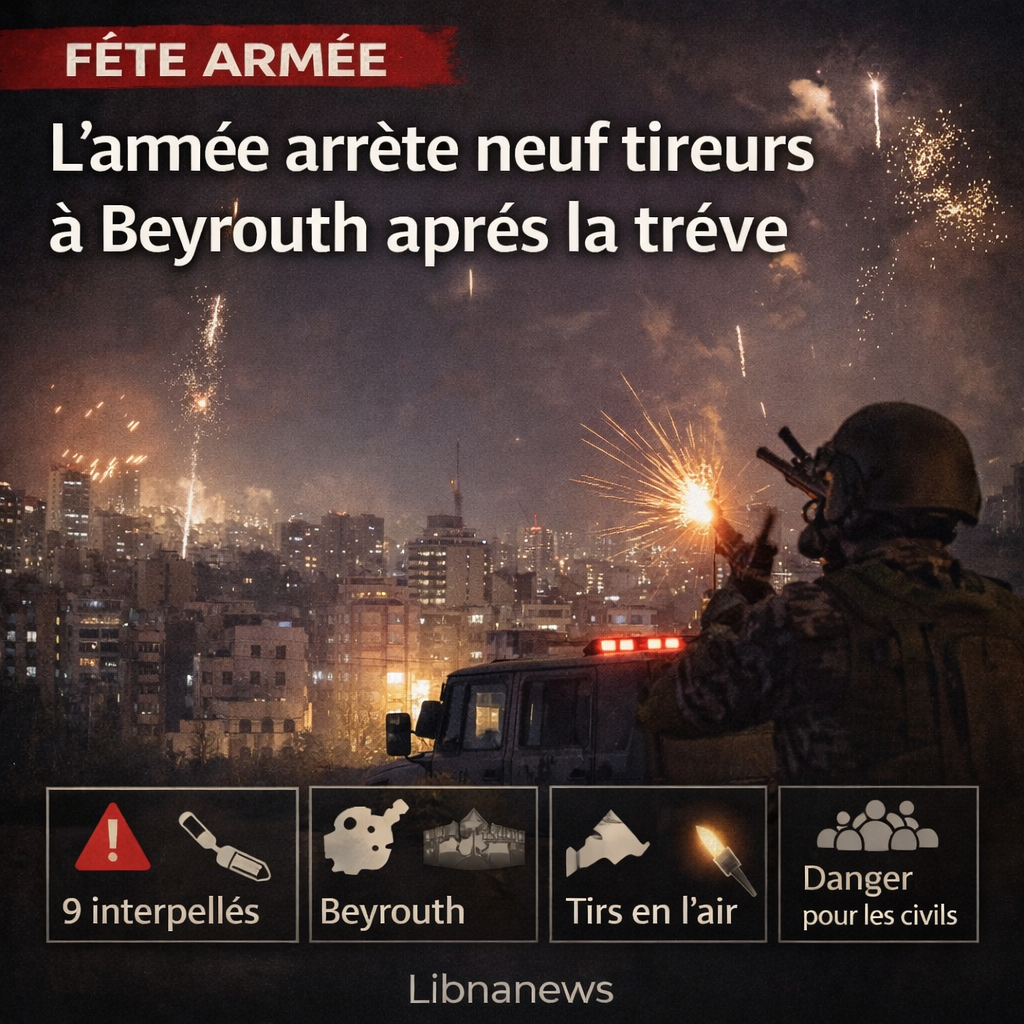
As soon as the cease-fire came into effect, another scene was imposed in Beirut and its southern suburb: shooting in the air, projectiles fired to celebrate the night, and an immediate demonstration of disorder at the same time as the country was supposed to shift towards the lull. The Lebanese Army announced the arrest of nine people, including seven citizens, one Syrian and one Palestinian, after firing on the night of 16-17 April. The focus of this sequence is therefore not only the announced end of the fighting. He is also in this old and dangerous Lebanese reflex that turns every political or military moment into a weapon dump over inhabited neighbourhoods.
A night of ceasefire caught up in the air
The cease-fire was to open a pause break. It also triggered another movement, much more familiar in Lebanon, in several areas of Beirut and the southern suburbs. Locals celebrated the entry into force of the agreement by firing in the air, in a night already full of emotion, relief and tension.
Fireworks also accompanied the night, but it was the return of weapons that caught the attention of the authorities. In dense neighbourhoods, the difference between a festive noise and a gesture that puts lives in danger is immediate.
The fact is not anecdotal. He says something very deep about the state of the country. Even when the war slows down, even when the population believes that there is a pause, part of the urban scene remains governed by armed gesture. Instead of a simple return to calm, the first visible reaction was, for some, to shoot.
In its communiqué, the Lebanese army leaves no room for ambiguity. She explained that the arrests had taken place following the security measures taken after the ceasefire agreement entered into force. In other words, the institution does not present these facts as a peripheral detail. It places them in the same time and security frame as the truce itself.
The moment is essential. Air fire was not reported in the middle of an ordinary day. They were raised in the very first night of the ceasefire, at a time when the State was seeking to regain control of the ground, to avoid spillovers and to reassure a population that had already experienced weeks of war.
This superimposition of sequences creates a brutal contrast. On the one hand, the official speech speaks of suspension of hostilities, caution, security and gradual return to order. On the other hand, weapons come out in the capital and in the southern suburbs to turn the announcement into an armed celebration scene. The ceasefire, in this case, does not immediately produce silence. It only changes the nature of the noise.
What exactly the military communiqué says
The communiqué of the army command is precise. Units deployed in Beirut and the southern suburbs arrested nine people for firing in the air during the night of 16-17 April. The institution details the administrative identity of the arrested persons: seven citizens, one Syrian and one Palestinian.
The text adds that the investigation has begun. It also specifies that persons arrested will be handed over to the competent authorities. Finally, he indicates that the search for the others involved is continuing. In a few lines, everything is there: the facts, the geographical framework, the number of arrests, the administrative profile of the suspects, the ongoing judicial procedure and the willingness not to stop at this first wave of arrests.
This is important. The army does not only announce that she acted. She announces that she continues. So the message is double. On the one hand, there is an immediate response, with nine arrests. On the other hand, there is a logic of pursuit, intended to show that practice will not be treated as a temporary tolerance linked to the emotion of the night.
The military statement comes after another warning issued the same day against random fire. In the text, the command explained that after the ceasefire came into force, several people fired in the air with war weapons and even rocket-type projectiles, endangering the lives of citizens and causing damage to public and private property. The army recalls that it will prosecute the perpetrators and bring them to justice.
Timeline is talking. First, the army warns. Then she announces arrests. This sequence shows that she wanted to do two things at once: to send a general message of firmness and to prove quickly that this firmness would not remain theoretical.
Beirut and the southern suburbs, theatre of an armed celebration
The choice of places mentioned in the press release also counts. Beirut and the southern suburbs do not appear here as mere scenery. These are two urban spaces where political symbols, the memory of war and armed expression intersect with particular intensity.
In the capital, shooting in the air is never just an individual behavior. It immediately becomes a public fact. It touches residential buildings, densely populated streets, neighbourhoods where any lost bullet can fall on a balcony, car, roof or passerby. The city turns the gesture of celebration into a direct threat to strangers.
In the southern suburbs, the symbolic load is even stronger. This territory has borne a major part of the weight of strikes, tensions and war. Seeing the night of the cease-fire accompanied by shooting in the air amounts to finding that the moment of relief is almost immediately confused with another demonstration of power, more social than military, but just as dangerous for civilians.
This is not the first time that Lebanon has known this scene. The announcement of an election result, the death of a person responsible, a marriage, a school success, a political decision, a ceasefire or a sporting victory: anything can become a pretext to shoot. But this almost reflexive return of weapons at the same time as the country tries to exit a war sequence gives the episode a more serious reach.
It is no longer just a bad habit. It’s a symptom. The cease-fire alone does not eliminate the trivialization of the weapon in the social space. The war may stop at the border or on certain front lines. But the culture of shooting continues to express itself in the heart of the city.
The real danger is not in the gesture, but in its fall
Air shooting is often presented, by those who practice it, as a gesture of joy, a sound signal, an act without a target. It is precisely this representation that makes it so dangerous. A bullet fired towards the sky does not disappear. She’s falling back. And when she comes back, she hits at random.
The army command insists on this point in its warning. It speaks of a dangerous phenomenon that endangers the lives of citizens and causes material damage. This institutional formulation is dry, but it sums up exactly the problem. Air shooting is not only illegal. It creates a blind risk.
In dense cities like Beirut and its suburbs, this risk is permanent. The bullets fall on populated areas. They can cross a light roof, break a window, pierce the body of a vehicle, reach a child on a balcony or a resident who mistakenly believes that the party is at a distance. The person who shoots doesn’t control anything from the moment the bullet leaves the weapon.
This lack of control explains why the armed celebration is so difficult to excuse. It has nothing to do with harmless folklore. It is, by nature, a delegation of chance to a lethal force. We don’t know where the bullet will fall. We only know she’ll fall back somewhere.
The reference in the military warning to rocket-type projectiles adds to this reading. Although the exact extent of these uses is not detailed, the mere fact that the army mentions them shows that the night was not only marked by a few isolated shots. She also saw weapons or ammunition of greater gravity than the mere image of the celebration ball.
An arrest is not enough, but it changes the signal
In Lebanon, one of the most frequent criticisms of air fire management is impunity. Many citizens have long considered that official warnings are repeated, but that arrests remain rare, selective or without lasting effect. That is what gives a special relief to the figure announced this morning.
Nine arrests alone will not solve an ancient phenomenon. But they change the signal sent to the public. This time, the message is not only moral or preventive. He’s a criminal. The army says in essence: the shooting took place, people were identified, they were arrested, the investigation started and other suspects are still being sought.
In a country saturated with declarations without tomorrow, this link between warning and questioning matters a lot. It gives military communication a concrete consistency. She also said that the ceasefire would not be an opportunity for a security release in the capital in the name of popular joy.
There is, of course, a broader question: will this firmness last beyond the first hours? The Lebanese experience calls for caution. An effort visible on the night of an event may weaken in the following days. But the real test will not only be on these nine people, but on the state’s ability to make it clear that any shot in the air, whatever the reason, is subject to arrest and judicial proceedings.
For now, the army is clearly seeking to impose this reading. She’s acting fast. She communicates quickly. And it explicitly links this action to the entry into force of the ceasefire. This link has nothing to do with it. It means that the return to public order is, in the eyes of the command, part of the first concrete consequences of the truce.
The ceasefire also reveals the crisis of civil authority
Perhaps the most striking thing in this case is not just the number of arrests. This is the fact that, once again, it was necessary to mobilize the army to prevent scenes that first came under civil order. Shooting in the air in Beirut or in the southern suburbs is not a military problem in the strict sense. It is a problem of public security, culture of impunity and law.
In Lebanon, however, the border between civil order and military intervention often blurs as soon as the situation becomes sensitive. The cease-fire, fear of overflow, collective emotion, urban density and the circulation of weapons quickly led the military institution to play a central role.
This centrality says something of the Lebanese state. In critical moments, the army often remains the most visible, rapid and credible structure to impose a limit. The arrests announced this morning are part of this logic. They show a command that does not want to let the capital and its suburbs move from war to a night of armed festive disorder.
But they also remind a deeper weakness. A fully secure state would not need to remind, at every sensitive sequence, that no air fire is fired into inhabited quarters. The fact that this injunction must be repeated after a cease-fire shows how fragile the norm remains.
This fragility is due to several causes. It is due to the country’s history, the circulation of arms, the politicization of territories, the difficulty of punishing quickly, and a form of risk trivialization. Many know these shots are dangerous. Too few act as if they really were.
Behind the nine arrests, a broader question
The army detailed the administrative profile of those arrested: seven citizens, one Syrian and one Palestinian. This is not neutral. It first responds to a logic of reporting. But it also points out that the phenomenon crosses several components of the society present in Lebanon.
It cannot therefore be reduced to a single community, neighbourhood or origin. The airshots follow less a line of identity than a line of practice. They appear where the weapon circulates, where the armed celebration remains tolerated by the social environment, and where fear of punishment remains limited.
This reading must avoid two pitfalls. The first would be to dissolve individual responsibility in a vague portrait of society. The second would be to transform the administrative accuracy of the communiqué into a political or Community reading grid. The real subject remains elsewhere: individuals fired in the air in inhabited areas after a ceasefire came into effect, and the army claims to have arrested them.
This refocusing is important because the night of the ceasefire has already produced enough tension, rumours and projections. The stake here is not to overload the case with a meaning that it does not have. It is to understand what it reveals: a persistent difficulty in Lebanon to dissociate public joy from the public use of weapons.
A night that summarizes a Lebanese contradiction
Lebanon celebrated a ceasefire with fire. This sentence alone summarizes a profound contradiction. The country aspires to calm, but some of its social reflexes continue to go through the vacarm of arms. He wants to turn the page of the war, but part of the urban space continues to speak the language of fire at the very moment when diplomacy promises a break.
This gives this morning’s case a scope far beyond the nine arrests. The subject is not only judicial. It is also cultural and political. It questions the way in which Lebanese society experiences collective events, the way in which it prioritizes the security of others in the face of the excitement of the moment, and the way in which the State tries, or does not, to impose boundaries.
In this perspective, the military communiqué performs a broader function than the mere announcement of inquiry. He’s tracking a border. He says that there is a difference between celebrating and putting in danger, between marking a historic moment and transforming the sky of the city into an area of uncontrolled fall.
It remains to be seen whether this border will last in the coming days. The ceasefire often opens unstable hours of relief, return, traffic and symbolic demonstrations. If the air fire continues, the issue will no longer be that of the nine people arrested on the night of 16-17 April. It will be that of the real capacity of the state to prevent a moment that is supposed to announce the continuing calm from exposing the inhabitants of Beirut and the southern suburbs to a danger from their own skies.




