

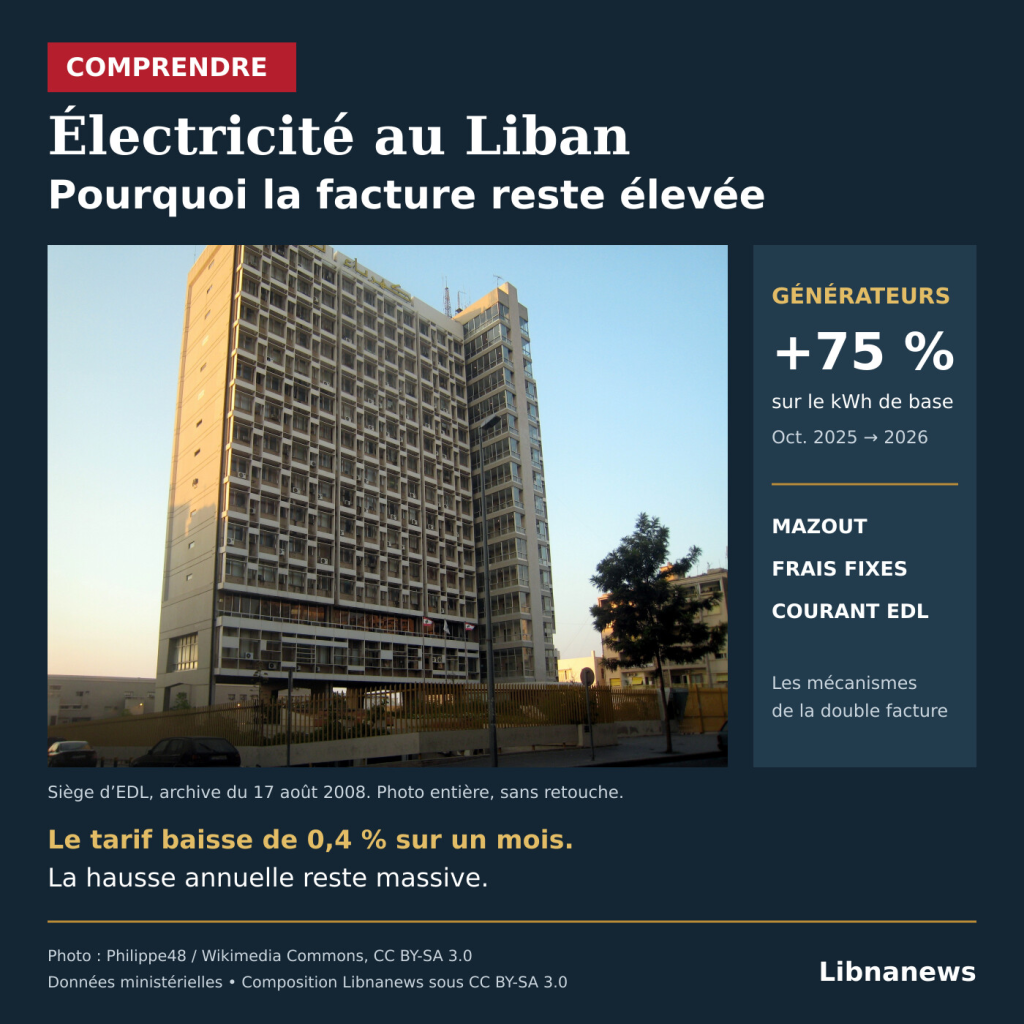
Electricity in Lebanon remains expensive despite the slight drop in generator prices in October 2026. Their base kilowatthour costs 75.1% more than a year ago. Fuel explains much of this tension. But the bill also depends on the fixed charges and current that households have to buy in lieu of electricity from Lebanon.
The latest scale available on 9 November sets the urban kilowatt hour at 52,622 pounds, compared with 52,840 in September. The decrease is only 0.4 per cent. For an unchanged consumption of 300 kWh, it represents 65 400 pounds. This is equivalent to approximately $0.73 at the reference rate used in the scale.
The annual comparison tells another story. By October 2025, the same basic tariff was 30,053 pounds. At 300 kWh, the gap on energy alone now stands at 6.77 million pounds. The small monthly relaxation therefore does not erase the accumulated increase.
This contrast helps to understand why a decline announcement may not change the sentiment of subscribers. They pay a price level, not just its last variation. They can also buy more private power when the public power supply decreases, even without adding devices to their homes.
Electricity in Lebanon: three comparable Octobers
To measure the increase, the same indicator must be maintained. The figures below relate to the basic official rate of generators with meter. They exclude subscription, geographical supplements and possible legally applicable VAT. They do not describe an average of the invoices actually paid.
| Period of consumption | Basic tariff, LL/kWh | Indicative equivalent, $/kWh | Reference oil, LL for 20 litres |
|---|---|---|---|
| October 2024 | 29 809 | 0.332 | 1 374 366 |
| October 2025 | 30,053 | 0.335 | 1 388 140 |
| October 2026 | 52 622 | 0.587 | 2,662,915 |
The three scales retain the same reference rate of £89,700 per dollar. The above equivalents are only used to compare the amounts. They do not replace the applicable billing currency or the rate indicated on an EDL invoice.
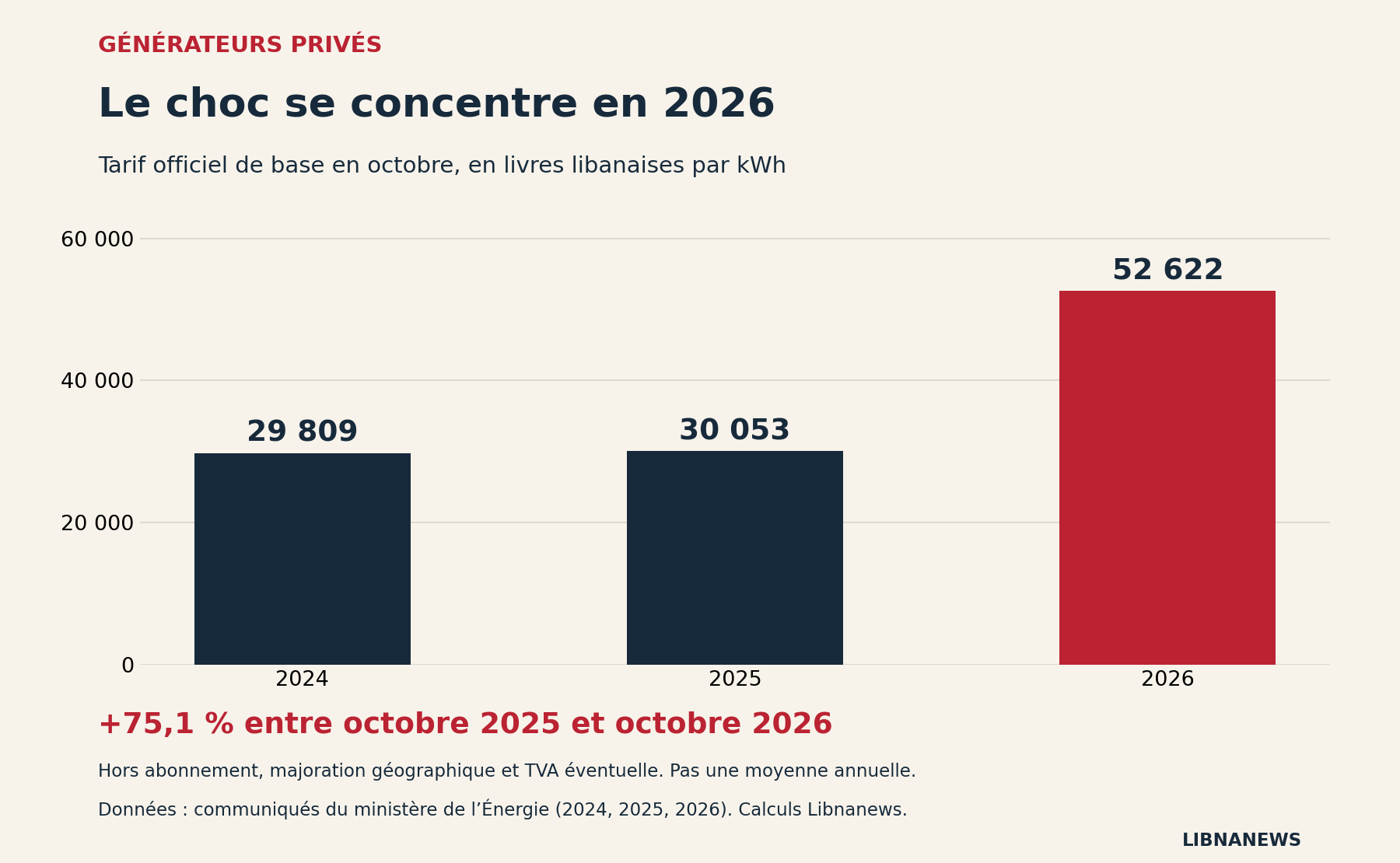
The base rate increased by 0.8% between October 2024 and October 2025, and then by 75.1% the following year. Over two years, the increase is 76.5%. The rupture is therefore in the last period, not in a steady progression of the same magnitude.
Compare October to October limits the effects of an arbitrary choice between winter and summer. This is not an annual average. Prices may have fluctuated between these observations. The amounts remain nominal: they do not measure their weight in wages or an inflation-adjusted trend.
The formulation of increased areas has also evolved. The comparison therefore uses only the basic tariff, without retrospectively applying the current geographical criteria. This precaution avoids confusing a price increase with a change in billing category.
Oil transmits shock to every kilowatt hour
The average reference price of 20 litres of fuel oil increased by 91.8% between October 2025 and October 2026. However, the exchange rate used remains the same. The recent increase cannot therefore be explained by a further depreciation of the pound in these scales.
The mechanism is direct: a generator must buy fuel to produce the energy sold. When the litre increases, the cost of each hour of operation rises. The number of kilowatt hours obtained then depends on the efficiency, machine load and distribution losses.
However, the tariff does not exactly follow the price of fuel oil. It also includes fuel delivery, oils, filters, wear and tear and other operating expenses. The calculation also provides for an operator’s remuneration. Not all of these positions vary at the same time.
Therefore, the 91.8% increase in reference fuel does not become an identical increase in kWh. The base rate is up 75.1%. This difference does not alone reveal the margin actually received by the operators. Their purchases, returns, sales volumes and actual expenses should be known.
Similarly, a daily drop in crude oil is not enough to announce an immediate drop in subscription. The generator consumes a refined product delivered locally. The scale uses an average monthly price of fuel oil. The crude oil, fuel delivered and final invoice correspond to three distinct levels.
For 300 kWh, an increase of almost 70%
The case of a subscription of 10 amperes allows to move from a tariff to a concrete sum. With a hypothetical consumption of 300 kWh at the base rate, the calculation combines energy with 685,000 pounds of fixed costs. This package was already identical in October 2025.
| Subscription of 10 A, 300 kWh | October 2025 | October 2026 |
|---|---|---|
| Energy consumption | 9 015 900 LL | 15 786 600 LL |
| Fixed share | LL 685 000 | LL 685 000 |
| Subtotal excluding VAT | 9 700 900 LL | 16 471 600 LL |
| Equivalent to reference rate | $108.15 | $183.63 |
The increase in the subtotal is 69.8 per cent, an additional $75.48 at the rate. It remains below 75.1% of the kilowatt hour because the fixed share does not change. This simulation does not represent a national average invoice or the budget of a household surveyed.
Lamp and kilowatt hour do not measure the same thing. The first refers to the available intensity and the power that the subscription allows to call. The second measure is a quantity of energy consumed. Two subscribers of 10 amps can therefore receive very different invoices.
Reducing the subscribed power can reduce fixed costs, but limits devices that can be used simultaneously. In October, going from 10 to 5 amperes reduced this package by 300,000 pounds. This does not change the price of each kWh. The compatibility with housing needs should be examined separately.
The invoice also increases when the supplier changes
The ordinary public tariff remains structured around two slices: 10 cents per kWh for the first 100, then 27 cents beyond. The EDL rules add a subscription share and applicable levies. The variable cost of energy must therefore be distinguished from the total to be paid.
A simulation isolates the cost of replacing the public current. Suppose a constant monthly requirement of 400 kWh, without solar. If EDL supplies 200 kWh, public energy costs 37 dollars. The remaining 200 kWh represent $117.33 at the generator base rate of October 2026. The total variable is $154.33.
If EDL only supplies 100 kWh, its variable component drops to $10. But then the generator must supply 300 kWh, for 175.99 dollars. The total is 185.99 dollars. The household therefore pays an additional $31.66, without consuming a single kilowatt hour.
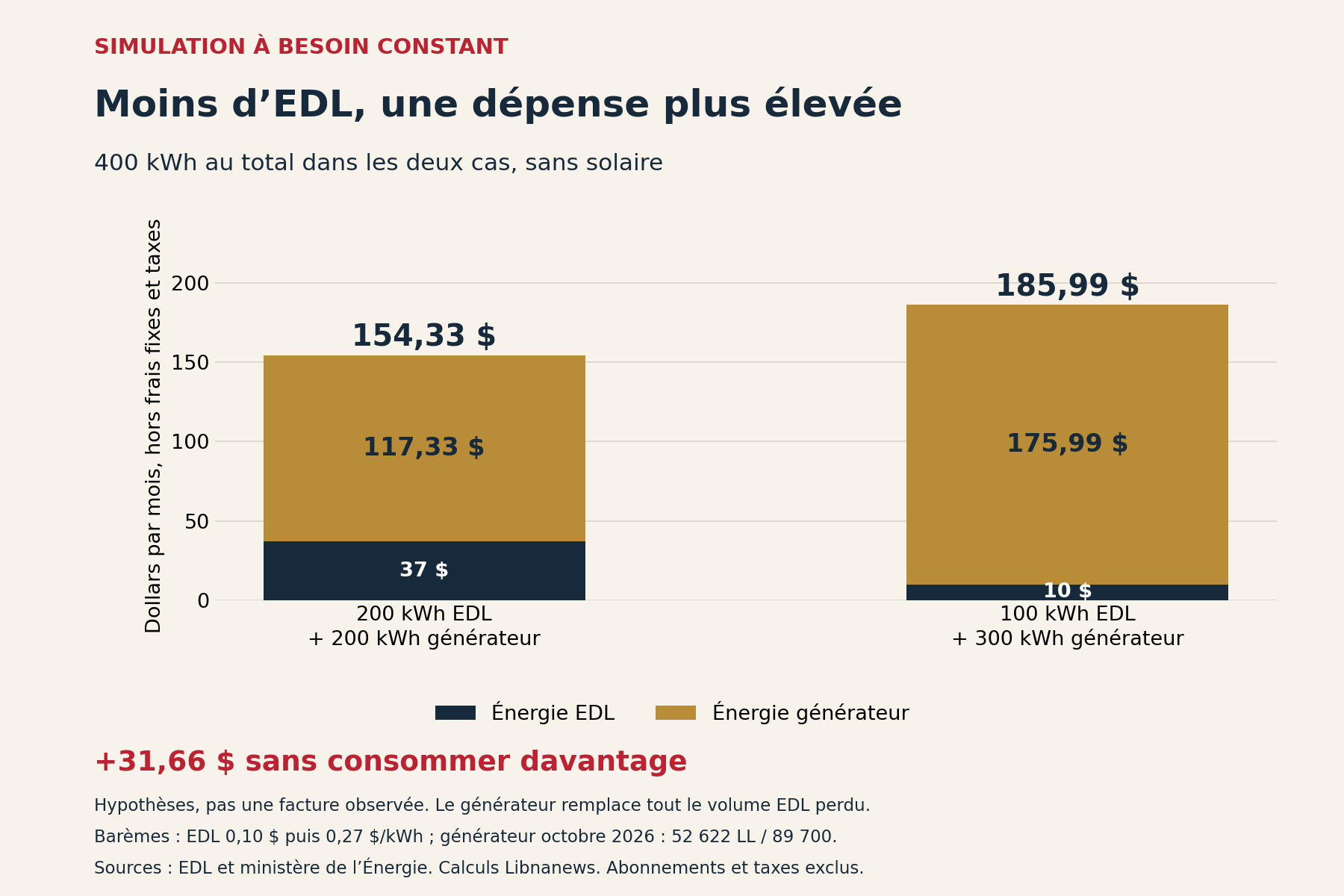
This simulation excludes subscriptions, taxes, stamps and common charges. It assumes that the private current fully replaces the missing public volume. Volumes are assumptions, not observations. Rates are based on published scales.
The difference measures the replacement of 100 kWh public at 27 cents per 100 kWh private at approximately 58.66 cents. The result would be different under the first public tranche. It would also vary with the geographical rate of the generator, quantities and tax conditions.
A decrease in the EDL bill can thus accompany an increase in total electricity expenditure. It can simply translate less public current received. Assessing the budget requires adding suppliers for the same period, then comparing the actual quantities available.
Fixed costs further penalise small volumes
A package is distributed over the kilowatt hours consumed. For a private subscription of 5 amperes, the 385,000 fixed pounds represent an additional 3,850 pounds per kWh at 100 kWh. At 300 kWh, they add more than 1,283 pounds per unit.
The average cost is therefore higher than the only price displayed. Reducing consumption reduces variable spending, but does not automatically remove subscription. This mechanism counts for small consumers and for dwellings whose solar covers part of the needs.
The October scale also distinguishes a tariff of 57 884 pounds per kWh. It targets cities where the distribution network exceeds 300 metres, or villages more than 700 metres away. This increase of about 10% concerns energy, not a 10% increase in all lines.
At 300 kWh and 10 amperes, the corresponding subtotal reaches 18,050,200 pounds, excluding any VAT. The difference with the basic rate is 1,578,600 pounds. The classification of the connection can therefore weigh more than the slight monthly decrease in the scale.
The ministerial release prohibits maintenance supplements and additional charges for solar-equipped subscribers. It also excludes VAT without justification by means of official tax registration. A cost already included in the tariff does not justify a second arbitrary billing.
Solar moves part of the expense
A house equipped with panels can buy less kilowatt hours from the generator during sunny hours. The economy depends on the energy actually used on the spot. Installed power does not guarantee the same production every day or autonomy throughout the night.
To compare solutions, investment, installation, maintenance and replacement of equipment must be integrated. With a battery, it is also necessary to count the loss of charge and discharge. A kilowatthour purchased for charging does not necessarily return a kilowatthour usable in the dwelling.
The relevant calculation therefore depends on the uses and their schedule. An initial expense can reduce monthly payments without making electricity free. No universal period of profitability can be deducted from the current rates alone, without cost estimates, expected production and documented service life.
The same caution applies to an individual generator. Its owner pays directly for fuel and maintenance, but also supports the purchase and wear of the machine. Compare only its fuel oil price to the private network rate omits part of the expense.
Why the payment of public arrears concerns households
On 9 November, the Parliamentary Finance and Budget Committee approved an appropriation equivalent to $100 million for EDL. It must pay part of the invoices of public administrations and institutions. The vote in plenary session is still due on 12 November.
This credit does not directly reduce the price of generators or household consumption. Its potential effect is through public treasury: cash receipts can finance fuel and operation. The improvement of the family budget would then depend on the additional public flow actually delivered.
Minister Joe Saddi explained in September that increased fuel costs limited EDL’s purchases. He also stated that the Government had not accepted his proposed variable tariff. These statements describe a funding constraint, not an overtime guarantee.
A one-time payment and a lasting reduction in the cost of production cover two different horizons. The first can support immediate supply. The second requires efficient equipment, network and operation. No amount of credit is automatically converted into the same number of hours for all subscribers.
The four elements to compare from one month to the next
A useful comparison begins with the period of consumption. An EDL bill collected today may cover previous months. Compare it directly to the private subscription of the current month mixes periods and risks assigning a variation of calendar to the tariff.
Then the index of meters and volumes come. At constant rates, an increase in consumption increases expenditure. At constant total consumption, a transfer to the generator can produce the same effect. These two situations require different explanations.
Finally, unit prices must be separated from fixed shares and justified taxes. The cost of lifts, pumping or collective lighting must also remain identifiable. Without this breakdown, an overall sum does not allow to know which item actually increased.
The next possible reduction in fuel oil will therefore have to be confronted with two distinct results: the generator rate and the amount of public current available. For households, the concrete test will remain the total cost of obtaining the same electrical service.
Sources and method
Libnanews calculations based on published rates. Comparisons are made for October of each year, at constant scope and at the reference rate of LL 89,700 per dollar. Examples of consumption are simulations, excluding taxes and fees not explicitly included. The rounded amounts are not observed invoices.
- Ministry of Energy and Water, scale announced for October 2026, 30 October 2026.
- LBCI, copy of press release of October 2026, 30 October 2026.
- Ministry of Energy and Water, September 2026 scale.
- Lebanon24, ministerial communiqué of October 2025, 30 October 2025.
- LebanonFiles, ministerial communiqué of October 2024, 30 October 2024.
- Electricity in Lebanon, charging and billing rules.
- LBCI, maintenance of 10 and 27 cents, 2 October 2026.
- Ministry of Energy and Water, interview with Joe Saddi, 15 September 2026.
- Libnanews, $100 million approved in commission, November 9, 2026.
- Photograph by Philippe48, EDL headquarters, August 17, 2008, Wikimedia Commons.
- License of Photography and Cover Composition: CC BY-SA 3.0.
Cover: entire and untouched archive photograph of the headquarters of the edL, Philippe48, 2008. Libnanews graphic dress, CC BY-SA 3.0. Graphs: Libnanews creations from the sources indicated.






Comments