

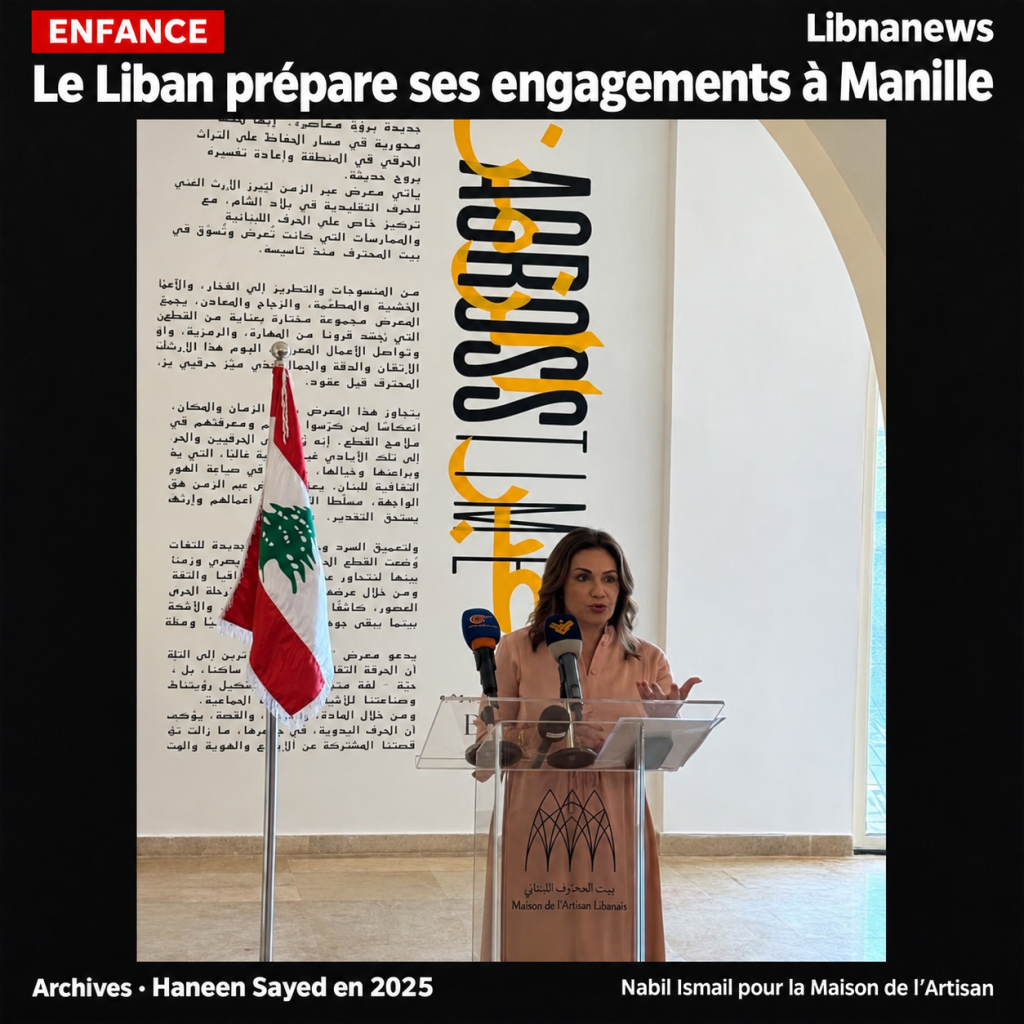
Lebanon is preparing to participate in the second global ministerial conference to end violence against children in Manila. The Minister of Social Affairs, Haneen Sayed, must present the national commitments resulting from consultations between administrations, international organisations and civil society. The challenge now is to distinguish the priorities displayed from those that can be funded, monitored and evaluated.
The Lebanese announcement of 16 November places the participation between 17 and 19 November. The main programme published by the organisers covers 18 and 19 November. These two indications should not be confused: the presence of a delegation and the main meetings of the summit do not necessarily correspond to the same timetable.
A preparation that goes beyond the Ministry of Social Affairs
The delegation announced includes the Director-General of Education, Fadi Yarak, representatives of Social Affairs and Public Health, as well as representatives of civil society, children and youth. The conference is organised with WHO, UNICEF and the UN Secretary-General’s Special Representative on Violence against Children.
The preparatory consultations involved justice, education, health, work, security and digital space. The announcement highlights clarification of responsibilities, strengthening social work professionals, sustainable funding and youth participation in policies that affect them. However, it does not yet detail the commitments to be presented to Manila.
Commitments to be linked to existing arrangements
This participation takes place within a framework of cooperation already committed. On 17 February 2026, UNICEF and the Lebanese Government collectively signed work plans with ten ministries under the leadership of the Prime Minister. These documents cover 2026-2027 and aim to clarify priorities, roles and expected results for children and adolescents.
Manila therefore does not leave a blank page. The question will be how the commitments announced extend these plans: what additional responsibilities they assign, how they mobilize and what results they measure. A new declaration alone is not a new benefit available to families.
Monitoring counts as much as the announcement
The international engagement platform distinguishes several states of progress, from launch to completion. It also identifies the presence of a budget and defined beneficiaries. This method highlights an essential difference: a political commitment may exist before its resources or timetable for implementation are determined.
In order to appreciate the Lebanese announcements, three informations will be particularly useful: the administration responsible for each action, the means allocated and how to report on the results. There should also be a distinction between prevention of violence, reporting of situations of concern and effective management. These steps complement each other, but do not measure the same.
Bilateral meetings are announced on the sidelines of the conference to strengthen cooperation and mobilize support. As of 17 November, the announcement of participation does not make it possible to present these exchanges as financing already obtained. The publication of the detailed commitments and their follow-up will help to measure how this displacement is changing in practice for the protection of children in Lebanon.





Comments