

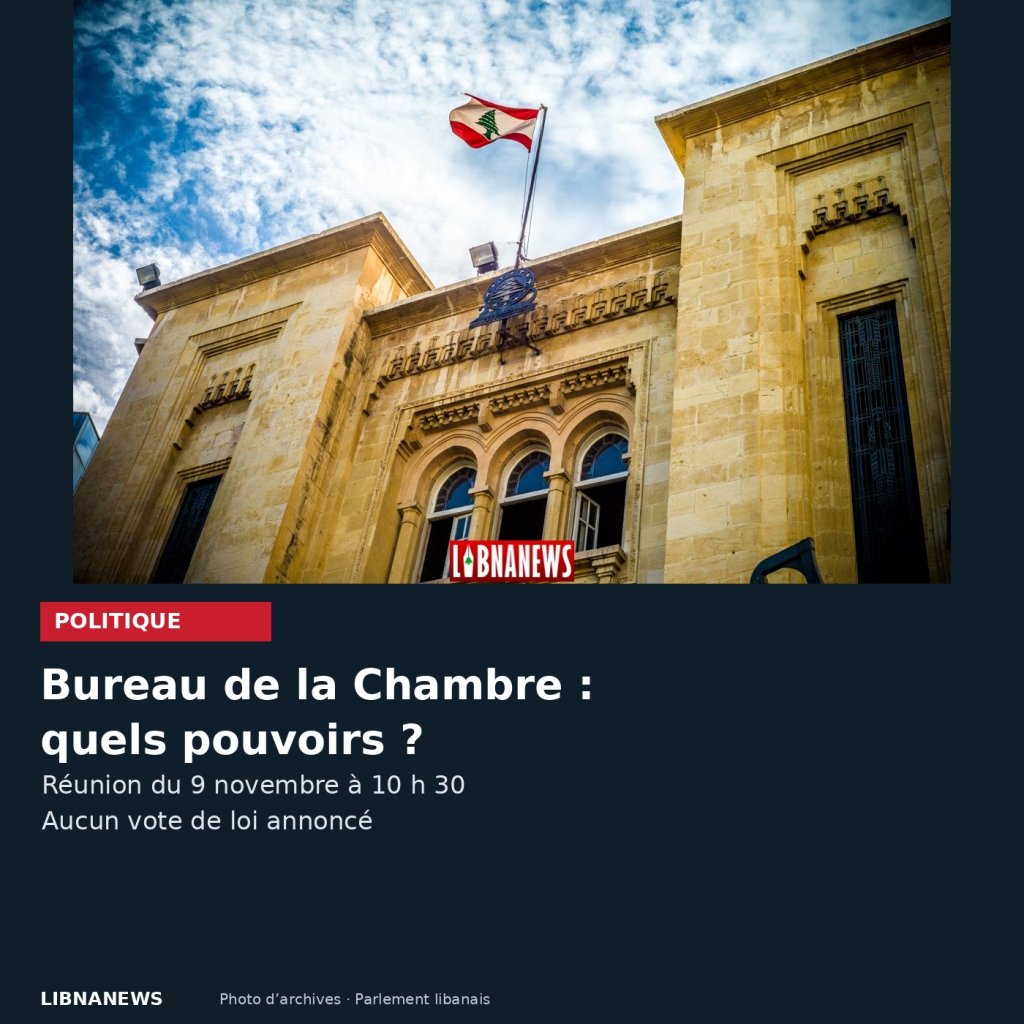
The Bureau of the Chamber of Deputies was convened on Monday, 9 November 2026, at 10.30 a.m., in Ain al-Tiné. The announcement appears in the press release published on 5 November on the official website of Parliament. It establishes a meeting of the body which organizes part of the parliamentary work. It does not convene MPs in plenary and does not announce the adoption of any legislation. This distinction is essential to understand what Nabih Berri and the other members of the Bureau will be able to decide, and what will remain of the House as a whole.
The House Bureau prepares the sittings
Rule 8 of the Rules of Procedure gives the Bureau a central competence: to adopt the agenda of each parliamentary sitting. This power comes before the public debate and the vote. It helps to determine the texts which Members will be asked to consider, on the basis of the drafts, proposals and reports to be communicated to them. Putting a text on the agenda opens a stage in the parliamentary process. This does not prejudge the amendments or the outcome of the deliberations.
The difference may seem formal. She’s not. A text discussed in committee, a text chosen for a sitting and a passed law correspond to three distinct situations. Confounding them would lead them to believe that a reform is being achieved when it has not yet taken the necessary steps. The November 9 release does not provide a list of files that will be reviewed. To assign it right now a specific program would go beyond the official announcement.
Seven functions, a collective responsibility
Rule 1 describes the composition of the Bureau: the Speaker, the Vice-President, two Secretaries and three Quaestors. It is therefore a seven-member body, separate from the specialised committees and the plenary assembly. The Rules assign specific responsibilities to the President, Secretaries and the Bureau as a whole. This architecture separates session management, work preparation and some administrative tasks.
The Speaker represents the House and speaks on his behalf. It ensures that the Constitution, laws and regulations are respected in its operation. The secretaries assist in the keeping of lists of speakers, the counting of ballots and the monitoring of the preparation of minutes. The office is therefore not limited to an informal meeting between politicians. It has institutional powers defined by a text accessible to the public.
An agenda must be communicated to Members
The same Rule 8 provides for the publication of the agenda on Parliament’s premises and its transmission to Members with the relevant drafts, proposals and reports, at least 24 hours before the sitting. This rule makes it possible to distinguish between the decision to organise the work and the information necessary for those to discuss it. It concerns the agenda of the parliamentary sitting, not the general announcement of a preparatory bureau meeting.
The convening of 9 November thus constitutes a first chronological landmark. A possible release after the meeting will determine whether an agenda has been agreed or whether some files still need to be prepared. A separate summons will then indicate, if applicable, the date of a sitting of the House. Before these announcements, it is not possible to transform Monday morning in Ain al-Tinah into a certain legislative deadline.
The office also deals with internal affairs
The competence of this body goes beyond the selection of texts. The Rules of Procedure entrust him with the examination of disputes concerning minutes, summaries of sittings, their conduct, votes and the proclamation of results. He also assigns him the preparation of the House’s annual budget and the monitoring of its implementation. Finally, it provides for the management and staff regulations, as well as the examination of petitions and complaints.
These administrative powers should not be confused with the vote on the state budget. The internal budget of the parliamentary institution concerns its functioning. The National Finance Act follows a separate legislative procedure. Similarly, the examination of a petition by the office does not constitute a judgment of a court or the adoption of a measure requested by its authors. Each jurisdiction retains its object and limits.
What belongs to the plenary session
The Constitution gives legislative power to the Chamber of Deputies. The Rules of Procedure then organise the debates and the votes. It provides, inter alia, that the meeting may not be opened without the presence of a majority of the members and that a quorum shall be held in the Chamber at the time of the vote. A meeting of the Bureau, even if politically important, does not satisfy in place of a plenary session these requirements of presence and deliberation.
The Rules of Procedure also provide, after the general discussion, for the examination and vote of articles, subject to the procedures which they organise. This means that a text that has arrived at the meeting is still subject to discussion and modification. The preparation of its examination is not the early determination of the vote of Members. The role of the office is important because it organises access to this stage, not because it could replace it.
A law passed has yet to follow the constitutional path of promulgation and publication. Article 56 lays down, inter alia, the time limit within which the President of the Republic shall promulgate laws finally approved after their transmission to the Government, with a particular time limit for those whose urgency has been decided by the Chamber. Without entering into the assumptions of review, this step is sufficient to recall that a preparatory meeting is well before a text comes into force.
How to measure the November 9 result
The political interest of the meeting will first be what it will make public. An agenda would identify priorities and files deemed ready for submission to Members. A postponement would indicate an additional stage of preparation, but its reasons should be established before it sees any obstruction or political agreement. The absence of a text in a press release alone does not make it possible to conclude that it is abandoned.
For each file, the relevant information will be its exact title, its nature as a government project or as a parliamentary proposal, the accompanying committee report and the procedure. These elements will help to avoid too wide an announcement of a reform that only one provision would be discussed. They will also be used to compare the text under consideration with what would then be voted on.
The next known step therefore remains precise and limited: the Bureau will meet on 9 November at 10.30 a.m., according to the official convocation. If a legislative session is to be fixed, its files and results will have to be checked separately. The actual scope of this meeting will be found in the decisions made at the end of this meeting and in the documents transmitted to Members.





Comments