

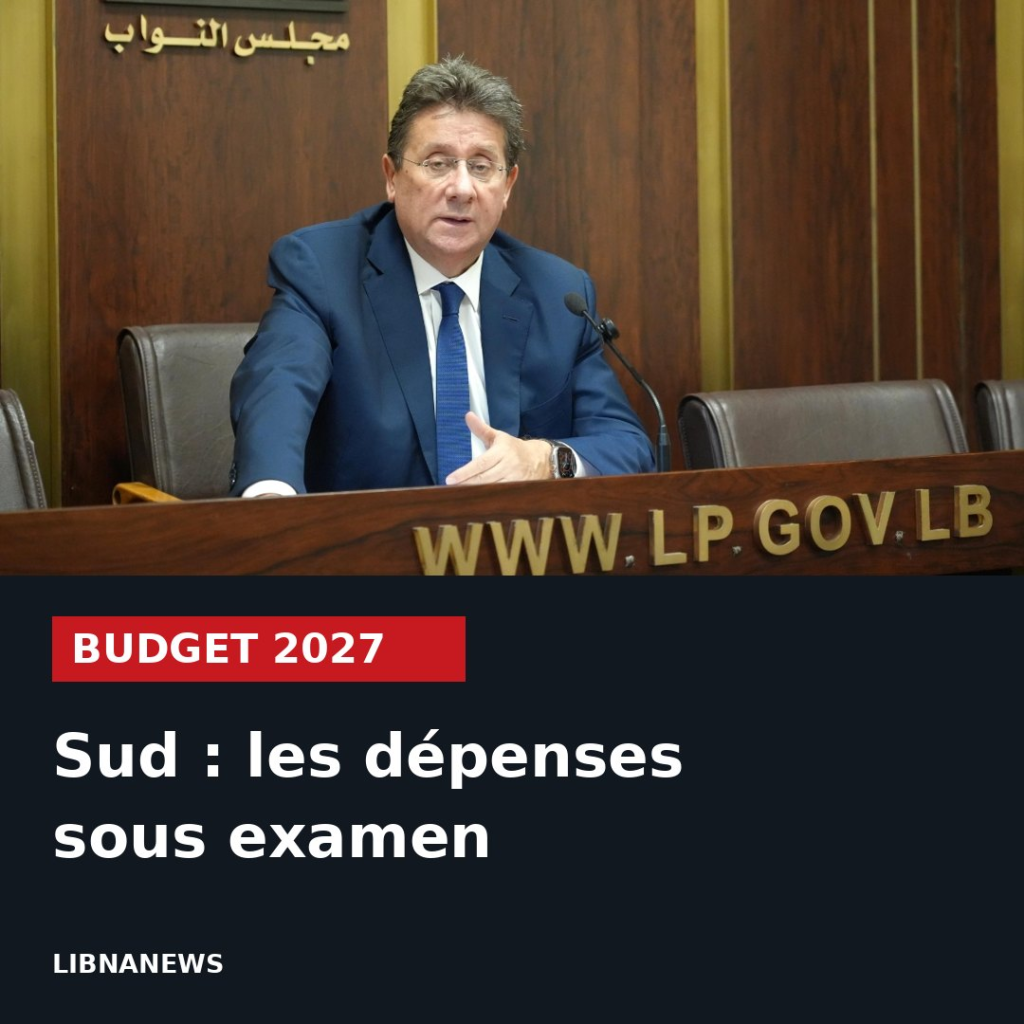
The Parliamentary Committee on Finance and Budget requested, on Monday, 16 November, a statement of public expenditure related to the consequences of the war, particularly in South Lebanon. Chaired by Ibrahim Kanaan, she wanted to have this overview available to assess the needs included in the 2027 draft budget, beyond the appropriations of the Southern Council alone.
The meeting resulted in the approval in committee of appropriations from the General Secretariat of the Higher Defence Council, the Southern Council, the Development and Reconstruction Council, the Central Statistics Directorate and the General Directorate of State Security. This is not Parliament’s adoption of the budget.
The agencies concerned were invited to provide detailed reports on their missions and expenditures. The challenge is to reconcile the amounts requested with the actual interventions, while several administrations take responsibility for the separate consequences of the same war.
Grouping expenditures dispersed across departments
The commission asked the Ministry of Finance to collect the expenses incurred by all the departments and agencies concerned. The scope must therefore exceed that of the Southern Council: it includes, inter alia, hospitalisation costs under the Ministry of Health and social affairs and public works.
This work will help determine next year’s needs on a common basis. An agency’s budget is not sufficient to account for the public effort alone, when other governments finance care, household support or work.
Ibrahim Kanaan referred to an amount of approximately $10 billion for damage suffered by Lebanon, particularly in the South, noting that this was the figure reported to the Commission. This amount should be read as an evaluation reported during parliamentary work, not as a final assessment: according to the Member, the operations continue and the data continue to be monitored.
Distinguish Causes of Damage
For its part, the High Rescue Committee was invited to distinguish between damage caused by Israeli attacks and damage caused by other disasters, including damage to buildings in Tripoli, Kesrouan and other areas. This separation should identify the specific needs of each intervention category.
The situation of Ain Saadé was also raised. According to evidence presented by Ibrahim Kanaan, more than 49 families were affected. Associations have contributed to building enhancement work, but housing allocations and other financial obligations remain to be completed.
Loans, donations and proofs at the heart of control
Beyond the war damage, the commission asked the Ministry of Finance for a list of loans and donations. It intends to compare the appropriations provided for in the budget with the sums actually spent in order to have a more accurate reading of the financing and its use.
The General Directorate of State Security must also provide written explanations of its hospital and fuel expenses. This request for clarification accompanies the examination of its credits; It does not in itself make it possible to conclude an irregularity.
Ibrahim Kanaan also indicated that the Commission had received the accounts until 2022. The Panel requested the evidence in respect of 2023, 2024, 2025 and 2026 to allow for the necessary comparisons. Since the financial year 2026 is still ongoing, this request should not be confused with the finding of a delay in closing its final accounts.
Consideration of the draft budget is to continue on Tuesday, 17 November, with the appropriations of the Ministry of Energy and Water, as well as its administrations and institutions, according to the parliamentary calendar. For war-related expenditures, the next expected step remains the transmission of the required reports and statements, before being able to accurately measure the needs covered by the 2027 appropriations.





Comments