

Israeli press statement revives collective punishment in war against Lebanon
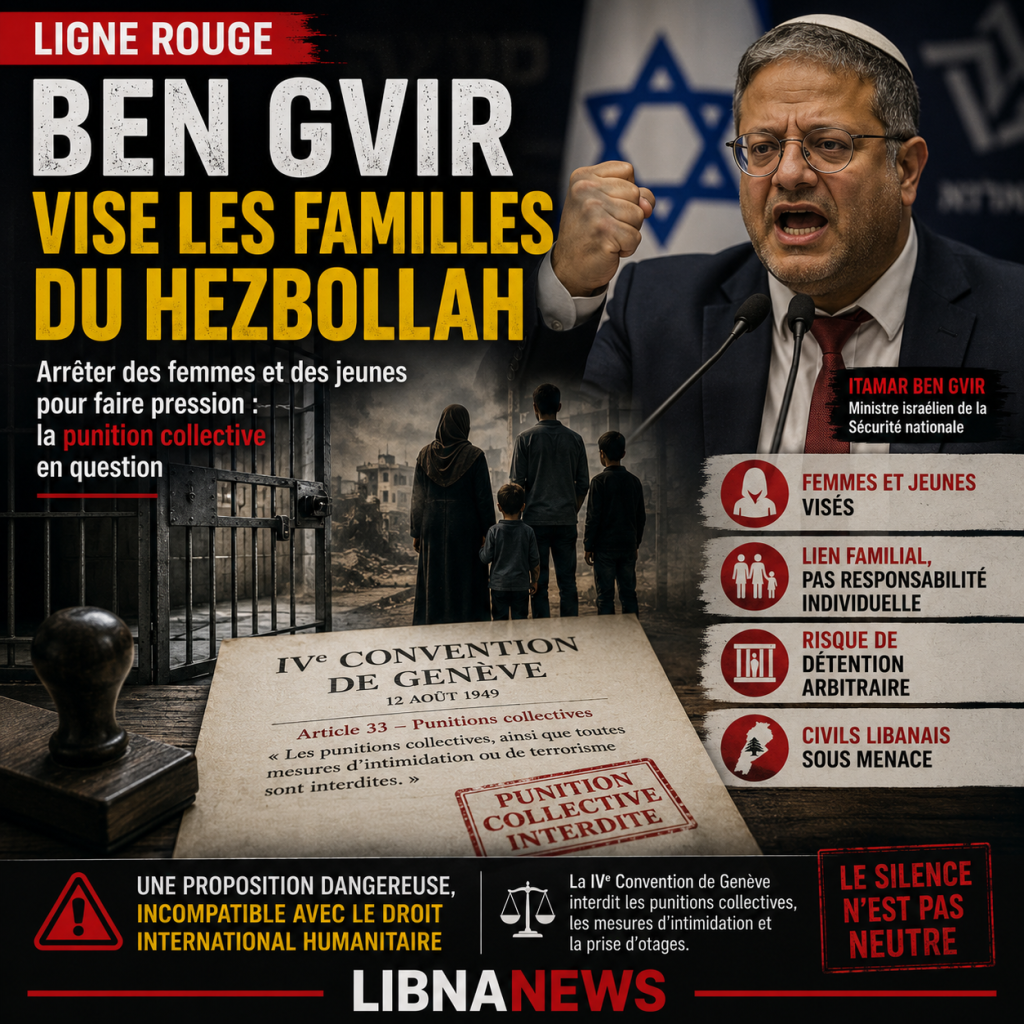
Itamar Ben Gvir crossed a new threshold in Israeli war rhetoric against Lebanon. According to the Jerusalem Post, the Israeli Minister of National Security proposed, at a meeting of the political and security cabinet, to arrest members of the families of Hezbollah fighters or operators, including women and youth, and then to send them to Israeli prisons reserved for security detainees.
The declaration, if confirmed in its entirety, is no longer solely a political auction. It raises a central legal question: can a State arrest civilians, not for acts they have personally committed, but for exerting pressure on an armed organization? In international humanitarian law, the answer is clearly no.
A proposal on the family environment
According to the Israeli daily, the discussion focused on the Lebanese front and the possibility of an expansion of military operations. It is in this context that Ben Gvir reportedly called on Israeli officials to « think differently » against Hezbollah. He reportedly mentioned the conquest of territories, the elimination of combatants, but also the arrest of « their women and youth », in order to send them to « terrorist prisons ».
The wording is important. This is not, in the evidence available at this stage, a call to stop Lebanese women and children indiscriminately. The proposal targets families of Hezbollah members. But this shade does not solve the problem. She only moves him. For arresting a wife, a son, a daughter, a relative, because of the family connection with a person suspected of belonging to an armed organization, would amount to making the family an instrument of pressure.
This is precisely what the law of war seeks to prevent.
The shift towards collective punishment
In any war, the distinction between combatants and civilians is one of the fundamental principles of international humanitarian law. A civilian cannot be punished for an offence that he or she has not committed personally. Nor can it be used as a means of pressure against a third party.
The proposal attributed to Ben Gvir is therefore part of a logic of collective punishment. It amounts to considering that the family environment of a Hezbollah member becomes a legitimate target, not because of a direct act, but because of a kinship. It is a dangerous logic, because it destroys the boundary between individual responsibility and family affiliation.
This is not a technical detail. It’s the heart of the problem. When a political power proposes to arrest civilians to « worse » their loved ones, it no longer only speaks of security. He speaks of coercion on alleged innocent people to get an effect on an opponent.
A method incompatible with international conventions
The Fourth Geneva Convention prohibits collective punishment, intimidation and hostage-taking. These principles are not decorative. They were established precisely to prevent an army or government from turning civilian populations into exchange currency.
In the case mentioned by the Jerusalem Post, the stated intention is explicit: to reach members of Hezbollah by arresting their relatives. If such a measure were to be implemented, it could be described as arbitrary detention, collective punishment or even hostage-taking, depending on the specific circumstances, the status of persons arrested and the objective pursued.
The gravity is therefore less due to the verbal brutality of Ben Gvir than to the political logic it reveals. It is not just about hitting military positions, targeting combatants or conducting operations against infrastructure. The aim is to extend the pressure to the family sphere.
Lebanon faced with a doctrine of intimidation
For Lebanon, this statement is taking place in an already cumbersome context. Israeli strikes are continuing, evacuation orders are increasing and the civilian population in southern Lebanon is under constant threat of a widening of the conflict. In this climate, the idea of arresting relatives of alleged Hezbollah members adds an additional dimension: that of psychological warfare against families.
The message sent is clear. It is no longer just a question of fighting an armed organization. The aim is to make it clear that the family environment could also pay the price of confrontation. Such a doctrine, if formally assumed, would pose a direct threat to Lebanese civilians whose only « fault » would be to be the parents, spouses or children of a person related to Hezbollah.
It is precisely this kind of confusion that turns a war into a system of collective intimidation.
A statement that also embarrasses Israel
Ben Gvir is not a marginal minister. He leads the Israeli Ministry of National Security and has a real political weight in the government coalition. His statements cannot therefore be treated as mere televised provocations. They express a political line, or at least ideological pressure within the Israeli power.
There is no indication at this stage that this proposal was adopted as an official policy by the Israeli government. This is an essential distinction. But the very fact that it can be formulated within the framework of a political and security cabinet shows the degree of radicalisation of the internal Israeli debate on Lebanon.
It also shows the danger of an escalation where each new threshold crossed makes the next one more acceptable.
A test for Israel’s allies
This case also puts Israel’s Western partners at a contradiction. The same capitals that regularly invoke international humanitarian law in Gaza, Ukraine or elsewhere cannot ignore a proposal to arrest civilians to pressure an armed group.
If international law makes sense, it must also apply when the civilians concerned are Lebanese. It cannot be invoked according to the geography, the alliance of the moment or the identity of the victims.
Silence in this type of situation is never neutral. It is understood as permission.
A political and legal red line
At this stage, the information must be accurately formulated. Ben Gvir did not, according to available evidence, call for the arrest of all Lebanese women and children. He reportedly proposed arresting women and youth belonging to the family environment of Hezbollah members. But this clarification does not make the proposal less serious. On the contrary, it confirms that this would be a measure targeting people according to their family relationship, not their individual responsibility.
That’s where the red line is.
In a war already marked by strikes, forced displacement, destruction and the collapse of any real diplomatic perspective, this statement adds an additional element to the escalation: the temptation to turn families into political hostages.
Lebanon has a duty to document these statements, to bring them before international forums and to demand formal clarification. For if such a doctrine were to be applied, it would not only be a threat to Hezbollah. It would be a threat to the very principle of the protection of civilians.




