

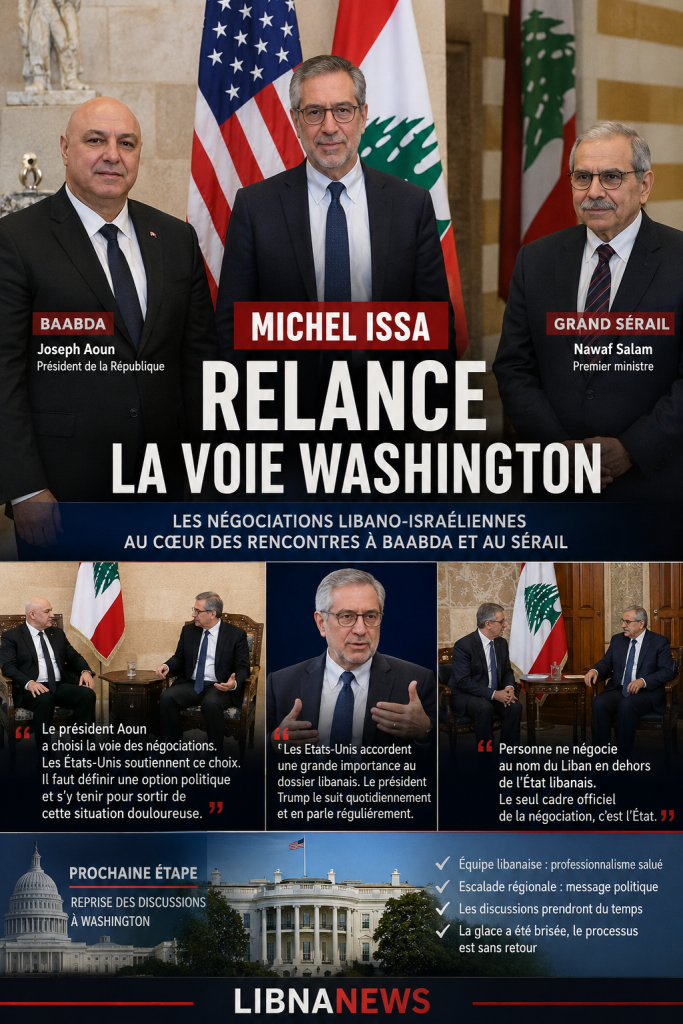
The Lebanese dossier occupied the centre of the exchanges led by the United States ambassador, Michel Issa, in Baabda and then in the Grand Serail. Received by the President of the Republic, Joseph Aoun, and then by the Prime Minister, Nawaf Salam, the American diplomat confirmed that Washington attached great importance to the ongoing sequence, marked by the Lebanese-Israeli negotiations under American sponsorship, the regional escalation and preparations for a new meeting in Washington.
In Baabda, Michel Issa stated that his meeting with the Head of State had allowed for a review of the Lebanese-American-Israeli negotiation process and the elements intended to put an end to the current situation in Lebanon. He also stated that he had conveyed to President Aoun his country’s appreciation for the positions he had announced in a recent interview. In his view, the US diplomat stressed the importance of clearly defining a political option and of sticking to it when it appears as the only way out of a « hard and painful » situation for the country.
The meeting was held in the aftermath of a further rise in tensions and as the Lebanese authorities prepared to resume discussions in Washington. When questioned, Michel Issa confirmed that negotiations should resume in the American capital. He praised the professionalism of the Lebanese team in charge of this case, saying that its members were talking about the Lebanese case in a clear and direct way. This assessment was made at a time when Lebanese officials are seeking to present an institutional position under the supervision of the State.
Michel Issa confirms Trump’s daily follow-up
Following his meeting with Joseph Aoun, Michel Issa said that the United States attached great importance to the Lebanese issue. He said that President Donald Trump followed this issue daily and that he spoke regularly about Lebanon. The diplomat felt that this element should be taken into consideration by Lebanese officials, in particular because the Head of State had chosen the path of negotiations.
Michel Issa added that Washington supported this choice and considered the ongoing process as a way to help make progress towards ending the suffering of the Lebanese. He presented the discussions as a framework that can produce positive results, while recalling that they could take time. According to him, one should not expect to solve all the questions at a single meeting.
The ambassador was also questioned about the escalation that occurred the previous day and continued in the morning. He described what had happened as a « political message. » He added that the United States had decided not to allow this confrontation to widen further. That statement was made as Lebanon remained exposed to the consequences of regional military developments and diplomatic discussions sought to avoid an extension of the crisis.
The American diplomat described his meeting with President Aoun as a good meeting. He said a useful meeting is one that produces positive elements and makes progress. He added that the United States believed that the process was on track. He also claimed that the discussions had reached a « no return » stage, indicating that « the ice » had been broken and that Washington would continue to help Lebanon emerge from its crisis.
Baabda puts forward the option of negotiations
The President of the Republic included the meeting between Joseph Aoun and Michel Issa as part of the latest developments related to the Lebanese-Israeli rounds of negotiations under American sponsorship. The Baabda Palace reported that the morning diplomatic talks focused on these developments and the situation created by the ongoing discussions.
The position expressed by Michel Issa refers to the option defended by Joseph Aoun. The US diplomat said that the Lebanese President had chosen the negotiations. He added that the United States supported this path. He also linked the continuation of this process to the possibility of reducing the suffering of Lebanese, while stressing that the discussions would not necessarily produce all their responses immediately.
The head of state received the American ambassador in a day marked by several other meetings in Baabda. But the US side dominated the political sequence, due to the expected resumption of discussions in Washington and the statements made by Michel Issa on Donald Trump’s personal follow-up. The message to Baabda focused on three points: the continuation of negotiations, the American will to contain the escalation and the importance given by Washington to the Lebanese issue.
The mention of the Lebanese negotiating team also occupied a place in Michel Issa’s remarks. He stated that this team was distinguished by its efficiency and professionalism. He added that his members approached the Lebanese case with clarity. These comments are made as Lebanon seeks to frame discussions through institutional channels and avoid multiple interpretations of the identity of the parties speaking on its behalf.
Salam receives Issa at the Grand Serail
After his visit to Baabda, Michel Issa was also received in the Grand Sérail by Prime Minister Nawaf Salam. The meeting focused on the gravity of the escalation in the region, its possible impact on Lebanon and preparations for the next round of negotiations in Washington. The Head of Government took the opportunity to recall that the Lebanese State remains the only official negotiating framework.
Nawaf Salam told the American ambassador that no one was negotiating on behalf of Lebanon outside the Lebanese state. This sentence was the main political message of the Grand Serail meeting. It intervenes in a context where several diplomatic, political and security channels are mentioned around the Lebanese issue, in particular on the South, the ceasefire and the guarantees sought by the mediators.
The Prime Minister thus placed the next meeting in Washington within a specific institutional framework. The talks concern Lebanon, but they must be conducted on behalf of the Lebanese State. The wording used by Nawaf Salam is intended to recall that the constitutional authorities intend to maintain the formal conduct of this process. It accompanies Baabda’s statements on the choice of negotiations and the role of the Lebanese team in the discussions.
The meeting at the Grand Sérail also addressed the possible consequences of regional climbing. Lebanon fears the direct impact of any expansion of confrontation. The Lebanese case is thus linked to broader discussions with Washington, while the authorities claim to want to avoid the country being dragged into a broader confrontation.
The wording chosen by the Ambassador
In his statements to the press, Michel Issa repeated several formulations intended to clarify the American reading of the sequence. He first insisted on the political choice to be made. In his view, it is important that an official determine what he wants and move in this direction, especially when this option is presented as the only way to end a painful situation. This remark was made with reference to President Aoun’s recent positions and the negotiation process.
The ambassador then recalled that the discussions could not be reduced to one meeting. He said that negotiations could take time and that it was not expected that all issues would be resolved in a single meeting. Nevertheless, he stated that the continuity of the process had a positive impact on the overall course of Lebanon and the region. This formulation places the next Washington meeting in a wider sequence, which will continue beyond a single session.
Michel Issa also linked the American position to the mastery of climbing. When asked about the events of the previous day and the morning, he said that what had happened was a political message. He added that the United States had taken the decision not to allow confrontation to expand further. These statements were made at a time when Lebanese officials were assessing the possible consequences of the escalation on the security of the country and on the preparation of the negotiations.
Finally, the Ambassador reaffirmed Washington’s support for Lebanon. He said that the United States was continuing to help the country out of its crisis. He said that the process was on the right track, while recognizing that the path remained linked to further discussions. The Baabda comments thus presented the negotiation as a progressive process, supported by Washington and followed at the highest level in the United States.
The same sequence between Baabda and Serail
The two meetings of Michel Issa formed the same diplomatic sequence. In Baabda, emphasis was placed on the President of the Republic, the choice of negotiations and the American appreciation of the positions of the Head of State. In the Grand Sérail, the discussion focused on the gravity of regional escalation, its impact on Lebanon and preparations for the next round in Washington. The two interviews were devoted to the same main dossier, but with two complementary institutional messages.
Baabda’s message highlighted the path of negotiation and American follow-up. The Grand Serail said that the Lebanese state remained the only interlocutor authorized to speak on behalf of the country. This articulation allows the Lebanese authorities to present the file as a formal process, conducted within an institutional framework, despite the complexity of the actors involved in the situation in the South and regional developments.
Nawaf Salam’s sentence on the negotiation was directly formulated. The Prime Minister claimed that no party was negotiating for Lebanon outside the Lebanese state. She intervened after Michel Issa’s statements in Baabda about the professionalism of the Lebanese team and the clarity with which she approached the case. Both points underline the role the authorities want to give to the official delegation in the next stage.
The day also showed that the Lebanese case remains followed on several levels by Washington. Michel Issa spoke about the US President, the resumption of negotiations, the Lebanese team and the will to contain the escalation. Successive meetings with Joseph Aoun and Nawaf Salam placed the American representative at the centre of the day’s institutional sequence, before the expected resumption of discussions in the United States.
The next step in Washington
The two meetings of Michel Issa in Beirut confirmed that Washington remains the place expected for further discussions. The U.S. Ambassador said negotiations should resume in the U.S. capital. In the Grand Sérail, preparations for this next stage were discussed with the Prime Minister. In Baabda, President Aoun received a message from the US diplomat in support of the negotiated option.
The resumption of discussions took place as Lebanon faced several related issues: the situation in the South, the consequences of military escalation, security assurances and the need to reduce pressure on civilians. Michel Issa’s comments emphasized the possible length of the process. According to him, it is not expected that all issues will be resolved in a single meeting. He felt, however, that continued discussions had a positive impact on the overall process in Lebanon and the region.
The diplomat also recalled that the United States had chosen not to allow the expansion of the confrontation that had occurred the previous day. This position was presented as part of US crisis management. It adds to the daily monitoring of the Lebanese case attributed by Michel Issa to President Trump. The diplomat’s comments show that Washington intends to remain directly involved in the upcoming sequence.
On the Lebanese side, the official line expressed in both meetings is based on the continuation of negotiations and the exclusive role of the State. Joseph Aoun was presented by the American ambassador as having chosen the path of discussion. Nawaf Salam recalled that no one was negotiating for Lebanon outside the Lebanese state. These two messages frame the institutional position before the next Washington meeting.
US support and Lebanese expectations
The US support posted by Michel Issa focuses on the diplomatic process. The Ambassador said that the United States continued to help Lebanon emerge from its crisis. He also claimed that Washington viewed negotiation as a tool to end the suffering of the Lebanese. These statements were made in a context where the country faces security, economic and social pressures.
The American diplomat stressed the importance of the stage reached. He said that the ice had been broken and that the process was on a positive path by Washington. However, he stressed the need to continue discussions. This caution accompanies expectations around the Washington meeting, presented as a new step and not as an immediate resolution of all issues.
Lebanese officials, for their part, reaffirmed the two principles put forward during the day. The first is the use of negotiation to address the current situation. The second is the state monopoly in conducting discussions on behalf of Lebanon. These messages were expressed in two distinct institutional locations, Baabda and the Grand Serail, and in front of the same American interlocutor.
The diplomatic sequence therefore focused on Michel Issa and the messages transmitted to the two heads of the executive. In Baabda, the ambassador highlighted the American commitment, Donald Trump’s daily follow-up, the professionalism of the Lebanese team and the desire to contain the escalation. In the Grand Serail, Nawaf Salam insisted that only the state negotiates on behalf of Lebanon, while preparations for the next meeting in Washington are continuing.




