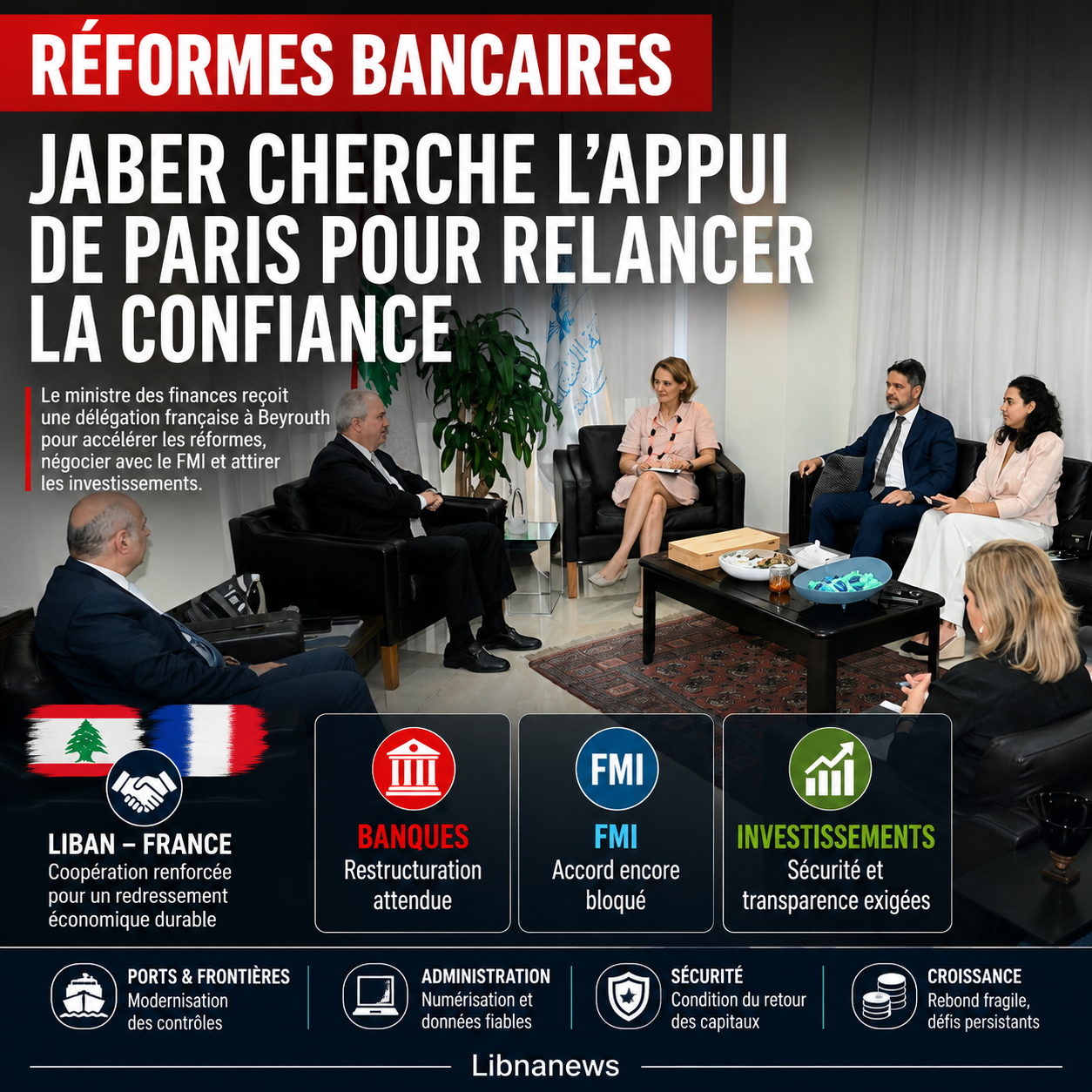
Finance Minister Yassine Jaber received a French delegation in Beirut to discuss economic reforms, banking restructuring and regional connection projects. The meeting takes place in a Lebanon that is still marked by the financial collapse of 2019, the loss of access to deposits, the weakness of public services and the effects of regional tensions. It places banking reforms at the centre of recovery, but also recalls that the Lebanese economy cannot attract investment without security, transparency and administrative capacity.
A meeting that goes beyond bilateral cooperation
The French delegation’s visit to the Ministry of Finance is not limited to a technical exchange between two administrations. It is part of a sequence in which Lebanon attempts to restore a minimum of economic credibility after several years of crisis. The country has experienced a sovereign default, a lasting fall in its currency, a banking freeze and a sharp deterioration in purchasing power. This has upset the Lebanese’s relationship with the state, banks and international partners.
Minister Yassine Jaber received Fanny La Barthe, Assistant Director of Economic Relations at the French Ministry of Finance. The head of the regional economic service, François Sporrer, and economic and financial attaché, Kenza Ouzzani, were also part of the delegation. On the Lebanese side, the Director of Public Finance, Georges Maaraoui, and two councillors to the Minister participated in the interview. This composition indicates a discussion oriented towards the implementation of the reforms, and not only towards the diplomatic display.
The meeting focused on three interrelated areas. The first concerns the banking sector, whose restructuring remains the main condition for a return to a normal economy. The second concerns negotiations with the International Monetary Fund and the fiscal framework. The third is the modernization of administration, borders and logistical infrastructure. These three dossiers today form the basis for a possible recovery, but each faces political, technical and social resistance.
Banking reforms: an uncompleted emergency
Banking reforms have dominated the Lebanese economic debate since the beginning of the crisis. Yet they remain incomplete. The blockage comes from a central point: the recognition and distribution of losses. Since 2019, depositors have been denied free access to their foreign currency accounts. Withdrawals were framed by variable rules, often decided by the banks themselves. This has created a deep divide between financial institutions, savers and the state.
The banking sector no longer plays its usual role. It does not finance companies properly. It no longer supports productive investment. It no longer offers to households the security that once founded the attractiveness of financial Lebanon. Part of the economy moved to cash payments, informal channels and external transfers. This adaptation has allowed some activities to survive, but it does not replace a sound financial system.
The bank restructuring project must respond to this breakdown. It must determine which banks can be maintained, which should be reorganized and how losses should be treated. It must also protect small depositors as much as possible, without placing an unrealistic burden on public finances. It is the most difficult balance. The State is in debt. The Bank of Lebanon has a major share of the imbalance. Banks challenge some of the responsibilities. The depositors ask for the return of their money.
Yassine Jaber presented the reordering of the sector as a national priority. This choice meets a simple need. No serious investor can commit significant funds in a country where the banking system remains paralysed. No international programme can move forward on a sustainable basis unless the losses are clarified. Banking reforms are therefore not a sectoral issue. They condition everything else: credit, currency, debt, trade, taxation and investment.
Lebanon in the face of a social economic crisis
In order to understand the scope of this meeting, the banking file must be placed in the current situation in Lebanon. The crisis is no longer just financial. It has become social, administrative and institutional. The devaluation of the pound reduced real wages. Households had to change their spending. Public services have lost quality. School, health, electricity, water and transport have suffered the cumulative effects of the lack of funding, the loss of skills and the decline in government revenues.
Recent indicators show a partial but fragile recovery. After several years of contraction, the economy rebounded in 2025, driven by tourism, consumption and a start to macroeconomic stabilization. This improvement is not enough to erase the accumulated damage. Gross domestic product remains below its pre-crisis level. Purchasing power remains very uneven. Households receiving foreign currency are more resilient than those dependent on local income.
The labour market illustrates this fracture. Unemployment remains high, especially among young people. Many graduates are still looking to leave. Administrations and businesses struggle to retain technical profiles. This lack of skills weakens the country’s ability to implement the reforms it announces. Lebanon still has significant human capital, but this capital is dispersed. It becomes more difficult to mobilize in public institutions.
Poverty and vulnerability also affect recovery. A large part of the population lives on unstable incomes. Social assistance, family transfers and informal activities play a dampening role. But they do not create a solid basis for recovery. In this context, the reforms required by foreign partners must be accompanied by social measures. Without minimum protection, adjustment may increase mistrust.
The IMF as a framework, not as a single solution
The meeting also discussed discussions with the International Monetary Fund. This issue remains central, as a programme with the Fund would serve as a signal to donors, markets and investors. It would provide a monitoring framework, measurable objectives and budgetary discipline. But it would not replace Lebanese political choices. The IMF can demand reforms. It cannot have them voted or applied them instead of national institutions.
Recent discussions with the Lebanese authorities include banking restructuring, debt sustainability, medium-term fiscal strategy and financial governance. The Fund also emphasizes the protection of small depositors and the limitation of the use of public resources to compensate bank losses. These demands reflect a concern: charging the whole of society without changing the practices that led to the crisis would prolong the problem.
Lebanon has already adopted certain transparency measures, particularly with regard to bank secrecy. These advances remain important. They should allow authorities to better access banking information and verify certain transfers. But they’re not enough. The restructuring law, the Loss Allocation Act and banking resolution mechanisms must form a coherent set. If one piece is missing, the system will remain fragile.
The government must therefore show that it can move from intent to execution. This step will be closely monitored by France, the international financial institutions and other partners in Lebanon. The promises of reform have not been lacking since 2019. What is lacking is the ability to resolve conflicts of interest, to publish clear figures and to set a credible timetable. Trust will not come back by declaration. It will come back with verifiable decisions.
Why France is following the case closely
The French presence in this file responds to several logics. The first is historical and political. Paris has long maintained close ties with Beirut. The second is economic. A stabilization of Lebanon can open up prospects in infrastructure, energy, public services, logistics and digital. The third is regional. France considers Lebanon’s stability to be an important element of balance in the Levant.
The interview with Yassine Jaber is therefore part of active economic diplomacy. France cannot finance Lebanese recovery alone. Nor can it compensate for the lack of internal agreement. However, it can support projects, provide expertise, support administration and encourage coordination with international institutions. Technical assistance is provided in a country where government services have been weakened by the crisis.
French support can also facilitate the preparation of bankable projects. In infrastructure, a project is not enough to attract capital. Studies, legal framework, governance, guarantees and monitoring capacity are needed. Lebanon has often announced ambitious plans without turning them into implemented projects. Technical cooperation can narrow the gap between announcement and implementation.
But the Franco-Lebanese relationship has a clear limit. Foreign partners demand action. They want to know who will bear the bank losses, how the state will improve its revenues, how borders will be controlled and how projects will be protected. External support can accompany a movement. It cannot replace the Lebanese political decision.
Reinventing Lebanon’s Regional Role
The Minister of Finance also presented a broader vision: making Lebanon a regional trade corridor. This idea is based on the geography of the country. Lebanon has a maritime façade, a main port in Beirut, a port in Tripoli and potential access to neighbouring markets. Its position could enable it to serve as a logistics platform between the eastern Mediterranean and the Arab world.
This ambition is not new. It refers to a historical function of Lebanon as a country of services, trade and intermediation. But the crisis weakened that function. Infrastructure has been ageing. Border crossings need modern equipment. Administrative procedures remain cumbersome. Transport costs can reduce business competitiveness. Regional tensions complicate the flow of goods.
The discussions referred to railway networks, pipelines, the development of border crossings and the modernization of the supply chain. These projects can reduce transport delays and improve commercial integration. But they demand strict conditions: security, financing, coordination with neighbouring countries, market transparency and regulatory stability. Without these conditions, major projects may remain announcements.
The rail illustrates this difficulty. Lebanon no longer has an operational rail network. It would require heavy investment and long-term vision. Pipelines pose other challenges related to energy, safety and regional agreements. Border crossings, on the other hand, can produce faster effects if controls are modernised and procedures simplified. The government will therefore have to prioritize.
Ports, borders and transparency of controls
The meeting placed special emphasis on scanning systems at the port of Beirut. This file seems technical, but it touches on major issues. The port remains an essential economic hub. The fluidity of controls, cargo security and customs transparency directly influence public revenues and the confidence of private operators. A truck inspected quickly, with clear procedures, costs the importer less and reduces the risk of fraud.
Scanner activation aims to subject more trucks to systematic control. It should make it possible to better target suspicious shipments and reduce arbitrary inspections. It can also improve the collection of duties and taxes in a State seeking to rebuild its revenues. But technology is not enough. It requires trained officers, regular maintenance, accurate protocols and traceability of decisions.
Border crossings follow the same logic. They are not just crossing points. They are instruments of economic policy and sovereignty. If they do not work properly, delays increase, costs rise and traffic prosper. If they function better, legal trade becomes more attractive and the state takes over some control over flows. The link between economic reform and security appears here in concrete terms.
Logistics modernization can therefore have a dual effect. It can support growth by facilitating trade. It can also strengthen public authority by reducing grey areas. For Lebanon, this dual stake is essential. The country must prove that it can become a reliable platform again, not just a survival economy supported by the transfer of its diaspora.
An administration to rebuild
The digital transformation was another aspect of the interview. Participants referred to the modern data centre established with the support of the Lebanon Financing Facility. This project is part of a strategy to digitize public administration. It can support more efficient tax, customs and administrative services. It can also improve data protection and service continuity.
Scanning can reduce contact corruption, shorten deadlines and make procedures more readable. It can help citizens access certain services without going through informal channels. It can also provide the state with more reliable data to drive public policy. But it requires strong governance. Poorly designed digital systems can replicate existing delays or create new vulnerabilities.
The human challenge remains central. Lebanese administrations have lost jurisdiction. Public wages have been severely devalued by the crisis. Computer, financial and legal specialists are difficult to retain. The reforms require precisely these profiles. A banking law, a scan system, a data centre or a budget strategy do not work without teams capable of managing them on a daily basis.
Lebanon must therefore rebuild its administrative capacity. This reconstruction requires training, stability of teams and protection of key functions. It also requires better coordination among ministries, the Bank of Lebanon, customs, oversight agencies and international partners. It is less visible than major infrastructure projects, but it depends on their success.
Security as a condition for the return of capital
Yassine Jaber and the French delegation insisted on security stability. This point is not incidental. Investors assess political risk, legal risk and physical risk. In Lebanon, regional tensions, episodes of violence and institutional uncertainty weigh on these three levels. A project can be cost-effective on paper, but remain blocked if the security environment seems too unstable.
Security also concerns infrastructure. A port, border crossing, data centre, railway or pipeline must operate over time. Such financing requires guarantees. Insurers, banks, companies and donors want visibility. They want to know whether the sites will be protected, whether the contracts will be enforced and whether the State will be able to ensure continuity of services.
The link between security and economy thus appears at the heart of the meeting. Lebanon can adopt laws, negotiate with IMF and receive technical assistance. But he must also convince that his institutions can protect investment. This condition applies not only to foreign capital but also to Lebanese investors. Many of them have resources and networks. They expect clear signals before rehiring funds in the country.
Stability does not mean total absence of risk. No country in the region is exempt. Rather, it means a predictable framework, a public authority capable of acting and reducing the threats that block projects. It is this predictability that Lebanon will have to rebuild if it wants to become a new investment destination.
Immediate projects
The meeting with the French delegation highlighted an implicit roadmap. The first project remains the bank clarification. The government must make progress on restructuring, protecting small depositors and allocating losses. The second project concerns negotiations with the IMF. It requires a credible fiscal framework and coherent financial reforms. The third concerns commercial infrastructure, with possible priority at ports and borders.
The fourth project concerns administration. Digital tools, data centres and control systems must become tools for reform, not isolated projects. The fifth concerns security. Without a stable environment, other efforts will produce limited results. These sites are linked. Banking reform without effective administration will remain fragile. A modern infrastructure without security will attract little capital. International negotiations without internal consensus will remain vulnerable.
Lebanon is therefore going through a time when announcements are not enough. The country has advantages: its diaspora, its geographical position, its skills, its ports and its adaptability. But these assets need a framework. The meeting between Yassine Jaber and the French delegation recalls that the recovery will not come from a single measure. It will depend on a series of concrete progress, followed in time, while the next legislative and administrative steps remain expected in Beirut.