






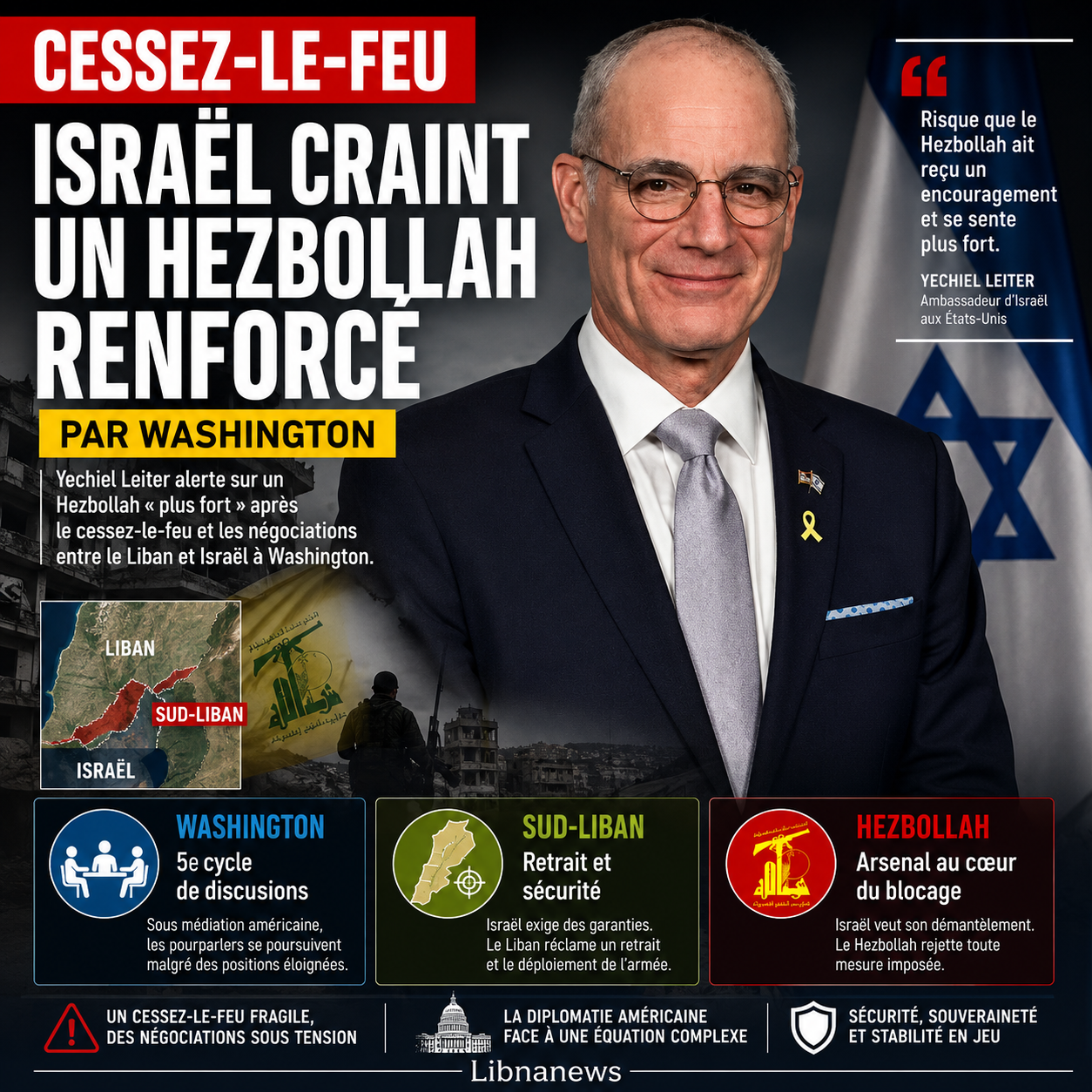
Israel’s ambassador to the United States, Yechiel Leiter, said Hezbollah felt strengthened by the latest developments around the ceasefire and negotiations between Lebanon and Israel in Washington. This statement, reported by Israeli and Lebanese media, takes place in a fifth round of discussions under American mediation. It reflects Israel’s fear that the Shiite movement will come out politically reinforced by a diplomatic sequence supposed, according to Israel, to pave the way for its military weakening and a return from the Lebanese state to the south of the country.
Yechiel Leiter warns against a process that « derails »
The formula used by Yechiel Leiter is deliberately alarming. According to the Israeli press, the ambassador said that the first rounds of negotiations resembled a train launched to a clear destination: a peace between Lebanon and Israel, the distance from Iranian influence, the dismantling of Hezbollah and lasting security for both countries. In his view, that trajectory would now be threatened. He claimed that there was a risk that Hezbollah might have been encouraged and felt stronger.
This public release comes at a delicate moment. Negotiations between Lebanese and Israeli representatives in Washington, D.C., are not taking place in a climate of confidence. They are part of the continuation of a fragile ceasefire, achieved after a confrontation phase in southern Lebanon. They are also being held in the shadow of broader discussions involving the United States and Iran, which fuel Israeli concerns. For Israel, any mechanism that involves Tehran in managing Lebanese de-escalation can be seen as an indirect legitimization of the Iranian role.
Yechiel Leiter’s message therefore targets two audiences. He addressed Washington first, to remind us that the Israeli priority remains the neutralization of Hezbollah, not a simple management of calm. He also addressed Israeli opinion, which was very attentive to the security of the northern part of the country. After months of tension, the inhabitants of the border localities demand strong guarantees before any lasting return. The ceasefire is not enough if Hezbollah retains a military capacity close to the border.
For Lebanon, this statement poses a political problem. Beirut is seeking Israeli withdrawal from the occupied areas and restoring its authority over the territory. But it must do so without appearing as executing an Israeli demand. This constraint explains the caution of the Lebanese authorities. They mean sovereignty, the role of the army and national security. Israel, for its part, means Hezbollah.
Hezbollah at the centre of Israeli perception
In Israeli reading, Hezbollah remains the main obstacle to lasting stabilization. Its arsenal, its location in southern Lebanon and its link with Iran are the three elements that structure this perception. Israel believes that any agreement that does not change these parameters will remain incomplete. The Israeli ambassador resumed this line when he said that Hezbollah would feel emboldened by the latest developments.
This analysis is based on a specific fear. The Shiite movement could present the ceasefire as the result of a balance of power that it would have helped to impose. It could also defend the idea that its military capability has prevented Israel from achieving all its objectives. Even if the party has suffered losses, it can seek to transform the sequence into an internal political argument. In a region where victory stories often count as much as military records, this dimension is not secondary.
However, Hezbollah is in a more complex situation than just a position of confidence. He faces military, diplomatic and internal pressure. The destruction in southern Lebanon, the displacement of the population and the human cost of the clashes are affecting its social environment. Part of the Lebanese population blames the movement for engaging the country in conflicts whose parameters the State does not control. Others continue to see its arsenal as a form of protection against Israel.
This national division limits Beirut’s room for manoeuvre. The Lebanese Government cannot ignore international demands related to the state monopoly of force. Nor can it open an internal confrontation around Hezbollah weapons without a strong political consensus. The result is an unstable balance. The subject remains central, but no Lebanese actor now has a simple way to solve it.
A fragile ceasefire, but already disputed
The ceasefire constitutes the immediate framework for discussions. It aims to reduce hostilities and allow for diplomatic work. But he remains disputed in his interpretation. Israel claims to want to prevent Hezbollah from reconstituting its positions in the south. Lebanon denounces violations of its sovereignty and calls for an Israeli withdrawal. Hezbollah rejects any provision aimed at disarmament without a comprehensive settlement of the conflict.
This fragility explains the political significance of Yechiel Leiter’s words. Speaking of a strengthened Hezbollah, he challenged the idea that a simple military break could produce security. He suggested that the ill-structured ceasefire might instead give the party time to reorganize itself, rebuild its capabilities and resume political initiative. For Israel, therefore, the problem is not limited to stopping the shooting. It concerns the military structure of southern Lebanon.
American mediators are trying to prevent an open resumption of hostilities. Their immediate priority remains the stabilization of the front. Washington knows that further burning in Lebanon could disrupt other regional issues. But this logic of de-escalation does not fully meet Israeli expectations. Israel wants verifiable guarantees. He wants to know who controls the terrain, who prevents the return of combatants and who monitors sensitive areas.
Lebanon also calls for guarantees. It wants to prevent the southern part of the country from remaining subject to a prolonged Israeli military presence. It also wants to prevent the case from being dealt with solely in the light of Israeli security needs. For Beirut, the withdrawal, reconstruction and deployment of the Lebanese army must be part of the same movement. Without that, the ceasefire could freeze a de facto situation at the expense of the Lebanese State.
Washington between mediation and strategic pressure
The fifth round of discussions in Washington places the United States in a difficult arbitrage position. The US administration must take into account the alliance with Israel, Lebanese demands and Iran’s regional role. It seeks to prevent the Lebanese-Israeli border from returning to an open front. It is also trying to preserve a broader diplomatic dynamic, in which Lebanon occupies a sensitive place.
The American mediation is based on a simple idea: to transform the ceasefire into a security mechanism. Several leads were mentioned in the international press. They include the gradual transfer of parts of southern Lebanon to the Lebanese army, the training or verification of certain units by the United States, and the maintenance of guarantees to reassure Israel. These elements aim to test the Lebanese State’s ability to regain control of the ground.
But this pattern raises resistance. Hezbollah sees it as an attempt to marginalize him under US and Israeli pressure. Israel fears, on the other hand, a weak system, which would allow the movement time to reorganize. Some Lebanese officials fear that the country will be placed at the centre of a regional arrangement negotiated over its institutions. These contradictory perceptions make each step difficult.
Yechiel Leiter’s statement therefore comes as a warning against a mediation which, in his view, could lose its original objective. The Israeli Ambassador seeks to reaffirm that the discussion should not be limited to incident management. It must address the fundamental issue of Hezbollah. It is this priority that often opposes the Israeli approach to American diplomatic prudence.
Southern Lebanon: Military and Human Issues
Southern Lebanon remains the main scene of this confrontation. Villages near the border paid a heavy price during the clashes. Families have left their homes. Infrastructure was damaged. Agricultural land has been abandoned or made difficult to access. The question of the return of inhabitants does not depend solely on a diplomatic text. It depends on real calm, road safety, housing conditions and the effective presence of the State.
For Israel, the same area represents a potential threat if Hezbollah retains positions, weapons caches or observation capabilities. The security trauma north of Israel feeds a strong demand: to keep the movement away from the border. The Israeli authorities want to prevent the ceasefire from bringing the situation back to the previous state, with a non-State armed presence just beyond the line of contact.
The Lebanese army is at the heart of the stabilization proposals. It is expected to play a more visible role in border areas. But its resources remain limited. The economic crisis weakened public finances, reduced the value of balances and complicated the maintenance of equipment. Foreign partners can provide support, but sustainable deployment requires internal political will and constant resources.
The people of the south expect concrete guarantees first. Residents want to know whether the bombings will stop, whether the roads will be safe, whether schools will be able to reopen and whether farms will be able to resume. These social expectations can affect political calculations. No Lebanese actor can for a long time ignore the human cost of prolonged conflict. Hezbollah itself must take into account this fatigue in its areas of influence.
Lebanon’s crisis weighs on negotiations
Lebanon addresses these discussions in a state of institutional weakness. Since 2019, the financial collapse has destroyed a significant part of confidence in banks, public policies and administrations. Public wages have lost value. Basic services have deteriorated. The state relies heavily on external aid and diaspora transfers to maintain part of its social functioning.
This situation weighs directly on the security issue. A weakened State can hardly quickly impose its authority on disputed areas. He may announce the deployment of the army, but he must finance this deployment, equip and support it for the duration. He could promise reforms, but he must have officials, magistrates, customs officers and managers capable of implementing them. Sovereignty is not decreed. It is built by functional institutions.
The question of Hezbollah is therefore also a symptom of an incomplete state. For decades the party has occupied a place that the state has never managed to absorb. Its military power developed in a context of conflict with Israel, Iranian support and Lebanese institutional weakness. The current crisis only makes this contradiction more visible. For many international partners, the return to stability requires a State that alone holds the military decision. For some Lebanese, this goal remains desirable, but difficult to achieve without guarantees in the face of Israel.
The Washington negotiations put this contradiction on the table. Israel calls for the actual dismantling or removal of Hezbollah. Lebanon calls for Israeli withdrawal and recognition of its authority. The US is looking for a formula that avoids escalation. Hezbollah wants to preserve its role. None of these objectives can be achieved in isolation.
Israel wants to avoid a political victory for Hezbollah
The fear expressed by Yechiel Leiter is less about an immediate military victory for Hezbollah than about a political victory. Israel fears that the movement can tell its supporters that it has resisted, that the discussions are under pressure from the ground and that its arsenal remains indispensable. In this case, the ceasefire would strengthen the party’s narrative instead of weakening it.
This battle of narrative counts in any exit from conflict. Israel wants to show that its military pressure has changed the rules of the game. Hezbollah wants to show that he was not forced to surrender. The Lebanese government wants to show that it is taking over by diplomacy. The United States wants to show that its mediation can produce results. Each actor therefore seeks to interpret the same events to his advantage.
The Israeli ambassador’s formula responds to this logic. It aims to prevent de-escalation from being presented as a success of Hezbollah. It recalls that, for Israel, the process can only be seen as positive if it permanently reduces the threat. It also prepares the ground for a tougher position if negotiations do not lead to guarantees deemed sufficient.
However, there is a risk in this line. Too much pressure on the disarmament issue can block Lebanese negotiations. The power in Beirut cannot impose in a few days a decision that affects the internal balance of the country. A gradual approach, based on military deployment, reconstruction, border control and international safeguards, may seem more realistic. But it will be considered insufficient by Israel if it does not produce rapid results.
Sovereignty, Condition and Objective
The word sovereignty returns in all speeches, but it does not have the same meaning for each actor. For Lebanon, it means the end of violations of its territory and the Israeli withdrawal from the occupied areas. For Israel, it means that the Lebanese State must prevent any attack on its soil. For the United States, it means an institutional framework capable of stabilizing the border. For Hezbollah, it remains linked to the resistance to Israel and the refusal of imposed disarmament.
The difficulty lies in this plurality of interpretations. A lasting agreement will have to combine several requirements. It must provide for a credible Israeli withdrawal. It will need to strengthen the role of the Lebanese army. It should prevent the reconstitution of non-State armed positions in sensitive areas. It must also offer the people of the south a prospect of return and reconstruction.
None of these points can be dealt with solely by declarations. Control mechanisms will be essential. Who checks the withdrawal? Who’s watching the evacuated areas? Who finances the Lebanese deployment? Who guarantees that incidents do not degenerate? These concrete questions will determine the real value of the process. They will also explain whether or not Hezbollah can turn the ceasefire into a political advantage.
Yechiel Leiter’s statement therefore highlights a real concern, but it does not solve the equation. It recalls the Israeli priority. It obliges mediators to clarify their objectives. It puts the Lebanese government before its own responsibility: to rebuild a credible national authority in an area where the state has long been competing.
Negotiations suspended at verifiable stages
The fifth round of Washington will have to show whether the parties can move beyond the general formulas. The discussions will have to produce verifiable steps: withdrawal or redeployment in certain areas, increased presence of the Lebanese army, monitoring mechanisms, United States safeguards and follow-up schedule. Without these elements, the ceasefire will remain vulnerable to incidents and mutual accusations.
Yechiel Leiter’s words set an Israeli red line. According to him, the process should not encourage Hezbollah, even indirectly. This position will weigh on the continuation of the discussions. It could harden Israeli demands. It could also push Washington to clarify the guarantees offered to Israel while avoiding weakening the Lebanese Government.
For Beirut, the challenge is to ensure that the role of the State is recognized without causing internal disruption. Lebanon must secure an Israeli withdrawal, strengthen its army and reopen a prospect of reconstruction in the south. It must also address the issue of non-State weapons, but within a framework that does not plunge the country into internal confrontation. This narrow path explains the slow pace of negotiations.
On the ground, the population remains exposed to uncertainty. The people of the south are waiting for decisions that change their daily lives. The northern Israelis want guarantees before they consider the border safe. The mediators are looking for a formula that can meet these two requirements. The next step will depend less on public statements than on the ability of delegations to put in black and white an applicable system, which is monitored and accepted by the forces still on the ground.