

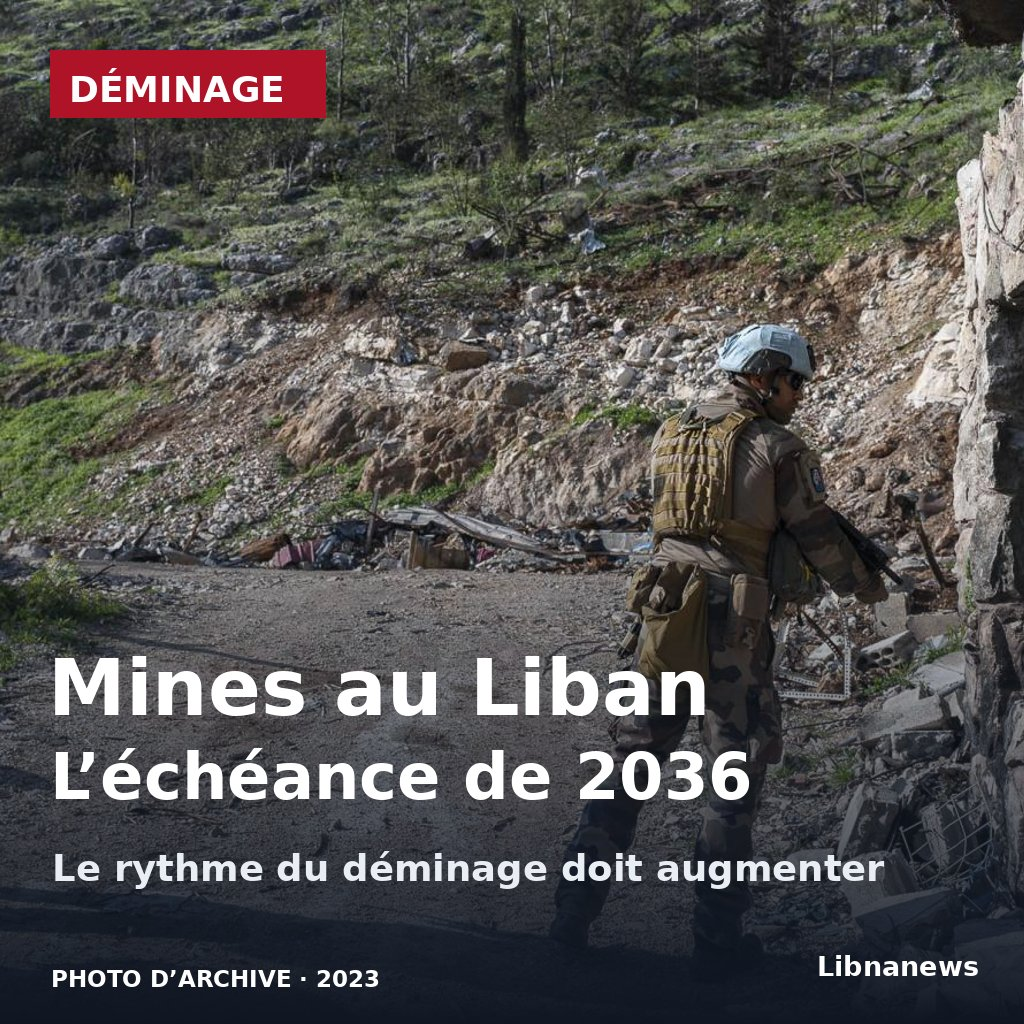
Lebanon has until 1 November 2036 to deal with mined areas under its jurisdiction or control. According to the reportLandmine Monitor 2026published on Tuesday 24 November, approximately 0.8 km2 per year would have to be made available to meet this deadline. In 2025, the country released 0.22 km2.
The calculation is based on the contamination recorded at the end of 2025. It does not take into account areas that could be added. By 2024, 0.51 km2 had been made available, according to the same report, and the historical average was around 0.6 km2 per year. The release includes land actually cleared and land investigated to raise or reduce the area of suspicion. It therefore does not only measure mine clearance in the field.
The first Lebanese report is due in April
Lebanon deposited its instrument of accession to the Ottawa Convention on 1 May 2026. According to the notification of the United Nations depositary, the Treaty entered into force for the country on 1 November. It prohibits, inter alia, the use, production, transfer and storage of anti-personnel mines, subject to the exceptions provided for in the text. It sets a time limit of four years to destroy stocks and ten years to treat mined areas. Lebanon’s first transparency report is due on 30 April 2027.
In particular, this first declaration shall establish the status of known or suspected stockpiles and mined areas. The 2036 deadline does not mean that all the risks associated with fighting fall within the same scope: unexploded shells and cluster remnants continue to threaten the inhabitants, but do not coincide with anti-personnel mines covered by the Convention.
South concentrates access difficulties
Most of the reported contamination is in the South. The report stresses that instability and access restrictions hinder operations. UNIFIL reports that it cleared nearly five million square metres between 2006 and 2023, prior to the suspension of its regular work on 8 October 2023. She said that she continued to coordinate with the Lebanese Armed Forces the reports of unexploded ordnance. These interventions are not equivalent to the resumption of a regular clean-up programme.
The biggest global record since 2020
The report recorded at least 6,929 victims of mines and explosive remnants of war in 2025: 1,955 deaths, 4,930 injuries and 44 persons whose fate could not be established. Civilians account for 84 per cent of known casualties. Myanmar has 1,891 victims and Syria 1,602, an increase of more than 50 per cent in the latter country. The report places this progression in a context of return after the fall of the Bashar al-Assad regime, without presenting the end of the fighting as the end of the danger.





Comments