

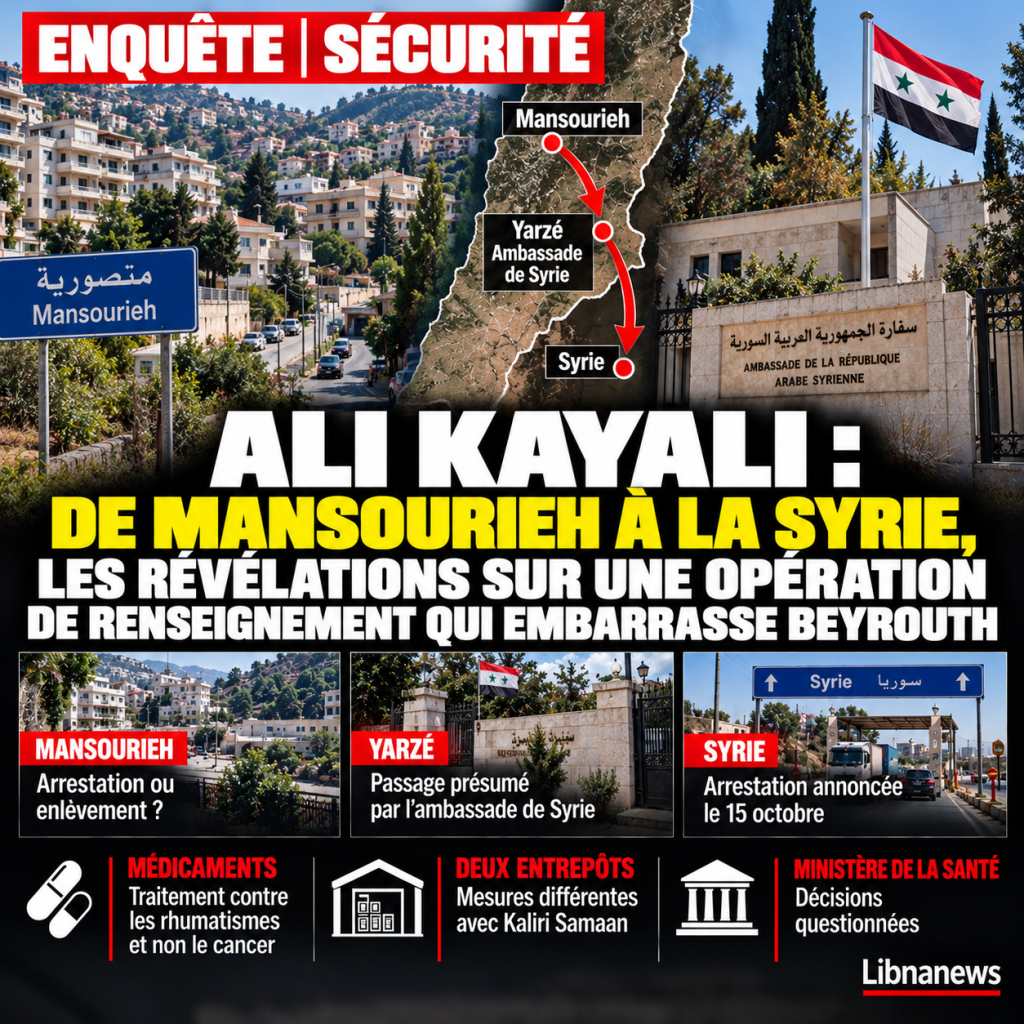
A man arrested, two versions at the place of his capture
The arrest of Ali Kayali, also known as Mihrac Ural, causes a diplomatic controversy between Lebanon, Syria and Turkey. In the centre of the case is a specific question: was the man arrested in Syria, as claimed by the Syrian authorities, or abducted in Lebanon before being smuggled to Damascus? The information released on 23 October 2026 reveals contradictory versions, while Turkish President Recep Tayyip Erdogan personally congratulated the Turkish and Syrian intelligence services for their cooperation.
According to a Lebanese security official quoted in the information provided by Agence France-Presse, Ali Kayali was allegedly abducted in Mansourieh, Mount Lebanon, without the Lebanese authorities being informed of the operation. He was then allegedly taken to the Syrian embassy in Yarzeh before being transferred to Syrian territory. This version describes an operation carried out within Lebanon by foreign services, without prior intervention by national judicial and security institutions.
The Syrian authorities have a different chronology. They announced his arrest on 15 October 2026, claiming that their intelligence services had arrested him. Their communication does not recognize a kidnapping operation on Lebanese territory. The contradiction between the two accounts therefore concerns a decisive element: the place where Kayali was deprived of liberty.
This difference is not a mere detail. If the arrest took place in Syria, it falls within the competence of the Syrian authorities, subject to compliance with the applicable rules. If the man was captured in Lebanon and then transferred without official procedure, the case directly raises the question of foreign intervention in Lebanese territory.
Erdogan congratulates Turkish and Syrian intelligence
On Wednesday, 21 October, Recep Tayyip Erdogan publicly congratulated the Turkish and Syrian intelligence services on the operation leading to the arrest of Mihrac Ural. The Turkish president spoke to the parliamentary group of his Justice and Development Party.
This statement is an important part of the file. It confirms that the Turkish authorities claim participation in the operation, in cooperation with their Syrian counterparts. However, it alone does not allow for the determination of the place of arrest or the exact modalities of intervention by the services concerned.
Turkish participation is due in particular to the judicial past of Mihrac Ural. The Ankara authorities accused him of having played a role in the attacks in Reyhanli, in the Turkish province of Hatay, in May 2013. This double attack killed 52 people. Ural has long been one of the people sought by the Turkish authorities in this case.
The arrest is therefore of major security interest to Ankara. It also intervenes in a context of cooperation between the new Syrian authorities and Turkey. The Erdogan declaration shows that this cooperation can now involve operations targeting personalities associated with the former Syrian regime.
However, it does not answer Lebanese questions. Cooperation between two foreign services does not automatically give them the power to intervene in the territory of a third State. It is precisely on this point that controversy is focused.
The alleged passage by the Syrian embassy in Yarze
The most sensitive element of the account attributed to the Lebanese security source concerns the alleged passage of Ali Kayali by the Syrian embassy in Yarzé. According to this version, the man was taken from Mansourieh to diplomatic representation, before his transfer to Syria.
If this chronology were confirmed, it would place the embassy at the centre of an operation whose Lebanese authorities would have been kept away. A diplomatic representation enjoys special protections, but these do not give it the right to organize arrests or forced transfers outside legal proceedings.
The available information does not specify how Kayali was transported between Mansourieh and Yarzé. They do not identify the vehicles used, the persons involved in the operation or the crossing point used to reach Syria. Nor can they establish whether Turkish agents were physically present in Lebanon.
Nevertheless, the account of the Lebanese security source is a sufficiently specific accusation to raise a diplomatic issue. It refers to a presumed capture site, intermediate stage and final destination. The verification of this chronology would determine whether the arrest announced by Damascus was preceded by an underground operation in Lebanon.
An arrest announced on 15 October by Damascus
The Syrian authorities announced the arrest of Mihrac Ural on 15 October. They presented the operation as an intervention by their intelligence services against a personality linked to the former regime.
Ural, also known as Ali Kayali, is a controversial figure in the Syrian conflict. He has been associated with armed groups that support Bashar al-Assad, particularly in coastal areas. His name appears in several accusations of violence during the civil war.
These accusations explain the Syrian authorities’ interest in his arrest. However, they do not allow the controversy over the circumstances of its capture to be resolved. The background of the person sought and the conditions for his arrest are two distinct issues.
The Syrian version places the operation in the context of the action of its intelligence services. The story from the Lebanese security source describes, on the contrary, a capture in Mansouriah followed by a transfer to Syria.
As of 23 October, there is no sufficiently detailed public explanation to reconcile these two versions.
Lebanon was allegedly kept away from the operation
One of the most worrying aspects of the case concerns the alleged lack of information from the Lebanese authorities. According to the security source cited, the relevant institutions were not warned of the operation in Mansourieh.
An arrest on Lebanese territory by foreign services, without official coordination, would constitute a serious violation of the State’s powers. The Lebanese judicial and security authorities normally have the necessary prerogatives to arrest or respond to a request for international cooperation.
The case could, in principle, have been the subject of a request for mutual legal assistance or an official procedure involving the Lebanese authorities. The account of the alleged abduction does not mention any such intervention.
The question also concerns the transfer of the person concerned from the territory. Formal surrender to another State requires identifiable procedures and decisions. If Kayali was indeed taken from Mansourieh to Yarzé and then to Syria, it would remain to be explained how this transfer could be carried out without the intervention of the Lebanese services.
These questions are all the more sensitive as the operation would have involved two foreign intelligence services. The participation claimed by Ankara and the arrest announced by Damascus give the case a regional dimension that goes beyond the personal situation of Mihrac Ural.
Lebanese diplomacy called for explanations
The controversy prompted calls for intervention by the Lebanese Ministry of Foreign Affairs. The request includes the convening of Syrian and Turkish ambassadors to obtain explanations of the circumstances of the operation.
This would make it possible to formally ask where Ali Kayali was arrested, which services participated in his arrest and whether the Lebanese authorities were informed of an intervention in their territory.
The alleged role of the Syrian embassy was another point that could be raised. It would be in the interest of the Lebanese authorities to determine whether the person concerned actually transited through the diplomatic representation of Yarzeh.
As of 23 October 2026, the evidence examined does not confirm that a meeting of the two ambassadors has already taken place. The request appears to be a reaction to the gravity of the alleged facts, not a diplomatic measure whose execution would be established.
The case nevertheless puts Beirut before a concrete question. Security cooperation between Syria and Turkey can meet the interests of both countries. However, it cannot justify clandestine intervention in Lebanon if the facts reported in Mansourieh are confirmed.
A case that goes beyond Mihrac Ural’s personal case
The arrest of Mihrac Ural comes in a context of recompositioning of the Syrian security services and rapprochement with Ankara. For the Turkish authorities, it represents a step forward in the search for a man accused of involvement in the attacks in Reyhanli. For Damascus, it is part of operations targeting personalities associated with the former regime.
For Lebanon, the question is different. It concerns the possibility that foreign services organized a capture in its territory and then transferred the wanted person outside its borders without official procedure.
The Erdogan declaration of 21 October confirms Turkish-Syrian cooperation in this case. The Syrian announcement of 15 October establishes that Damascus claims arrest. The testimony attributed to a Lebanese security source, however, places the capture in Mansourieh and describes a passage through the Syrian embassy in Yarzeh.
These three elements form the core of the file. Their confrontation leaves a major contradiction on the place and modalities of arrest.





Comments