





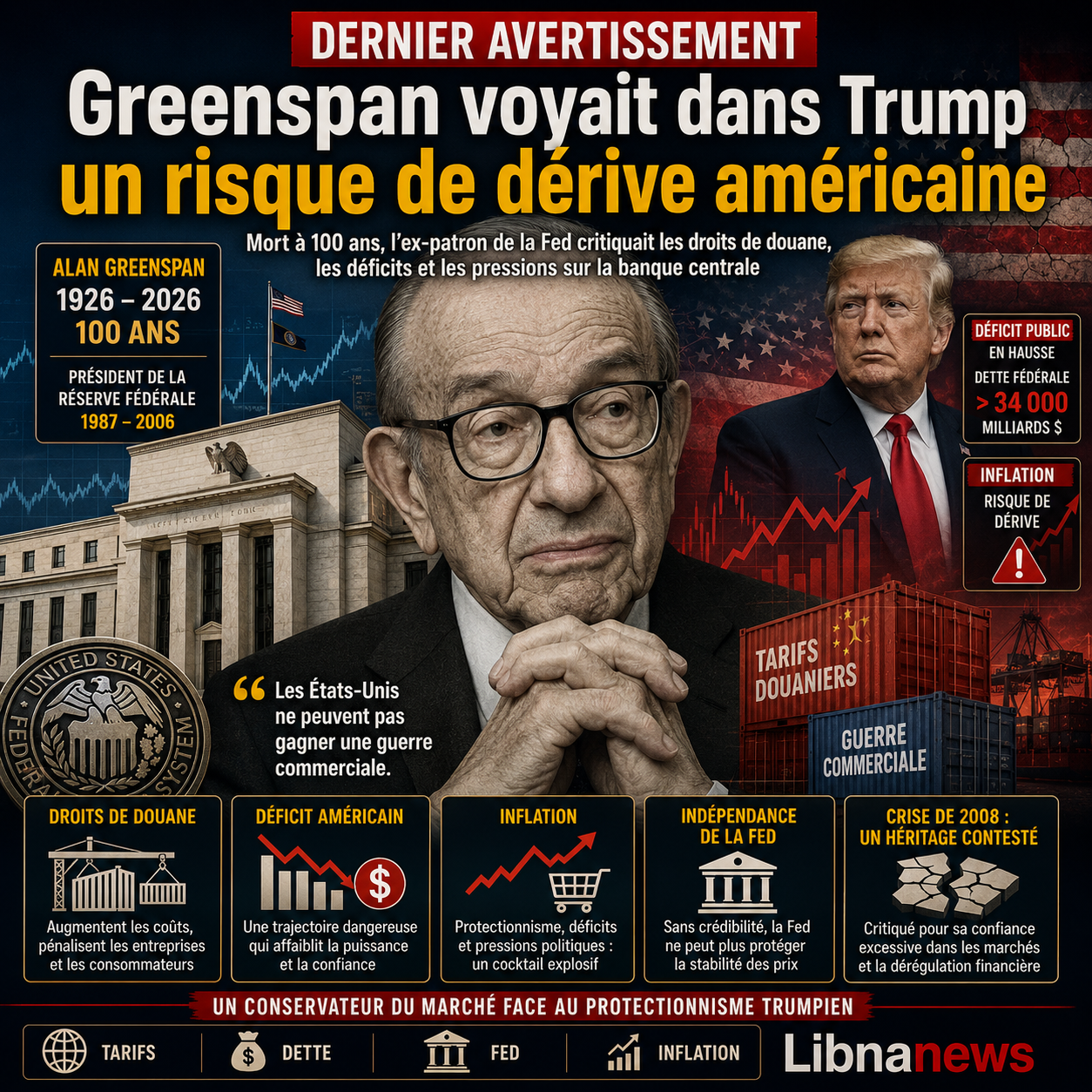
Alan Greenspan died at the age of 100, taking with him one of the most influential, but also the most controversial, figures in American monetary history. Former President of the Federal Reserve, serving from 1987 to 2006, he had passed the mandates of Ronald Reagan, George H. W. Bush, Bill Clinton and George W. Bush. For nearly twenty years he had embodied a certain American economic orthodoxy: independence of the central bank, fight against inflation, distrust of public deficits and deep faith in markets.
This route made his criticism of Donald Trump all the more significant. Greenspan was not a natural opponent of the American right. He came from the Conservative camp, had been close to Republican circles and remained associated with a liberal vision of the economy. But precisely for this reason, his warnings against economic trempism bore particular weight. He did not denounce Trump in the name of a progressive line. He criticized him for budgetary discipline, free trade and monetary independence.
Tariffs, an attack on the economy
The clearest break between Greenspan and Trump concerned tariffs. Donald Trump has made protectionism one of the pillars of his economic policy, particularly in China. He said he wanted to defend US workers, reduce the trade deficit and force US partners to renegotiate world trade rules.
On the contrary, Greenspan saw it as a major mistake. For him, tariffs did not protect the U.S. economy sustainably. They were upsetting her. They increased costs for businesses, weighed on consumers and risked a spiral of retaliation. When he explained that the United States was on the brink of a trade war, he was not just talking about a conflict with Beijing. He described a weakening of the international framework that had accompanied decades of American growth.
The former Fed boss considered protectionism to be based on a misconception that the United States would simply be « stealed » by its trading partners. This reading, very much present in Trump’s speech, reduced world trade to a bilateral balance of power. Greenspan reasoned differently. He saw trade as a system of interdependence, where supply chains, prices, competitiveness and productivity rely more than trade deficit slogans.
Its opposition to tariffs was therefore not only technical. It aimed at the heart of Trump’s doctrine: the idea that a powerful state can reindustrialize its economy by imposing barriers and forcing its partners to give in. For Greenspan, this strategy could have the opposite effect: less efficiency, more inflation, more uncertainty and a less open US economy.
The deficit, the central weakness of Trompian America
Greenspan also expressed concern about the US budget deficit. Again, criticism touched on a sensitive point. Donald Trump led a policy of massive tax cuts, while promising strong enough growth to compensate for the loss of revenue. This logic, classic in part of the American right since the Reagan years, has been pushed far under Trump.
Greenspan didn’t believe it. He had already, long before Trump, alerted about the US fiscal trajectory. For him, the accumulation of deficits was not only an accounting problem. It was a macroeconomic threat. A State that spends more on a sustainable basis than it collects is ultimately dependent on debt, reducing its room for manoeuvre and exposing its economy to higher rates or loss of confidence.
This criticism was all the more interesting because Greenspan had himself been criticized for his role in the tax debates under George W. Bush. But in the Trump years, his message was clear: America could not multiply promises of tax cuts, military spending, industrial protectionism and automatic growth without paying the price of these contradictions.
For Greenspan, the danger came from the mixture of fiscal populism and power illusion. Trump promised less taxes, more protection, more spending and less restraint. Greenspan recalled a simple rule: in the long run, accounts always come back into the debate.
Inflation: Trump’s Underestimating Risk
Greenspan’s other concern was inflation. Former Fed president, he knew that price stability was not decreed. It is based on the credibility of the institutions, control of expectations and a coherent economic policy.
However, in his view, several elements of Trumpian politics were in the opposite direction. Customs duties would increase imports. Deficits fueled demand and debt. Attacks on the Fed weakened monetary independence. To this added a political will to maintain low rates, even when the central bank considered it necessary to tighten its policy.
Greenspan saw this as a dangerous combination: political pressure on the currency, inflationary protectionism and a degraded fiscal trajectory. This combination could undermine what he saw as one of the great achievements of the post-Volcker period: the Fed’s anti-inflationary credibility.
It was also for this reason that he defended the independence of the central bank until the end. In his view, a Fed subject to the electoral calendar or presidential mood would lose its ability to act against inflation. A central bank that loses its credibility must then pay much more to find it.
A critique from within economic conservatism
What distinguishes Greenspan from Trump’s other critics is that he didn’t talk from outside the system. He did not denounce American capitalism. He was one of the great architects. He believed in markets, free trade, monetary discipline, fiscal moderation and the ability of innovation to bring growth.
It was precisely this vision that led to wary of trumpism. In customs duties, he saw a break with the trade opening. In deficits, a break with budgetary prudence. In the pressure on the Fed, a break with institutional independence. In Trump’s economic discourse, he saw less a coherent strategy than a policy of a permanent balance of power.
Greenspan was not naive about globalization. He knew that international trade was losing. But he felt that the answer should be training, compensation, labour market adjustment and productivity, not a generalized tariff war. Its logic remained that of a market economist: correcting the social effects of openness, without destroying the economic framework that makes it possible.
A figure itself contested
Greenspan’s death, however, cannot lead to economic canonization. His legacy remains deeply disputed. Long nicknamed « the Maestro » for his supposed ability to drive the US economy, he was then severely criticized after the 2008 financial crisis. His critics accuse him of having too much faith in self-regulation of markets, of having encouraged financial deregulation and of keeping rates too low in the early 2000s, thus fuelling the real estate bubble.
Greenspan himself had acknowledged, after the crisis, that he had discovered a flaw in his vision of the functioning of markets. This admission remains one of the most important moments of his intellectual career. She cracked the image of an economist convinced that financial markets always knew how to discipline themselves.
This shadow part counts. She even makes her criticism of Trump more interesting. Greenspan was not an infallible prophet. He himself had contributed to certain frailties of American capitalism. But he knew from within the dangers of an economy too dependent on debt, bubbles, market confidence and monetary credibility.
Last warning
In essence, Greenspan’s criticism of Trump can be summed up in one idea: the American economy cannot be governed as a real estate negotiation. Tariffs are not just weapons of pressure. Deficits are not just figures that are delayed. Money is not an instrument of political communication. And the central bank is not a service under the White House.
This reading contrasts two visions of American power. Trump sees the economy as a battlefield where the state imposes, taxes, threatens and renegotiates. Greenspan saw it as a fragile system of anticipation, price, trust, capital and institutions. One favours political shock. The other is credibility.
Greenspan’s disappearance came at a time when his old warnings resonated strongly. The United States continues to face high public debt, sustained protectionist temptation, recurrent trade tensions and political pressure on the central bank. Even contested, even weakened by its own record after 2008, Greenspan leaves behind it a clear warning: a great power can lose its stability not only by the crisis, but also by the gradual abandonment of its economic rules.