





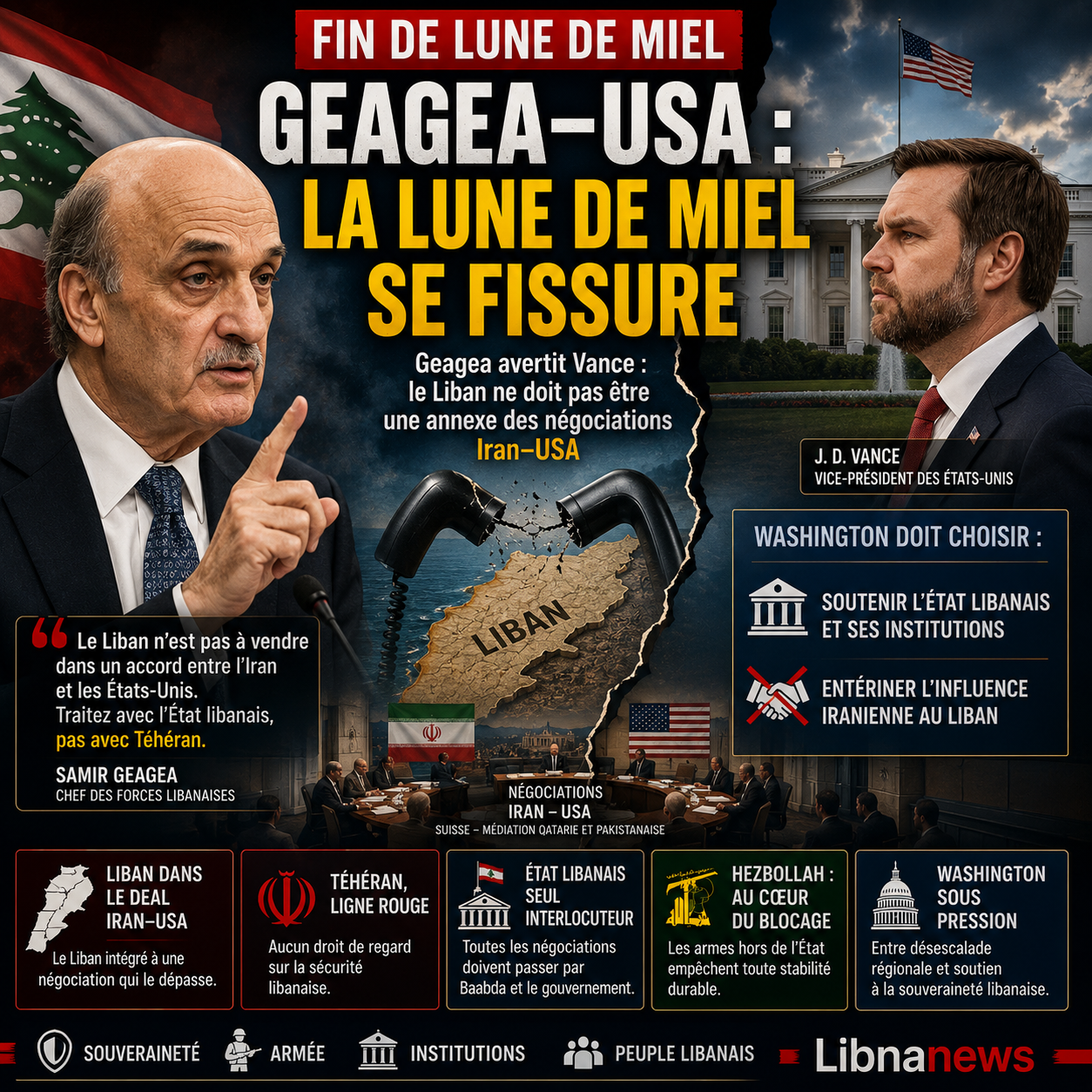
Samir Geagea sent a direct message on Monday to US Vice-President J.D. Vance: Lebanon should not be treated as an annex to the negotiations between Iran and the United States. The leader of the Lebanese Forces believes that Washington’s best support for the country is to strengthen legitimate institutions, limit all negotiations to the Lebanese State alone and permanently exclude Tehran from the Lebanese file. His position was taken after the announcement of a de-conflict cell linked to the ceasefire in Lebanon, resulting from Iran-US discussions in Switzerland with Qatari and Pakistani mediation.
This criticism is aimed at less diplomatic detail than a strategic shift. For Geagea, accepting Lebanon’s discussion in an Iran-USA agreement is tantamount to granting Tehran a right of control over Lebanese security. This is precisely what he has been fighting for years: a divided sovereignty, an armed Hezbollah over the state and a decision of war or peace that escapes institutions. His arrest at Vance thus seeks to place Washington in front of a clear alternative: to help the Lebanese state to become the only authority again, or to effectively endorse Iranian influence under cover of de-escalation.
A political warning to Vance
The Geagea Declaration comes at a time when Vance presents the discussions with Iran as a solid basis for a broader regional agreement. The Swiss talks planned a 60-day road map, technical groups and a cell to prevent friction in Lebanon. This architecture aims to prevent the South Lebanese front from failing the process between Washington and Tehran. It also gives a new place to the Lebanese issue in a compromise where Iranian nuclear power, oil, sanctions and the Strait of Ormuz are already central.
For the leader of the Lebanese Forces, this diagram contains an immediate danger. It places Lebanon’s stability in the hands of actors with their own priorities. The United States is seeking to reduce regional risk. Iran wants to preserve its influence and gain economic benefits. Israel wants to maintain security assurances. Hezbollah wants to avoid a unilateral concession. The Lebanese State, for its part, risks becoming a secondary participant in a negotiation which nevertheless concerns its territory, its citizens and its institutions.
Geagea does not reject the idea of a ceasefire or a follow-up mechanism. He challenged the framework within which that mechanism appeared. A de-conflict cell can be useful if it serves the Lebanese State, the army and UNIFIL. It becomes problematic if it transforms Iran into an indispensable interlocutor on the security of South Lebanon. The whole shade is there. De-escalation can save lives. But it can also devote an unfavourable balance of power if it suggests that Hezbollah’s weapons are an arrangement between Washington and Tehran rather than a Lebanese decision.
Refusal of a Lebanon negotiated by proxy
The formula advocated by Geagea is based on a simple principle: all negotiations must go through the Lebanese State. This principle is not only legal. He’s political. Since the end of the civil war, the issue of weapons outside the State has remained at the centre of the national crisis. Hezbollah justifies its arsenal by resistance to Israel and by defending the territory. Its opponents see it as a parallel military structure, capable of imposing a regional orientation on the country. Between these two readings, the Lebanese State has often sought balance, at the cost of an ambiguity that has become untenable.
By calling on Vance to separate Lebanon from Iran, Geagea refuses a proxy logic. He fears that the ceasefire will be negotiated with those who influence Hezbollah, without Beirut obtaining the necessary guarantees to regain control of the ground. He wants Washington to treat the Lebanese government as the sole holder of national legitimacy. This request corresponds to the traditional line of the Lebanese Forces, but it has become new in scope since Lebanon appeared in the press releases related to the Iran-USA talks.
The risk for Geagea is that a double circuit will form. The first would be official, between Washington, Baabda, the Grand Serail, the army and international partners. The second would be regional, between Washington, Tehran, Doha, Islamabad and Hezbollah relays. In this scheme, the Lebanese State would be consulted, but not really master of the timetable. Major decisions would be taken elsewhere. It is this situation that the Lebanese Forces leader attempts to prevent by addressing Vance directly.
A cell that crystallizes all concerns
The deconfliction cell is at the centre of the controversy. On paper, it must ensure compliance with the cessation of military operations in Lebanon. It can receive alerts, verify incidents, send messages and prevent fire or strikes from causing a resumption of war. In an area as flammable as South Lebanon, such a tool can be of real use. It can reduce misunderstandings, speed up contacts and give mediators a means of rapid pressure.
But its composition is not a detail. If Iran plays an explicit, even indirect, role, Hizbullah’s opponents will see it as a recognition of its regional sponsor. If Israel is not publicly mentioned, the mechanism may seem incomplete. If the Lebanese army is not the pivot, Beirut risks losing the essential: the ability to transform de-escalation into a return from the state. Geagea therefore insists on an institutional requirement. The cell must not become a space where Lebanon is managed with Iran. It should be used to strengthen the Lebanese authorities.
This concern feeds on recent events. Israeli strikes and clashes with Hezbollah threatened to derail the regional process before a pause observed since Saturday night, according to media reports. Iran, for its part, has linked Lebanon’s stability to the security of the Strait of Ormuz, which shows the magnitude of the interdependence created by the crisis. Geagea reads this sequence as a warning: the more Lebanon remains associated with Iranian calculations, the more vulnerable it becomes to crises that are being played elsewhere.
Hezbollah, central point of the Geagea line
Geagea’s last sentence summarizes his doctrine. According to him, the greatest contribution that the United States can make to the Christians of Lebanon, and to all Lebanese, is to help the State extend its authority throughout the territory and disarm Hezbollah. The mention of Christians is not annoyed. She speaks to a community that often feels exposed to the collapse of the state, demographic pressure, emigration and militarization of political life. But Geagea immediately expanded his speech to all Lebanese, in order to avoid a strictly Community reading.
In his vision, the Christian question is not separated from the question of the state. The Lebanese Forces believe that community security can no longer be based on militia balances, foreign protections or compromises with parallel weapons. On the contrary, it would depend on institutions able to control borders, enforce the law and decide war alone. This line opposes the Hezbollah line, which continues to portray its arsenal as a guarantee against Israel and as a component of national deterrence.
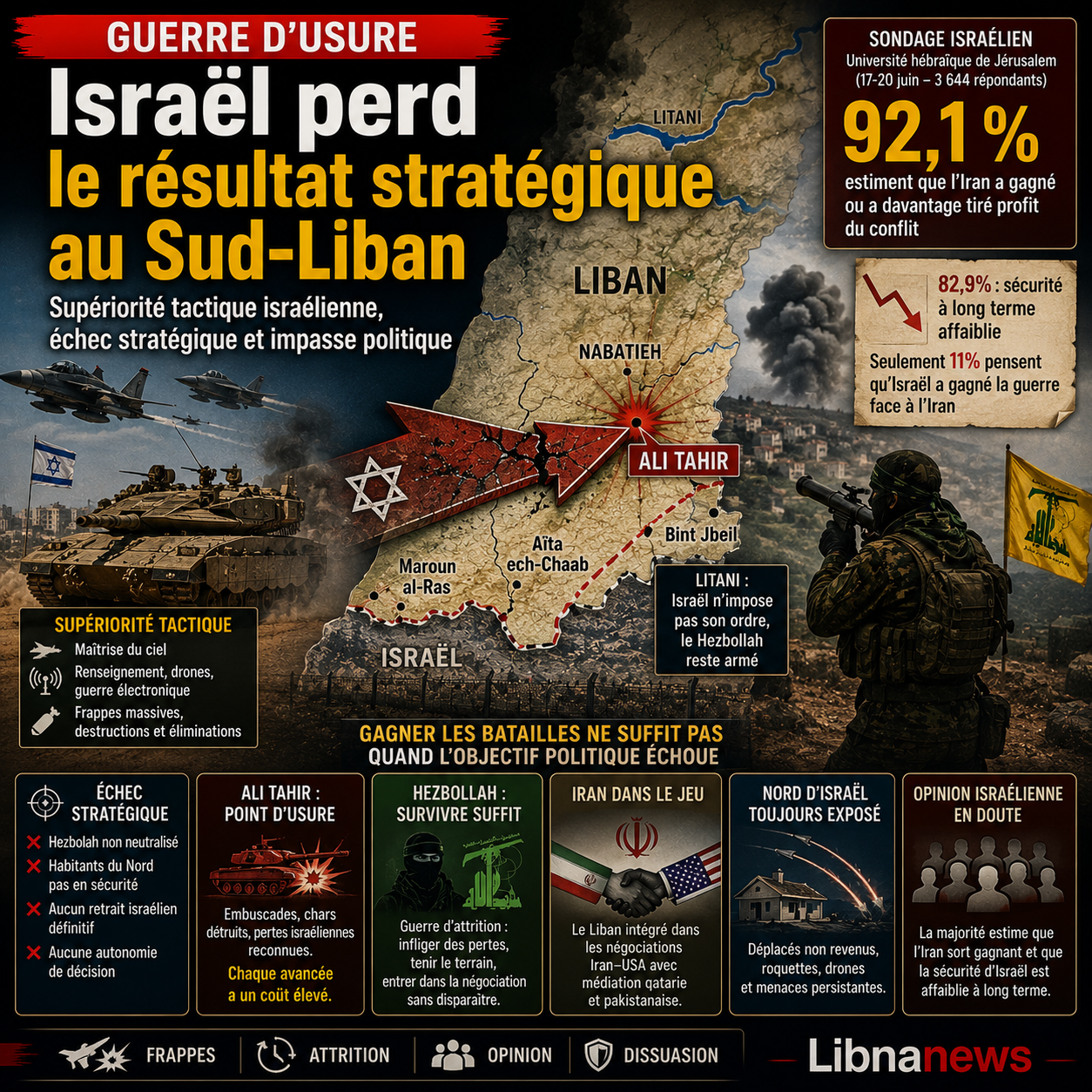
The debate is not only ideological. He’s playing in South Lebanon. If Hezbollah retains military capabilities south of the Litani River, Israel claims to maintain justification for its operations. If Israel maintains positions or strikes, Hezbollah claims to maintain justification for its weapons. The Lebanese State is caught in this circle. Geagea wants to break it by a clear decision: arms must go back to legitimate institutions. But this decision requires a political and military environment that Lebanon does not yet fully possess.
Washington between realpolitik and institutional support
The call to Vance also puts the United States in the face of their contradictions. Washington has been repeating for years that it supports the Lebanese army, Lebanon’s sovereignty and the state monopoly on weapons. But managing the regional crisis pushes the US administration to talk with Iran, because Tehran influences Hezbollah and can weigh on the entire front. This logic of realpolitik can produce a temporary calm. It can also weaken the American discourse on the authority of Lebanese institutions.
Geagea therefore asks Vance to choose a hierarchy. If the American goal is only to avoid escalation, Iran becomes a useful interlocutor. If the objective is to build a stable Lebanon, the Lebanese State must become the only entry point again. Both approaches may coexist for a few days, but they diverge as soon as it is necessary to decide who monitors the truce, who controls arms, who represents the people of the South and who negotiates the Israeli withdrawal.
This contradiction explains the strength of criticism. The United States can hardly promise to help Lebanon restore its authority while treating the Lebanese case as a variable in discussions with Iran. They can use Tehran to obtain Hezbollah’s silence, but they cannot present this method as a consolidation of Lebanese sovereignty. Geagea seeks to make this inconsistency appear before it becomes a fait accompli.
Baabda, the Great Seral and Army in front of the same test
Geagea’s position also concerns the Lebanese authorities. President Joseph Aoun and Prime Minister Nawaf Salam must avoid the de-confliction cell becoming a parallel device. They can accept an international mechanism if it strengthens the army, UNIFIL and institutions. They must refuse or correct it if it reduces Beirut to an observer role. The challenge is all the greater as Lebanon needs Washington to weigh Israel and a regional channel to contain Hezbollah.
The Lebanese army is at the centre of this equation. It must be the main actor of any return from the state to the south. It must document violations, monitor the axes, support municipalities, work with UNIFIL and prepare for the return of internally displaced persons. Without it, the ceasefire will remain a promise between powers. With it, the truce can become a process of sovereignty. Geagea knows that. His appeal to Vance also amounts to asking for concrete means for the army, not just declarations of respect for the state.
The government will nevertheless have to manage the risk of internal confrontation. The disarmament of Hezbollah cannot be decreed as an ordinary administrative measure. It affects security, religious balance, the relationship with Iran and the memory of past wars. That is why the Lebanese authorities must link each stage to visible guarantees: Israeli withdrawal, cessation of strikes, official military deployment, financial support and reconstruction. A purely declarative strategy will not suffice.
Can we really separate Lebanon from Iran?
Geagea’s request is clear. Its implementation will be difficult. Iran is not an ordinary outside actor on the Lebanese file. It has an ancient relationship with Hezbollah, a real political influence and a strategic interest in using the Lebanese front in its relationship with Israel and the United States. To say that Lebanon must be separated from Iran is therefore a requirement of sovereignty. This is not yet a diplomatic reality.
For this separation to become possible, Lebanon must create its own levers. It must strengthen the army, secure the South, limit armed circuits, restore its institutions and obtain Arab and international coverage. He must also speak to Iran through official channels, not to give it the right of veto, but to signify the limits of the Lebanese State. Cessation of contact with Tehran can satisfy a political reflex. It can also leave the field at the parallel channels of Hezbollah and its allies.
Lebanese Forces face their own diplomatic record
The position of the Lebanese Forces leader raises an internal political issue. The FLs got real weight in the Salam government. They supported a firm line against Iranian influence. They saw one of their own, or at least one minister chosen by them, leading Lebanese diplomacy. Yet, when the decisive moment came, the Lebanese issue moved to the Iran-USA talks. This contradiction feeds the idea of a disavowal.
The disavowal is not personal. He’s strategic. It shows that a ministry is not enough to pilot a case if the state does not control the ground, if Hezbollah keeps its channels, if Israel imposes its operations and if Washington chooses the regional route. The Lebanese Forces won a battle of speech. They have not yet won the instrument battle. Their position is clear, but their ability to transform this position into concrete guarantees remains limited.
This may be severe, but it is useful. He forces Geagea to clarify what he really asks Americans. Is it just a matter of saying that Iran must be ruled out? Or is it a matter of empowering the Lebanese State to make this exclusion possible? The difference is great. In the first case, we remain in the political register. The second calls for funding, withdrawal guarantees, an increase in the military, a specific role for UNIFIL and a reconstruction strategy.