

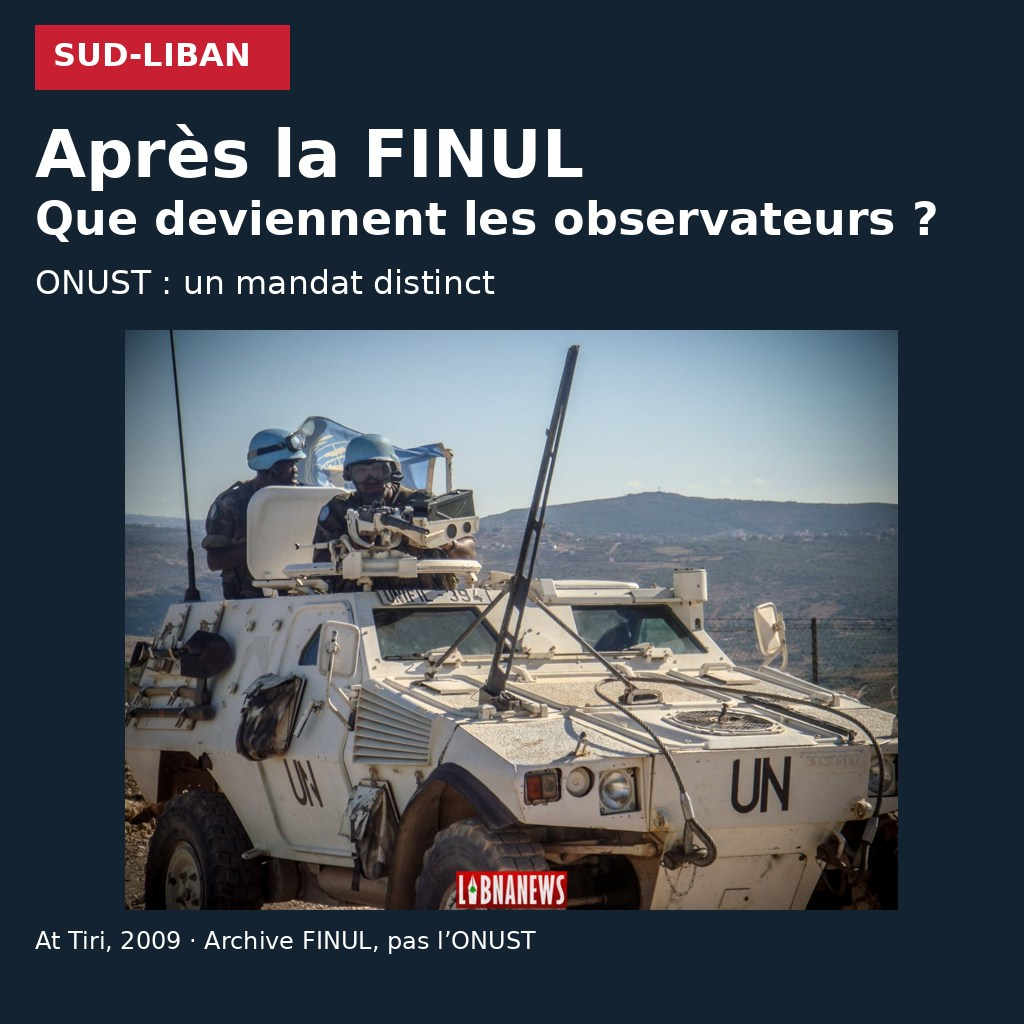
UNIFIL is scheduled to cease operations on 31 December 2026. But not all UN observers in southern Lebanon are covered by this force. An unarmed group belongs to UNTSO, an older and separate mission. The UN budget documents shed light on a concrete question of transition: how can we continue its work without the support that UNIFIL provides today?
Following the 19 November consultations on resolution 1701, the Latvian presidency of the Security Council reaffirmed its support for UNIFIL. It called on the parties to protect United Nations personnel and to respect the freedom of movement of the mission. This statement to the press does not decide on an extension or a succession mission. However, it comes at a time when the United Nations must prepare for the departure of the force and organize the continuity of other activities.
Observers who were there before UNIFIL
The United Nations Truce Supervision Organization (UNTSO) dates back to 1948. The Observer Group in Lebanon, one of its components, has been present in Lebanon since 1949. UNIFIL was established in 1978. Observers therefore report to a mission whose existence does not derive from the mandate of the interim force.
On its operational page, UNIFIL indicates that the group is assisting in the South. UNTSO also explains that its observers meet with local officials and community representatives. This work is part of observation and liaison. It does not give them all the responsibilities that the Security Council has entrusted to UNIFIL.
The word « observer » may be confusing. The group already present belongs to UNTSO. The observer teams referred to in the three scenarios sent to the Council in June are hypothetical for the future. They do not constitute an announcement of reinforcement for the existing group or the transfer to it of the mandate that ends.
A separate mandate, shared services
The separation of mandates does not mean that both organizations operate without any material link. UNIFIL budget documentation for 2026-2027 describes the support it provides to the Observer Group in Lebanon. In particular, it cites communication services. This is a concrete example of the day-to-day support provided to a team that is part of another mission.
In his letter to the Security Council of 1 June, the Secretary-General requested that the necessary protection and logistics of the unit be taken into account after the closure of UNIFIL. According to this document, any future organization will have to make other arrangements to perform these functions or find equivalent. This passage is distinct from the proposals on the size and mandate of a possible new international presence.
The United Nations Advisory Committee on Administrative and Budgetary Questions recalls this point in its report on the budget for 2027. He said that UNTSO continued to exercise its mandate in Lebanon, but that the departure of UNIFIL should change the working conditions of its observers in the South. The Committee referred in particular to the adaptation of existing resources and infrastructure. It does not present a replacement device already stopped.
What observers can preserve, and what they do not replace
The Security Council and the Secretariat therefore have two questions. The first is to maintain the necessary resources for a group that already exists. The second is to decide, as appropriate, on the functions to be entrusted to another international presence to support the implementation of resolution 1701. Replying to the first does not, in itself, provide a response to the second.
This difference counts for the people of the South. Maintaining an international interlocutor is not enough to maintain all the services associated with UNIFIL. Liaison, humanitarian support and the protection of civilians do not involve the same means or authorizations. During the withdrawal, resolution 2790 leaves UNIFIL with certain functions, within its capabilities; it does not automatically transfer them to UNTSO.
As of 20 November, public documents thus distinguish between a continuity of mandate and a transition that remains to be organized. The observer group is neither a new mission nor a smaller UNIFIL. Future decisions will have to show how he will continue to work and what other functions will or will not benefit from a separate mandate.
Photo: UNIFIL contingent in At Tiri, 14 July 2009, Libnanews archive. It does not represent UNTSO observers. © Libnanews.com.





Comments