

An agreement that stops the war without ending the conflict
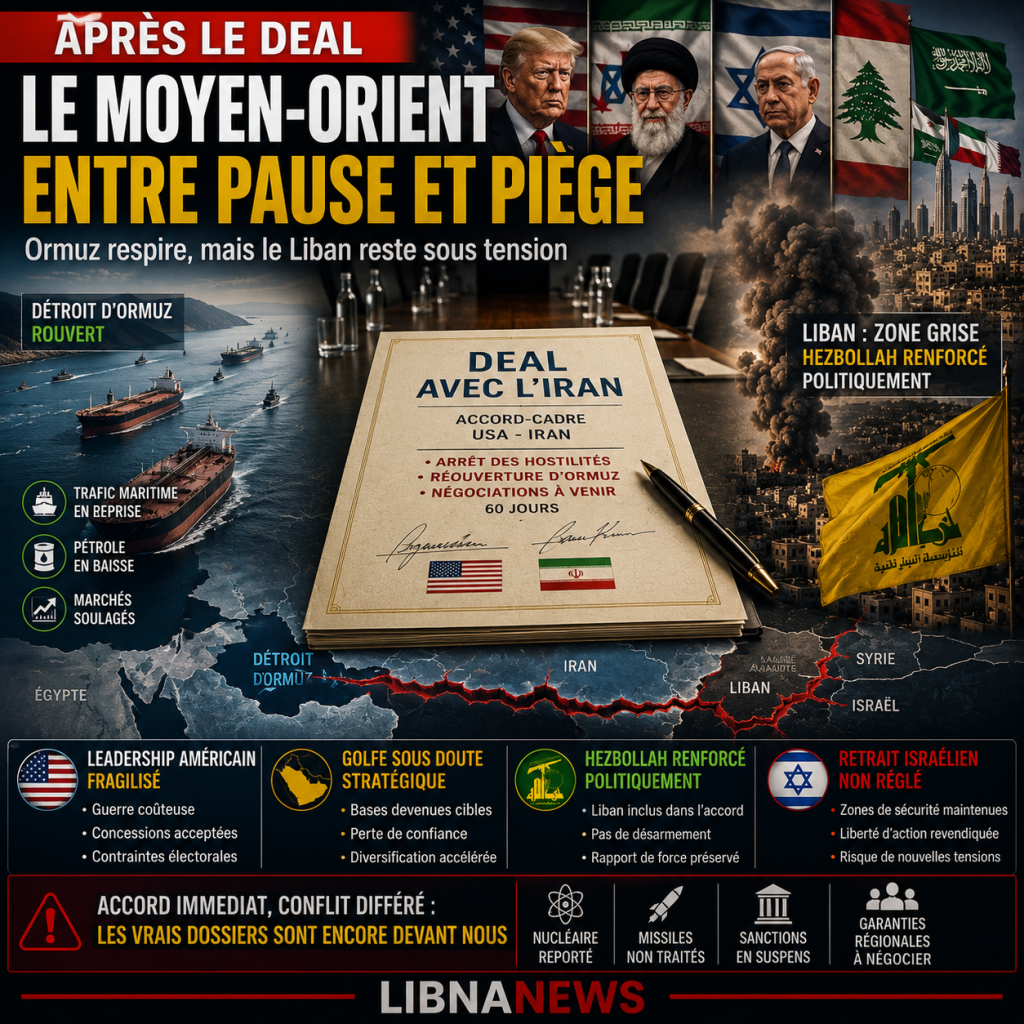
The framework agreement between the United States and Iran opens a post-war sequence that is more unstable than calmed. The deal with Iran, announced on the night of 14-15 June and expected for signature on 19 June in Switzerland, does not resolve the main issues that justified the escalation. It suspends the war, reopens the Ormuz Seaway and returns nuclear, sanctions and regional guarantees to further negotiation. It is an emergency stop more than a comprehensive settlement. However, it is already changing regional balance. Washington has agreed to a formula that leaves a number of disputes pending. Tehran can see this as a validation of its pressure capacity. Israel sees this as a strategic risk. Lebanon, for its part, finds itself in a grey area that can strengthen Hezbollah politically, while weakening the state in its attempt to resume the decision of war and peace.
The first impact is the image of American power. The United States does not emerge from this sequence in a clear force position. They waged war with Israel, struck Iran, imposed a naval blockade, and then agreed to a compromise that postponed key issues. Iranian nuclear power is not dismantled at this stage. The ballistic programme is not dealt with in the immediate agreement. The Tehran regional networks are not neutralized. The question of sanctions remains open. In exchange, Washington obtained the cessation of hostilities, the reopening of Ormuz and a 60-day diplomatic window. This hierarchy reflects a constraint. The US priority is no longer to impose a maximum settlement. It is to stop a war that weighs on markets, alliances and US domestic policy.
The American umbrella in the Gulf challenged
The Gulf is the first space to measure this displacement. For decades, the Gulf monarchies have been living on a double principle: the US military presence must deter Iran, and global energy integration must protect strategic infrastructure. The war has damaged these two convictions. American bases have become targets. Ports, terminals, pipelines, refineries and gas plants were exposed. Shipping has been disrupted. Insurance, charterers and shipowners have integrated a war risk into an area that is supposed to function as the stable core of global energy trade. The signature of June 19 can reduce immediate tension. She doesn’t fix the loss of trust.
This doubt about the American umbrella does not mean that Riyadh, Abu Dhabi, Doha, Kuwait or Manama will break with Washington. They don’t have a simple alternative. Defence systems, intelligence, armaments and diplomatic depth remain largely linked to the United States. But these capitals are emerging from the war with a more precise question: what is the purpose of a massive American presence if it turns the Gulf territory into a target without guaranteeing a favourable outcome? This question can speed up diversification already under way. Gulf countries will seek more channels with China, India, Russia and Europe. They will also strengthen their own missile defences and naval capabilities. The connection with Washington will survive, but it will be less automatic.
The other consequence concerns the use of Ormuz as a lever. The strait does not just become a sea crossing. It becomes proof that a state under pressure can weigh on the world economy without winning militarily. Iran does not need to completely control the sea to create a shock. It is enough to make the passage uncertain, to threaten the ships, to devote the mines or to push the companies to wait. The return of first traffic is not enough to normalize the area. Operators want guarantees, safe corridors, inspections and a sustainable reduction of risk. Until these conditions are visible, Ormuz will remain a barometer of the solidity of the deal with Iran.
Washington facing the internal cost of war
For the United States, domestic calculations have become central. Donald Trump can present the deal as a victory because he promises the end of hostilities and the fall of oil. He can say that he has imposed a nuclear negotiation on Iran. It can also highlight the reopening of Ormuz. But its opponents can answer that the war has cost dear, that it has not settled the nuclear and that it has forced Washington to accept concessions. The debate will therefore move from the military field to the political field. The American president will have to convince his electorate that the exit from war is not a step backwards. The toughest Republicans on Iran will demand written guarantees. The Democrats will stress the economic and human cost of escalation.
The US electoral constraint explains part of the urgency. A distant war can be sustained a few days if it seems controlled. It becomes dangerous when it raises the price of gasoline, feeds inflation, mobilizes troops, exposes bases and opens the prospect of a land conflict. In the run-up to the mid-term elections, Trump cannot offer a long war whose objective becomes blurred. His immediate political interest is to close the crisis, calm energy and regain control of the internal agenda. This logic makes the relationship with Israel more tense. Washington no longer wants Benjamin Netanyahu’s military calendar.
Israel and the United States, two agendas that diverge
The fracture with Israel should not be exaggerated. The strategic alliance remains deep. US military support remains massive. Both countries still share the same hostility to Iran’s nuclear programme. But the deal with Iran shows a divergence of priorities. Netanyahu wants to keep the pressure until he permanently weakens Tehran and its allies. Trump wants to stop the political hemorrhage. Israel is reasoning in terms of national security and government survival. The United States is now thinking of electoral, energy and diplomatic costs. This shift explains the American anger after the Israeli strike on Beirut. He also explains why Washington signed despite Israeli reservations.
Public opinion accentuates this divergence. In Israel, a significant part of society supports the continuation of the war, especially if it is presented as an opportunity to weaken Iran, Hezbollah and other Tehran regional allies. Netanyahu enters a period when he must show that he has not lost the initiative. In the United States, the dynamics are inverse. The perceptions of Israel and Netanyahu have deteriorated. The war with Iran has become unpopular. The price of fuel, inflation and strategic fatigue weigh on the debate. This national opposition produces lasting tension: the Israeli leader gains in prolonging the test of force, while the American president gains in stopping it.
Israel therefore faces a new risk: to put itself behind a part of the American political apparatus by forcing decisions that Washington no longer wants to assume. This is the meaning of the Beirut sequence. The Israeli strike was presented as a response to an attack by Hezbollah. But its timing gave the impression that Israel was trying to test, or even frame, the American margin of manoeuvre. Trump received this signal very badly. For him, the attack threatened an agreement that had to save a political exit. For Netanyahu, she recalled that Israel would not accept losing its freedom of action in Lebanon. The difference is not tactical. It affects the control of war.
The post-war period will therefore be marked by a more transactional American-Israeli relationship. The United States will continue to help Israel, but will demand more strategic discipline. They will demand that Israeli operations do not sabotage the diplomatic phases opened with Tehran. Israel, for its part, will seek to preserve freedom of action, particularly in Lebanon, Syria and Gaza. This arm doesn’t necessarily produce a public break. It can take the form of messages, restrictions, delays in some deliveries, harder votes in Congress or pressure on operations. The 19 June agreement will also be a hierarchy test between allies.
In Lebanon, Hezbollah resumes political space
Lebanon has the most immediate impact. Tehran claims that the cessation of operations concerns all fronts, including Lebanon. This reading reinforces Hezbollah. The movement can say that its front has not been isolated, that Iran has not negotiated only for itself and that the regional ceasefire also protects Lebanese territory against Israeli freedom of action. Internally, this position weakens the camp that wanted to take advantage of the war to impose a rapid political and military retreat on Hezbollah. It also complicates the line of President Joseph Aoun and Prime Minister Nawaf Salam, who defended the restoration of state authority and the public monopoly of military decision-making.
This strengthening of Hezbollah does not mean that it is free from war. His positions were struck. Its civilian environment has been destroyed. Part of the Lebanese opinion blames him for exposing the country to a regional war. But Lebanon’s inclusion in the Iranian formula offers a strong political argument. Hezbollah can argue that he was not disarmed, that Israel did not obtain his freedom of action and that the regional power ratio forced Washington to take account of the Lebanese front. In a country where politics is often built on the perception of force, this argument will weigh.
The sovereignist camp and the opponents of Hezbollah find themselves in a more delicate position. They hoped that the war would permanently weaken the Shiite movement and allow the state to recover the initiative. They can still insist on the cost of destruction, the need for arms monopoly and sovereignty. But their margin now depends on the reality of the text. If the deal with Iran imposes a cessation of Israeli strikes without any visible compensation on the Hezbollah arsenal, their arguments will lose force. If, on the contrary, the sixty-day phase includes a Lebanese mechanism, an Israeli withdrawal and a discussion on the deployment of the army, they can resume the political offensive.
Joseph Aoun and Nawaf Salam will have to avoid two traps. The first would appear to be circumvented by regional negotiations between Washington, Tehran and the mediators. The second would be to transform the agreement into an internal defeat against Hezbollah. Their most likely line will be to demand a complete halt to Israeli strikes, respect for sovereignty, strengthening the army and implementation of international commitments. This position makes it possible not to align with Israel, while maintaining the demand for a return of the military decision to the State. It remains narrow. Hezbollah will hardly accept a discussion of its weapons if Israel maintains positions or operations in Lebanon.
Israeli withdrawal, 19 June central test
The Israeli position is the main blocking factor. The Israeli defence minister has already stated that the army will remain in safe areas in Lebanon, Syria and Gaza for an indefinite period. This statement is in direct contradiction with the Iranian reading of a permanent stoppage of operations on all fronts. She puts Washington in front of an arbitration. Either the United States tolerates this presence and weakens the agreement in Tehran’s eyes. Either they impose limits on Israel and take the risk of a political crisis with Netanyahu. In both cases, Lebanon becomes the space where the strength of the compromise will be verified.
The sixty-day phase will therefore be decisive. It should clarify what the cessation of hostilities meant. It will have to say whether targeted strikes are prohibited, whether drones can continue to fly over Lebanon, whether Israeli positions must be evacuated, whether the Finul and the Lebanese army have a strengthened role, and whether a verification mechanism exists. Without these details, each incident will revive the escalation. Israel will threaten. Hezbollah will respond to a violation. Iran will say that Washington does not control its ally. The United States will say it wants to save the deal. The cycle can resume very quickly.
A regional recomposition still uncertain
At the regional level, Iran exits the sequence with a confirmed nuisance capacity. He suffered strikes and losses. It has not yet obtained the general lifting of sanctions. He must negotiate under pressure. But he showed that he could open several fronts, disrupt Ormuz, touch American interests and force a negotiation that did not begin with his disarmament. This perception will count as much as the text. Iran’s allies will see evidence of resistance. His opponents will see it as a danger. The Gulf countries will see the need not to depend on a single US protection.
Europeans will seek to return to the game through three doors: nuclear, Ormuz and Lebanon. France, the United Kingdom, Germany and Italy have an interest in de-escalation, as their economies suffer from energy tensions. They also want to avoid a bilateral agreement that ignores nuclear and ballistic safeguards. Paris will insist on freedom of navigation and Lebanese sovereignty. But European influence will depend on its ability to propose means: maritime mission, mine clearance support, support to the Lebanese army, nuclear control expertise and reversible sanctions. The statements won’t be enough.
The world economy is already reacting as if the worst had been avoided. Oil declined after the announcement. Markets welcomed the prospect of a return of traffic to Ormuz. This relaxation can help Trump sell the deal. It can also help importing countries in Asia and Europe breathe after months of cost pressure. But economic actors remain cautious. A maritime route is not becoming safe again by communiqué. The companies are waiting to see if the ships pass, if the premiums drop, if the mines are pushed aside and if the naval forces avoid incidents. The post-economic war will be gradual.
The real impact of the deal with Iran will therefore depend on its application, not its announcement. June 19 in Switzerland will mark a legal and political stage, but not the end of the arm. Negotiators will have to fill the blanks: enriched uranium, sanctions, frozen assets, missiles, militias, Israeli withdrawal, Ormuz, European role, Gulf guarantees and Lebanon’s status. Each folder can block the others. Each capital will seek to present the agreement as a victory. The question is no longer just who gave in. It is about who will control the consequences of these concessions.
The most immediate risk is a fragmented peace. Ormuz could reopen, prices could drop and the United States could lift part of the blockade, while Lebanon would remain under threat of strikes and counter-attacks. Such a scenario would create a market-relevant de-escalation but insufficient for the region. It would strengthen those who claim that the great powers first protect energy flows, then only fragile states. For Beirut, the challenge will be to turn Lebanon’s mention in the agreement into concrete guarantees, before the next violation only redefines the rules of the game.




