

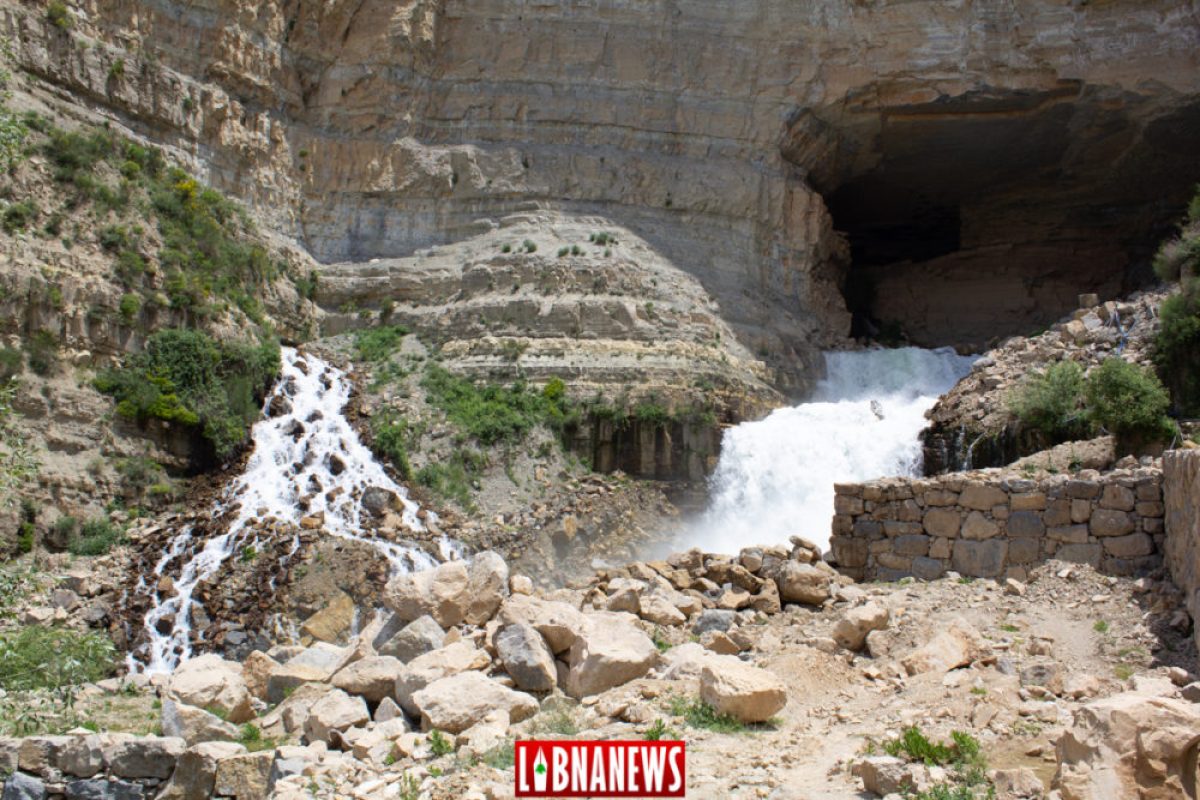
From the source of Afqa to the coast of Byblos, Nahr Ibrahim bears one of the great ancient legends of Lebanon: that of Adonis, a young god wounded by a boar, whose blood would have tinted the river in red. Behind the myth is a landscape, ancient rites, celebrations of mourning and rebirth, but also customs that still resonate in Lebanese homes.
There are places where the landscape seems to have preceded the legend. Afqa is one of them. In the Lebanese mountain above Byblos, the water comes out of the rock, descends in waterfalls, crosses the valley and eventually reaches the Mediterranean. Today, this stream is known as Nahr Ibrahim. In ancient times it was also called the Adonis River.
This name is not just a poetic memory. A whole religious and mythological memory was built around this valley. It linked the sacred source of Afqa, the heights of Mount Lebanon, the ancient shrines and the coast of Byblos, one of the oldest Phoenician cities. In this landscape, water was not only a natural element. She was becoming a sign. She recounted the death of a god, the mourning of a city and the periodic return of life.
The legend is famous: Adonis, a young figure of beauty and desire, loved by Aphrodite in the Greek world, but rooted in a near-eastern religious background, was mortally wounded by a boar. His blood would have sank into the river. It was said that since then, Nahr Ibrahim’s waters have been blushing every year, as if the Lebanese mountain itself recalls the god’s wound.
Afqa, the sacred source
Afqa is not a secondary decor added to the story. It’s one of his hearts. The site concentrates all the elements that nourish ancient myths: a cave, a powerful source, a waterfall, a cliff, ruins, an impression of passage between the underground world and the visible world.
Water comes out of the mountain like an open wound. It then descends towards the valley, traverses a landscape marked by rocks, vegetation, villages and ancient cultural traces, then reaches the sea near Byblos. The river thus forms a natural axis between the mountain and the coast, between the spring and the city, between the world of gods and that of men.
In ancient times, Afqa was associated with the cult of Aphrodite and Adonis. The Greek divinity covers here an older reality, linked to the Phoenician and Syrian-Palestinian cults of fertility, desire, vegetation and the seasonal return of life. Adonis himself bears a name of Semitic origin, close to the idea of the Lord. He is therefore not only a character of Greek mythology imported into Lebanon. It is also the result of an old oriental fund that the Greeks and Romans then took up, adapted and integrated into their own religious universe.
In Afqa, the myth becomes geographical. We’re not just talking about an injured god anymore. We see the source. We hear water. We understand why the elders were able to read in this place the theater of divine death.
The river that roars
The most striking detail of the legend remains that of the Red River. Each year, during certain periods, Nahr Ibrahim’s waters could become reddish or brownish. For the ancients, this color reminded the blood of Adonis.
Lucien de Samosate, inThe Syrian GoddessReport this tradition. He explains that the inhabitants of Byblos claimed that the story of Adonis and the boar had been produced in their country. When the river, descending from Mount Lebanon, was coloured in red, the inhabitants saw the sign of blood shed and the moment of ritual mourning.
But Lucien also reports a more rational explanation, already given in antiquity: this color would come from the red earth torn from the mountains by rains and winds, then driven into the river. In other words, the elders already knew that the phenomenon could have a natural cause. It did not destroy the myth. On the contrary, it made him stronger.
The river did not need to actually carry the blood of a god to become sacred. It was enough to change colour at the right time, in the right landscape, at the heart of an already constituted religious tradition. Nature provided the sign. The myth made sense to him.
Byblos, the city crying Adonis
Byblos was not a spectator of this story. She was celebrating. In ancient times, the city was one of the major centers of Adonis-related rites. It wasn’t just a legend told at the corner of a sanctuary. It was a ritualized memory, replayed, inscribed in the religious calendar.
The inhabitants mourned the death of Adonis. Lucien describes lamentations, gestures of mourning, blows to the chest, funeral rites. The death of the god was to be visible in the body of the faithful. Grief was not an abstract idea. It manifested itself in the screams, gestures, hair cut, physical marks of loss.
Then came the other moment of the rite: Adonis was proclaimed alive again. After mourning, rebirth. After the wound, the return. After the red river, hope for a start again.
It is this cycle that gives the myth its depth. Adonis is not only a young god who died too soon. He is a figure of nature that disappears and returns. It embodies fragile vegetation, brief beauty, life that grows quickly and then fades, before reborn with the season.
In Byblos, this story must have had a particular strength. The city looked towards the sea, traded with the Mediterranean, transmitted writing, but it remained linked to its sacred hinterland. The mountain gave water, the river gave the sign, the city gave the rite.
Adonias, mourning and returning rituals
These celebrations are known as Adonias. In the ancient world, the Adonias were dedicated to the death and symbolic return of Adonis. They associated mourning, lamentation, funeral gestures, and then the announcement of a rebirth.
In Byblos, these rites took on a very strong local dimension. The Adonis River was not just a decor. It was integrated into ritual time. When the water was blushing, the landscape itself seemed to announce the return of mourning. Nature participated in the ceremony.
The logic of the Adonias rests on a simple tension: Adonis dies, the community weeps him, and then declares her return. This is not a Christian resurrection. It is a cyclical, seasonal, plant return. The god belongs to this ancient world where the death of nature and its awakening were thought to be a sacred drama.
The strength of these rites is also due to their female dimension. In several Mediterranean traditions, women played an important role in Adonis lamentations. They cried to the young god like we were crying about a fiancé, a son, a lover or a lost beauty too soon. The mourning of Adonis was therefore also a mourning of the desire, youth and fragility of life.
The gardens of Adonis
Another essential element of Adonia is that of the Adonis Gardens. The seeds were rapidly germinated in small containers: wheat, barley, lentils or other fast growing plants. They greened in a short time, then faded just as fast.
The symbol is obvious. These shoots represented young, fast, fragile life. They were born, ascended, and died almost immediately. Like Adonis. Like vegetation exposed to drought. Like the beauty that doesn’t last.
These miniature gardens were therefore more than a ritual decoration. They materialized the destiny of the god. Watching them grow and then disappear, the faithful saw the cycle of life, death and possible return.
It is here that ancient memory joins gestures still familiar in Lebanon.
Still Living Customs
In many Lebanese homes, especially around the Holy Barbe and the Christmas cycle, wheat, lentils or other seeds continue to germinate on plates, on cotton or in small containers. These shoots decorate houses, accompany parties, announce life in the heart of winter.
Today, this custom is Christianized. It is attached to Sainte Barbe, celebrated on December 4, with its disguises, visits, songs and wheat dishes. But the gesture itself is very ancient in its symbolic language: to grow the grain, to watch life come out of a dry seed, to place germination in the center of a festive or ritual time.
You have to be careful. It cannot be said that there is a direct, intact and demonstrated continuity between the ancient Adonias of Byblos and the current Lebanese practices related to Sainte-Barbe or Christmas. Traditions change name, calendar and meaning. They are taken over, displaced, Christianized, folklorized.
But symbolic kinship is difficult to ignore. In both cases, there is grain. In both cases, germination occurs. In both cases, there is the idea that life can come back from what seemed dry, dead or asleep.
The gods change. Rites change. Sometimes gestures survive longer than doctrines.
A stronger memory than ruptures
Perhaps this is where the real adonisiac survival in Lebanon is. Not in a pagan ceremony preserved as it has been since Antiquity, but in a set of gestures, images and symbolic reflexes that continue to make sense.
To germinate wheat in a Lebanese house is obviously no longer to cry Adonis in Byblos. But it’s still the old language of the earth. That is to say, life can come back. It is still associated with season, home, seed and hope. It’s still giving vegetation a ritual function.
So Adonis’ myth did not completely disappear. It was dissolved in other traditions. He lost his ancient name, but he left traces. In the valley of Nahr Ibrahim, in the spring of Afqa, in the memory of Byblos, in the colour of the river after the rains, in the seeds that still grow in the houses.
A Lebanese myth turned Mediterranean
Adonis is often presented as a Greek figure. This presentation is too short. The Greeks have taken over, transformed and spread its history, but the myth has its roots in the Phoenician and Near Eastern world. Today’s Lebanon retains one of the most powerful sets of this memory.
Afqa, Byblos and Nahr Ibrahim are not tourist accessories added to an ancient fable. They form a true sacred geography. The source is here. The river is here. The city is here. The natural phenomenon of water roaring is there. Old rites are documented. Germination customs still exist in other forms.
That’s what makes this legend so strong. It is not suspended in an abstract mythological sky. It is attached to places that can still be covered. You can go up to Afqa, see the source, follow the valley, go down to Byblos and understand why this landscape could produce a dead and reborn god.
The river does not need blood to be sacred
It would be easy to smile at the idea of a river bluffed by the blood of Adonis. That would be missing the subject. The elders were not only naive. They observed nature and gave it meaning. The red of the river probably came from the land, from the rains, from the soil driven by the water. But this physical explanation does not cancel the power of the narrative.
On the contrary. It shows how a legend is born: a real phenomenon, an impressive landscape, a community that celebrates, a memory that is transmitted, a rite that gives shape to the fear of death and the desire for return.
In Afqa, Byblos and Nahr Ibrahim, Lebanon thus preserves one of its great ancient accounts. A wounded young god. A mourning goddess. A red river. A city crying. Seeds that grow and fade. Customs that change their name but keep a part of their meaning.
Perhaps the Adonis River never carried the blood of a god. But it has carried something else: the ability of a Lebanese landscape to become a Mediterranean legend, then to survive in the simplest gestures, those that are still repeated in houses, sometimes without knowing that they come from far away.
References used:Lucien de Samosate,The Syrian GoddessUNESCO, notice on Byblos; works and notices on Afqa/Aphaca and the Nahr Ibrahim Valley; classical studies on Adonia and Gardens of Adonis Lebanese traditions related to Sainte-Barbe and wheat germination.




