

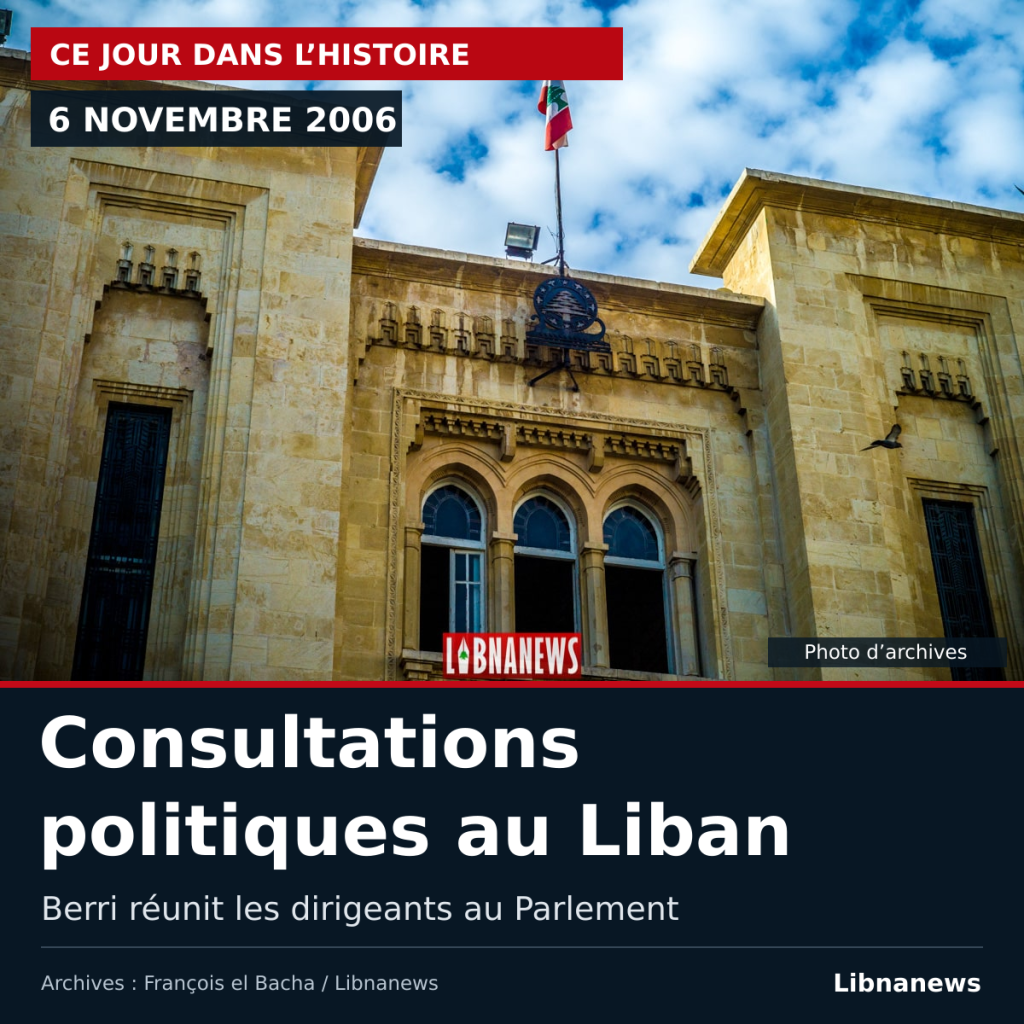
This day in the history of Lebanon.
On 6 November 2006, Nabih Berri opened political consultations in Beirut in an attempt to resolve the government crisis. Nearly three months after the war between Israel and Hezbollah, the leaders remain divided on power-sharing. Their first meeting resulted in a media truce, without agreement on the composition of Fouad Siniora’s cabinet.
Political consultations in Lebanon after the war
The President of the Chamber brings together representatives of the main political forces around an immediate objective: to avoid a further breakup. Hezbollah and its allies are calling for a government of national unity that would give them more seats. The parliamentary majority, dominated by the 14 March camp, refused to give up a blocking power within the executive.
The meeting on Monday 6 November allowed us to resume discussions. Participants agree to discontinue their reciprocal media campaigns. They plan to continue discussions the next day. This decision reduces verbal confrontation, but does not resolve any disagreement on portfolio allocation.
The meeting was held under strong military and police protection in central Beirut. Berri describes a positive atmosphere at its end. The gap between the desired calm and the expected government compromise remains considerable.
Sharing seats at the heart of the dispute
Since July 2005, Fouad Siniora has led a twenty-four-member cabinet. Hezbollah and the Amal movement already have representatives there. The Free Patriotic Movement of Michel Aoun, an ally of Hezbollah, does not participate. The request for enlargement therefore concerns several components of the opposition, whose situation in the government differs.
The majority is considering the entry of Aldermen. On the other hand, it opposes a new division that would allow the opposition to prevent essential decisions. The negotiations thus concern the concrete conditions for the functioning of the Council of Ministers, beyond the mere presence of each party.
For Hezbollah and its allies, a united government must strengthen their participation in national decisions. Siniora and her supporters defend the cabinet’s ability to govern. These positions become more difficult to reconcile after the summer war, which exacerbated tensions between the political camps.
What the blocking minority means
The battle of seats is explained by the constitutional rules of the Council of Ministers. Article 65 lays down a quorum of two thirds of its members. It provides for the search for consensus and then a vote when it cannot be obtained.
Ordinary decisions are then made by a majority of the present. The basic questions require the approval of two thirds of the members set out in the training decree. This category includes budget, war and peace, international agreements and electoral law.
Article 69 adds another rule: the government is considered to have resigned if it loses more than one third of its members. The threshold therefore exceeds the exact third. In a cabinet of twenty-four ministers, nine departures would pass this threshold, compared to eight for a third.
Sufficient representation may thus affect the votes, quorum or survival of the firm. It is this capacity which, in the November negotiations, covers the demand for a minority blockage.
A step taken before 6 November
These consultations do not mark the birth of the 2006 national dialogue. Nabih Berri had already gathered fourteen leaders on 2 March. The spring talks included relations with Syria, Palestinian weapons and the proposed court to try the assassination of Rafic Hariri.
Between the two sequences, the summer war disrupted the country’s priorities. The reconstruction and deployment of the Lebanese army and UNIFIL in the South is accompanied by strong political polarization. The question of State authority remains central. In November, it was directly reflected in a dispute over the composition of the executive.
The proposed international tribunal is also a major challenge for institutions. At this stage, discussions on its establishment continue. The November 6 session did not create this tribunal or a new government.
An opening followed by a rupture
The respite obtained at the first meeting did not lead to a lasting compromise. On 11 November, after the failure of the consultations, the five Shiite ministers announced their resignation. On 13 November, Environment Minister Yacoub Sarraf, close to President Emile Lahoud, left the cabinet.
These departures opened a new conflict over the legitimacy of the government. The opposition and Lahoud contest the continuation of its activity in the absence of Shiite representation. Siniora maintains the cabinet, supported by the parliamentary majority, and does not formally accept resignations.
On 6 November, this was the first day of an attempt to compromise, the immediate result of which was limited to media calm. A week later, the government continues to meet, while its opponents now challenge its constitutional legitimacy.





Comments