

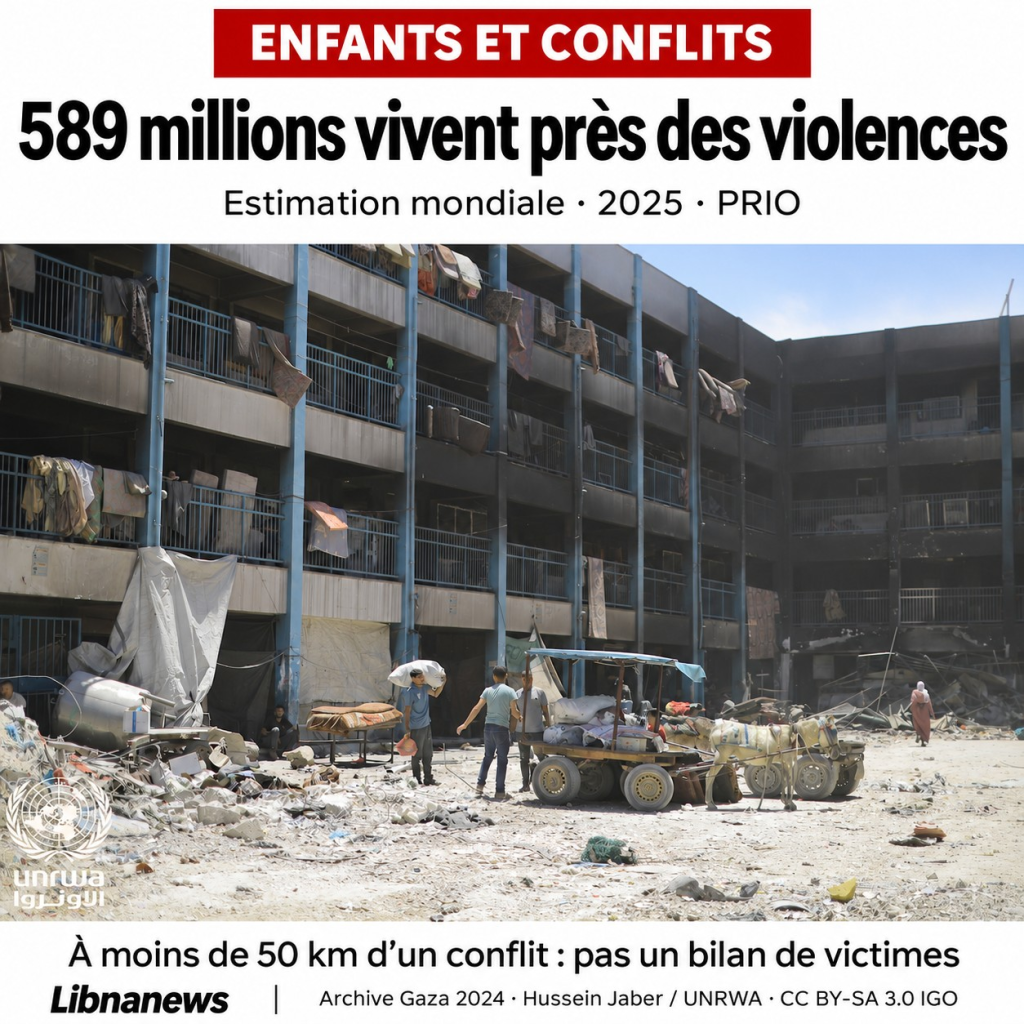
Nearly one in four children lived near an armed conflict in 2025. Save the Children released a new analysis on 19 November, which estimates this population at 589 million. This figure measures a geographical exposure, not a number of victims. The organisation also warns about obstacles to humanitarian aid: 8,322 incidents of denial of access to children were verified by the United Nations for 2025.
589 million children near conflict
The report Stop the War on Children: Changing the Odds combines two data sets. The first one comes from the Peace Research Institute Oslo, or PRIO. It estimates how many children live in an area less than 50 kilometres from a deadly conflict event in a given year. The second includes violations against children documented and verified by the United Nations.
These indicators are not interchangeable. The 589 million children identified by mapping are not as many children killed, injured or personally targeted. They live close to organized violence. The estimate also does not mean that everyone suffered an attack at home.
The proportion reaches 23.4 per cent of the world’s child population. This is the highest level in this series, dating back to 1990. The estimate is 7 per cent higher than the revised figure for 2024. The word « revised » is important: comparing this edition to an old published figure without taking into account corrections can produce a different evolution.
The measure remains more precise than simply being resident in a country in conflict. According to the report, about 1.5 billion children lived in such a country by 2025. But fighting does not necessarily cover its entire territory. The 50-kilometre radius makes it possible to distinguish the proximity of violence from belonging to a war-affected State.
A new analysis, not a new UN review
The publication of November should not be confused with the annual report of the Secretary-General of the United Nations. This document, referred to in document A/80/723-S/2026/357, is dated 16 June 2026 and covers January to December 2025. Save the Children now offers an analysis, supplemented by historical comparisons and PRIO estimates.
The United Nations stresses that its figures do not represent the full extent of violations. Insecurity, access restrictions and verification difficulties limit the census. Some facts committed earlier, but only verified in 2025, are also included in this year’s data. A verification date is therefore not always a commission date.
Nor does the number of violations coincide with that of the children concerned. The same person may be subjected to several violations. Unwise addition of children, attacks and incidents of access would give a total without homogeneous meaning.
Aid refused, almost once per hour
Humanitarian access is one of the main aspects of NGO work. In a press release issued on November 18, associated with the separate document Access restricted: Delivering Aid Against the OddsSave the Children compares 509 verified incidents in 2015 to 8,322 in 2025. The number has thus been multiplied by about sixteen in ten years.
The expression « almost every hour » summarizes an annual average. It does not describe a real-time observation, nor does it describe a child who is not assisted at any given time. An incident can affect several children and cover very different situations. Barriers include movement restrictions, administrative barriers or violence against humanitarian persons, premises and property.
The total of 8,322 is consistent with the United Nations report. The NGO communiqué indicates that incidents are concentrated in particular in the Occupied Palestinian Territory, Libya and Ukraine. This concentration does not ignore other situations, but it also prohibits presenting the rise as uniformly distributed around the world.
Why totals differ according to report
Save the Children retained 38,967 violations in its 2025 analysis. This total differs from the 38,558 reported in the UN report. The organisation explains its methodological choice: it adds military use of schools and hospitals to the category of attacks against these establishments. It also retains only violations in a specific category.
The share of more than 21 per cent attributed to denial of humanitarian access is therefore the total used by the NGO. It does not represent the proportion of 589 million children who have personally been refused assistance. These figures measure two distinct realities: a population exposed to conflict and verified incidents.
The limitations of the census are also practical. When teams cannot access an area, they struggle to provide help, but also to document the attacks. A decrease in the verified facts alone is therefore not sufficient to demonstrate an improvement in the situation.
Protecting children beyond counting
The report calls for action on three fronts: adherence to the norms of conduct of hostilities, accountability of those responsible and concrete strengthening of the protection and recovery of children. Save the Children insists on continuity of services, staff training, humanitarian access and predictable funding.
The mapping of PRIO and the monitoring of violations thus answer different questions. The first indicates where children close to violence live. The second documents the violations that have been verified. Between these two scales, access to a school, care and assistance still depends on the actual possibility of sending people and supplies to the population.
Photo archive: Jabaliya, Gaza Strip, May 31, 2024. Hussein Jaber / UNRWA, CC BY-SA 3.0 IGO. Illustration of the humanitarian context, without representation of a specific incident identified in 2025. Libnanews editorial dress under the same license.





Comments