

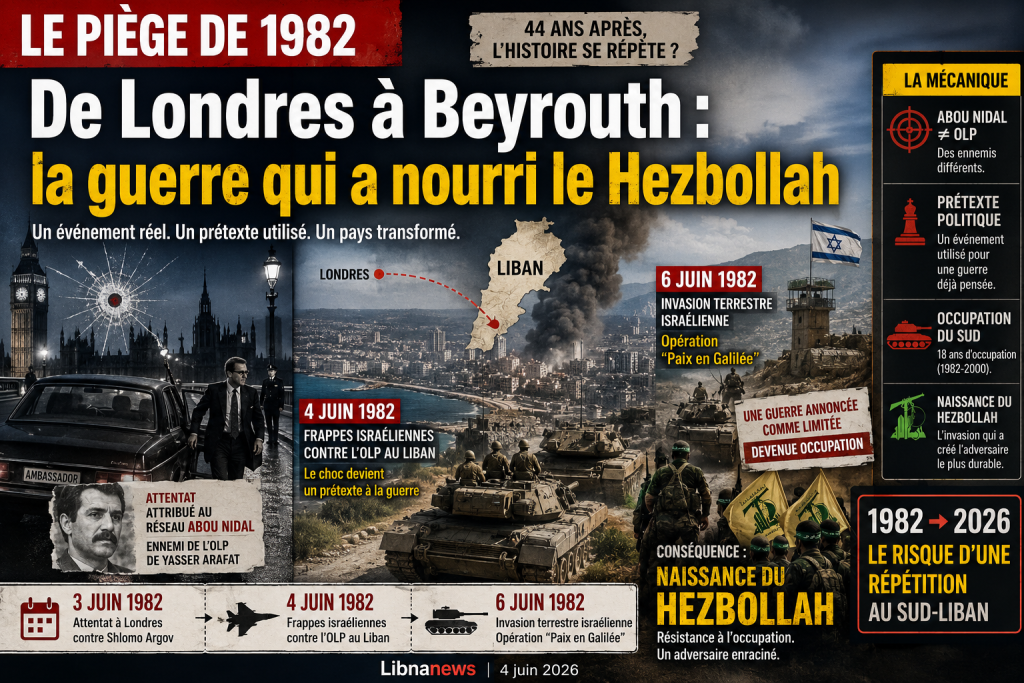
4 June 1982 is not the first day of the Israeli land invasion of Lebanon. It formally began on June 6, as Operation Peace in Galilee. But June 4 marks the political shift. The day before, in London, Shlomo Argov, Israel’s ambassador to the United Kingdom, was seriously wounded by bullets. The attack is attributed to the Abu Nidal network, a Palestinian organization hostile to Yasser Arafat’s PLO. However, Israel chose to strike the PLO in Lebanon and then to invade the country. Forty-four years later, this sequence remains a matrix. It shows how a real event can become the pretext for an already thought war. It also recalls that an operation presented as limited may produce the opponent which it claims to destroy. In 2026, as Israel and Lebanon discuss a conditional ceasefire, this precedent sheds light on the risks of repetition.
4 june 1982: the tip of the pretext
The attack on London created an immediate shock. It aimed at a diplomat in a western capital and placed the Menahem Begin government before an indignant Israeli opinion. Defence Minister Ariel Sharon then has a political window. The official account presents the response as a need for security. Israel claims to want to protect its northern border and to keep Palestinian fighters away from Galilee. The vocabulary is measured. He talks about defence, distance, cross-border fire and the protection of civilians. But the first decisions say something else. On 4 June, Israeli aircraft bombed Palestinian positions in Lebanon. Gear’s on. Two days later, the troops entered the country.
One of the most sensitive elements of this sequence is the separation between the perpetrator of the attack and the target of the war. The Abu Nidal network is not part of the PLO. He was separated in violence. He fought Palestinian officials, rejected Yasser Arafat’s diplomatic strategy and acted according to his own regional logics. This fact is known in 1982. It does not block the Israeli decision. The reasoning changes in scale. The attack is no longer just the act of a precise commando. It becomes the sign of a general problem that the Hebrew state wants to resolve in Lebanon: the Palestinian military and political presence.
This mechanism approximates the episode of a false flag by its effects, without making it an operation under false identity established by public evidence. The event does not need to be manufactured to be politically used. It is enough that it is used to move the useful responsibility to the adversary that one wants to strike already. In June 1982, the London bombing provided time, emotion and justification. It transforms a strategic project into a presentable response. It reduces the space for internal debate. He puts Western allies before a fait accompli. It gives a war of broad objectives the initial appearance of an emergency-imposed response.
A limited war that reaches Beirut
The war is quickly beyond the announced framework. The Israeli army does not stop at a security band in the south. It progresses towards Beirut, confronts Palestinian forces, crosses the Syrian presence and sinks into the Lebanese civil war. Lebanon of 1982 is not a State capable of absorbing such an offensive. The institutions are fractured. The militias control territories. Syria weighs heavily. The PLO has bases, weapons and political autonomy. Israeli intervention adds foreign power to an already saturated system of weapons. It does not rebuild sovereignty. It accelerates its fragmentation.
The siege of Beirut then reveals the real dimension of the operation. Israel obtains the evacuation of the PLO from the Lebanese capital. The immediate military outcome is considerable. Politically, it opens a vacuum. President-elect Bachir Gemayel is assassinated before taking office. The Sabra and Shatila massacres committed by Lebanese militia allies of Israel in an area controlled by the Israeli army destroy the story of a strictly security intervention. The agreement of 17 May 1983, supposed to organize normalization between Lebanon and Israel, collapses under pressure from internal and regional power relations. The war was to produce a new order. It sets up a deeper crisis.
South Lebanon becomes the symbol of this failure. Israel gradually withdrew from several areas, but maintained direct or indirect occupation in the South with the support of the South Lebanon Army. The scheme lasts until May 2000. An operation launched on behalf of a limited objective thus results in 18 years of military presence. It creates prisons, control lines, separate villages and a memory of occupation. It turns armed resistance into a lasting political argument. It gives a part of the Shiite population of the South, already marginalized and often caught between Palestinian forces, local militias and the Israeli army, a new reason to mobilize.
The birth of Hezbollah as a strategic effect
Hezbollah is born of this combination. It does not arise from one cause. The Iranian revolution of 1979 gave him an ideological matrix. The historical marginalization of the Lebanese Shiites gives it social ground. Civil war destroys national mediation. Syria allows Iran to invest in Bekaa. Advisers to the Revolutionary Guards participate in the formation of armed networks. But the 1982 Israeli invasion gave these elements their catalyst. It provides a visible enemy, a territorial cause and a narrative of resistance. The movement does not appear immediately in its present form. It is gradually structured, through religious, military, social and political networks, before becoming one of the country’s central actors.
The strategic consequence is major. Israel wanted to expel the PLO from Lebanon. It contributes to the emergence of an opponent more rooted in Lebanese society. The PLO was a Palestinian organization based in Lebanese territory. Hezbollah became a Lebanese actor, anchored in villages, families, social institutions, schools, associations, religious networks and later in Parliament. The threat is changing in nature. It can no longer be treated as an external presence to be removed. It is confused with part of the national fabric, while remaining linked to Iran. It is this dual nature that has made the case so difficult for four decades.
Historical irony is heavy. The 1982 invasion weakened a Palestinian opponent, but it was preparing a more lasting Shiite opponent. The Israeli withdrawal of 2000 then reinforces the account of Hezbollah, which presents the liberation of the South as proof of the effectiveness of weapons. The 2006 war did not suppress the movement. It destroys part of Lebanon, but consolidates the idea that Hezbollah can resist a superior army. Each confrontation brings its share of losses, weakenings and assassinations. But each confrontation also reactivates the political authority on which the movement relies: occupation, strikes, violated sovereignty and the inability of the State to protect the territory alone.
2026, the return of an old reflex
This is where 1982 speaks directly at 2026. The context has changed. Hezbollah is no longer a nascent force. Iran has a much more structured regional role. The United States is trying to manage simultaneously the Lebanese case, Israel’s security and negotiations with Tehran. Lebanon has a recognized army, but limited by the economic crisis and internal balances. Yet some reflexes remain. Israel continues to present its operations as necessary for the security of the North. It seeks buffer zones, military guarantees and freedom of action. He says he wants to strengthen the Lebanese army, while maintaining pressure that weakens the sovereignty he says he wants.
The cease-fire announced in Washington in June 2026 recaptured this dilemma. The text requires the complete cessation of hostilities upon the cessation of Hizbullah fire and the evacuation of its operators from the southern Litani sector. It provides for pilot areas under the sole control of the Lebanese Armed Forces. On paper, the logic corresponds to the expected international framework: return of the State, exclusion of non-State armed actors, stabilization of the border. But the agreement leaves open the question of Israeli withdrawal and the freedom of action claimed by Israel. This asymmetry threatens its credibility. The Lebanese State cannot be asked to embody sovereignty in an area where a foreign army retains its positions or its right to strike.
Donald Trump’s sentence on the desire to separate the Lebanese issue from the Iranian negotiations adds another layer of contradiction. Washington wants to prevent Tehran from using Lebanon as a lever. But this dissociation confirms, by its very existence, that the two files are linked. Hezbollah links Lebanese territory with Iran. Israel links its northern security to regional war. Lebanon seeks not to become a currency of exchange. Iran asserts that any broader agreement must cover the fronts where its allies are engaged. The White House wants to cut the crisis into separate files. The land immediately recomposes them.
The lessons history has not imposed
The parallel with 1982 must not be forced. The London bombing, the PLO, the civil war, Syria and the structure of Lebanon of the time belong to another moment. But strategic reasoning is repeated. A real threat is used to justify a broader operation. A war announced as limited can expand. A safe area can become an occupation. Military pressure can give the opponent new legitimacy. An attempt to remodel Lebanon from outside can produce the opposite of the desired result. This repetition is not fatal. It is a matter of decisions that ignore the lessons available.
The first lesson is that military superiority does not produce a political order. Israel reached Beirut in 1982. He got the departure of the PLO. He showed his power. He did not create a stable and allied Lebanon. Even today, destroying deposits, tunnels, launchers or positions is not enough to build a legitimate authority. Sustainable security requires a Lebanese State capable of acting, a respected border, protected civilian populations and guarantees accepted by local actors. Without this, tactical victory becomes a pause between two war cycles.
The second lesson concerns occupation. Any prolonged Israeli military presence on Lebanese territory feeds the story of Hezbollah. She offers him the justification he needs to maintain his weapons. It places its Lebanese opponents in a difficult position, as they must denounce its arsenal without appearing indifferent to national sovereignty. In 1982, the occupation of the South provided Hezbollah with its public raison d’être. In 2026, any Israeli retention in southern areas could have a similar effect. The movement can be militarily weakened and politically strengthened at the same time.
The third lesson concerns the Lebanese State. Washington, Paris, Beirut and even Tel Aviv say they want the Lebanese army to control the South. But the army cannot succeed if it is perceived as executing a device imposed under Israeli compulsion. It must appear as the instrument of Lebanese sovereignty, not as the local force responsible for securing a foreign occupation. This requires clear Israeli withdrawal, financial resources, coordination with UNIFIL, minimal internal consensus and a national defence strategy. Without these elements, pilot areas may become fragile showcases.
Lebanon between two denials of sovereignty
Hezbollah’s responsibility does not disappear in this analysis. Its weapons outside State control, its alignment with Iran, its role in the decisions of war and its military presence in the South have helped to trap Lebanon. The movement often imposed on the country choices that the institutions had not debated. It has weakened the principle of the legal monopoly of force. But history also shows that Israeli pressure does not resolve this contradiction. She can even harden it. The more Israel strikes, occupies or threatens, the more Hezbollah can present its weapons as a necessary response. Lebanon remained locked in between two denials of sovereignty.
4 June 1982 is not only an anniversary. It’s a warning. It recalls that a war may arise from a pretext and produce effects contrary to its objectives. It shows how a response to an attack attributed to an actor hostile to the PLO allowed to launch an offensive against the PLO and then transform Lebanon for decades. It sheds light on the birth of Hezbollah as a product of a wider history of Iran, Shiite marginalization, civil war and, above all, Israeli occupation. He invites us to look at the current sequence with distrust. The press releases speak of ceasefire, pilot areas and security. The field will tell whether these words open a political exit or whether they are preparing a new version of the same cycle.
Forty-four years after 4 June 1982, Israel still seems to hesitate between two readings of its Lebanese past. The first recognizes that the occupation has fed Hezbollah and that limited operations can escape their designers. The second continues to believe that higher pressure will eventually produce the result that previous pressures have not achieved. Lebanon, for its part, does not have the luxury of this hesitation. He knows the price of wars unleashed in the name of the safety of others. In the coming weeks, with the follow-up of the ceasefire, the question of the Litani, the role of the Lebanese army and the status of Israeli positions, will say whether 1982 remains an open lesson or a mistake in repetition.




