

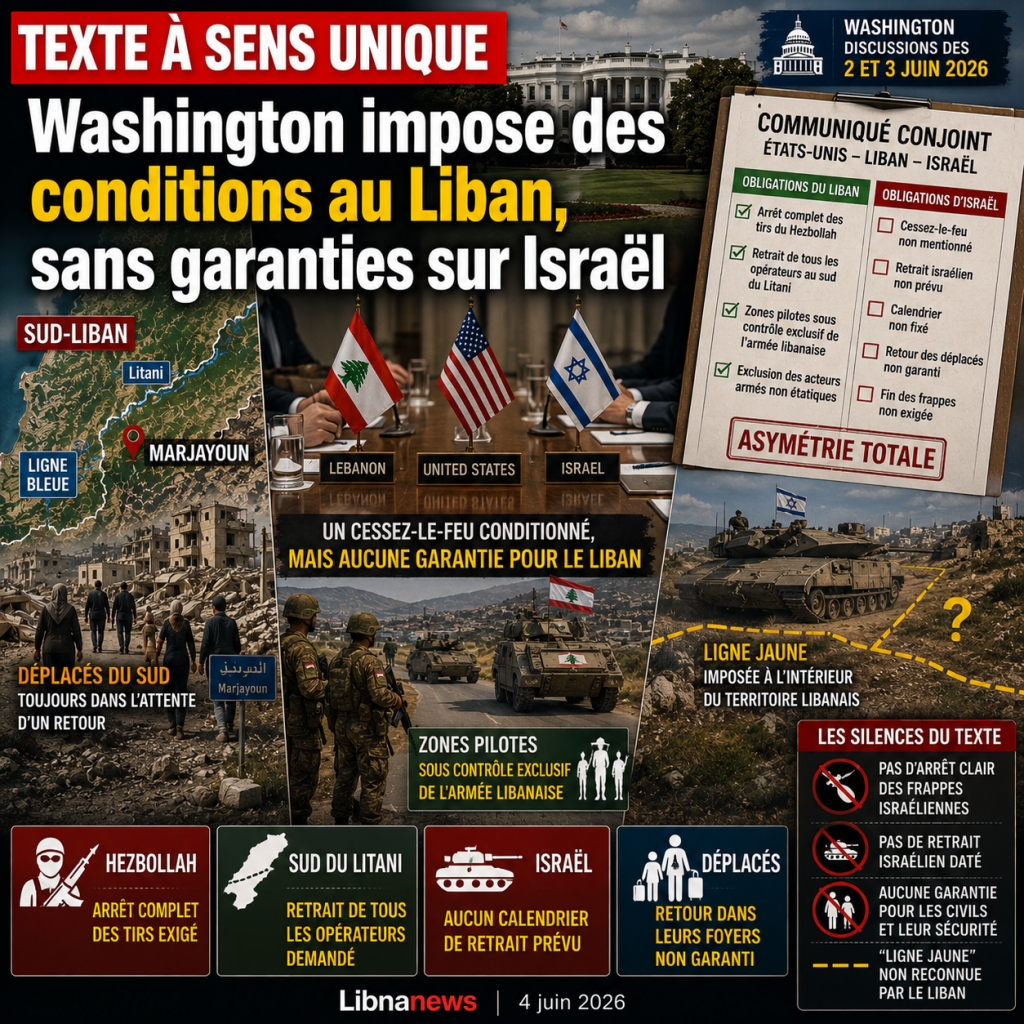
The joint US-Lebanon-Israel communiqué, which emerged from the discussions held in Washington on 2 and 3 June 2026, is a step towards a ceasefire. Seen from Lebanon, it looks more like an asymmetry text. It imposes specific conditions on Hezbollah, places the Lebanese army at the centre of pilot zones and uses American vocabulary on non-State actors. But it makes no equivalent Israeli obligation. It does not provide for a clear ceasefire on the Israeli side. It does not mention a withdrawal schedule. It does not guarantee the return of Lebanese displaced persons. It does not state how the destruction, strikes and maintenance of a safe area within Lebanese territory will be stopped. The document speaks of sovereignty, but let Israel reserve the right to occupy, strike and decide who can return to the South.
A text that speaks of peace, but mainly imposes conditions in Lebanon
The fourth high-level trilateral meeting organized by the United States brings together Lebanese and Israeli representatives in a moment of strong military pressure. Washington presents the result as a basis for de-escalation. The communiqué announced that Lebanon and Israel had agreed to implement a ceasefire. This formulation may give the impression of mutual commitment. The detail of the text tells another reality. The central condition is Hizbullah: complete cessation of fire and evacuation of all its agents from the area south of the Litani.
This construction immediately places the obligation on the Lebanese side. The Lebanese government is engaged in a mechanism whose application depends on an armed actor who did not sign the communiqué. Hezbollah becomes the subject of the text, but not its interlocutor. The Lebanese State is required to resume the ground, advance the army and prove that the South can be placed under exclusive state authority. Israel, on the other hand, is not subject in the communiqué to such a precise constraint. The text does not say that the Israeli army must stop any operation. He does not say that she should withdraw from the occupied areas. He does not say that strikes must stop unconditionally.
This dissymmetry changes the political nature of the communiqué. A balanced ceasefire should set clear obligations for each of the parties. It should require the cessation of Hezbollah fire, the cessation of Israeli strikes, the withdrawal of Israeli forces from Lebanese territory, the protection of UNIFIL, the return of internally displaced persons and an independent verification mechanism. The Washington text focuses on the first part. It transforms the ceasefire into a test imposed on Lebanon, without exposing with the same sharpness what Israel must abandon.
Hezbollah identified as a central Lebanese problem
The press release goes further than just a security text. It builds a political reading. He affirms that the future of relations between Israel and Lebanon must be decided by their sovereign governments and rejects any attempt by a State or non-State actor to take Lebanon hostage. The formula clearly targets Hezbollah and, behind it, Iran. It presents the movement as an obstacle to Lebanese sovereignty, not just as an adversary of Israel. The message is powerful: the problem is no longer just the confrontation between Israel and Hezbollah, but the ability of Hezbollah to impose a war on Lebanon that the state has not decided.
This reading contains some Lebanese truth. Hezbollah weapons outside state control pose a central question. The decision on war and peace cannot be taken by an armed party. The South cannot remain under double authority. The Lebanese army must be the only legal force in the area between the Blue Line and the Litani. A large part of the Lebanese defend this principle, not by aligning with Israel, but by attaching themselves to the State. The press release exploits this requirement and reflects American language.
But the formulation becomes problematic when it ignores the other hostage-taking that Lebanon has suffered: the Israeli occupation, the strikes, the destruction and the restrictions imposed on the inhabitants of the South. The designation of Hezbollah as a threat to the Lebanese state is not enough if Israeli actions that weaken the same state are ignored. A text that claims to free Lebanon from a non-State actor cannot allow a foreign army to decide on security lines, prohibited villages and the pace of destruction. Otherwise, sovereignty becomes selective.
No explicit Israeli ceasefire
The first dead angle of the communiqué concerns the cessation of Israeli hostilities. The text refers to a cease-fire, but it mainly conditions it on the behaviour of Hezbollah. It does not clearly prohibit Israeli operations in Lebanon. This lack of support is all the more so as Israeli officials have affirmed, in the meantime, that operations would continue. Israeli Defense Minister Yisrael Katz defended the maintenance of a security zone and the continued destruction of infrastructure attributed to Hezbollah.
These statements remove part of the scope of the communiqué. A ceasefire in which a party retains the right to conduct operations is not a complete ceasefire. It looks like a conditional suspension granted by the dominant military power. Israel can then say that it is not conducting a general war, but targeted actions. Lebanon, on the other hand, continues to suffer from strikes, restrictions and a foreign military presence. The words of diplomacy mask an operational reality: the Israeli army retains the initiative.
The danger is immediate. Every Israeli strike can be justified in the name of dismantling an infrastructure. Every Hezbollah fire can be described as a ceasefire violation. The text thus gives Israel a wider interpretation than in Lebanon. It is sufficient for an activity to be described as preventive to escape the logic of a total cessation of hostilities. In a country already destroyed by months of fighting, this margin is not technical. It decides on the lives of the inhabitants, the return of families and the credibility of the State.
No enemy withdrawal schedule
The second is even more serious: there is no Israeli withdrawal schedule in the communiqué. It does not specify which positions should be evacuated, in what order, under what control and when. He did not say whether the sectors occupied since the last operations should return immediately under Lebanese authority. It does not link the establishment of pilot zones with the prior departure of the Israeli army. This omission places Lebanon in a dangerous position. He must act on Hezbollah without a clear guarantee that the occupation will end.
Israeli statements exacerbate this gap. Yisrael Katz claimed that Israel would not withdraw from southern Lebanon and that the army would remain in a safe area to a « yellow line ». In Lebanese reading, this line has no sovereign legitimacy. It is not a recognized border. It is not the product of an agreement between two equal states. It represents a military demarcation imposed by Israel within Lebanese territory. Lebanon has already experienced this logic with the occupation of the South until 2000. It always starts as a security measure. It ends up becoming a de facto territorial order.
The absence of a clear withdrawal also destroys the argument of the return of the state. How can we ask the Lebanese army to exercise exclusive sovereignty if Israel retains positions in the same area? How can the inhabitants be convinced that the state takes over if a foreign army decides where they can move? How can we ask Hezbollah to withdraw from southern Litani without giving the Lebanese proof that the Israeli occupation is receding at the same time? The press release is not responding. He called on Lebanon to produce an internal result, but allowed Israel to maintain its external constraint.
Return of the displaced, a great absence from the text
The third silence concerns the Lebanese displaced. The communiqué speaks of security and sovereignty, but it does not guarantee the return of the people of the South. This is a central point. A cease-fire makes sense for civilians that if it allows them to return home, to reopen schools, to resume agricultural land, to rebuild houses and to move on the roads. Israeli statements suggest that the return to certain areas will remain blocked as long as the Israeli army finds the situation dangerous.
This omission reveals a military approach to the file. Pilot zones are designed as control spaces. They are not yet thought like spaces of life. The text does not specify which localities can be rehabited. He doesn’t say who will finance the reconstruction. He does not say how the roads will be cleared or secured. He did not say how people could recover their property if their village was behind a line imposed by Israel. Peace is mentioned as an objective. The concrete conditions for civilian return are not included in the communiqué.
For Lebanon, this silence is politically explosive. The inhabitants of the South cannot be transformed into adjustment variables. They suffered bombing, destruction, displacement and uncertainty. Their return cannot depend solely on Israeli security appreciation. If the communiqué does not protect the displaced, it will be seen as an agreement on territorial control, not as an agreement for the people. A stabilization that ignores civilians is preparing for the next crisis.
Experimental pilot zones, but at what cost?
The « pilot zones » form the operational core of the text. The term indicates an experiment. Washington wants to quickly establish sectors under the exclusive control of the Lebanese army, without any non-State armed actor. The idea may seem pragmatic. Rather than pretending to transform the whole South in a few days, the device tests limited areas. If they work, the model can expand. If they fail, negotiators will be able to adjust the mechanism.
But this experimental logic raises a fundamental question. Lebanese territory cannot become a security laboratory without political guarantees. A pilot zone can serve sovereignty if it begins with the Israeli withdrawal, the return of the Lebanese army, the protection of UNIFIL and the reopening of the area. It becomes a trap if it is used to test the ability of the Lebanese army to hold areas under Israeli surveillance. In this case, the military institution may be perceived as managing a constraint imposed from outside.
The map of these areas will therefore be decisive. Are they located in areas where Israel has withdrawn? Do they include destroyed villages? Do they allow people to return? Are they connected to the Blue Line, the Litani or the Israeli « yellow line »? What will UNIFIL do? Who will report the violations? Who will prevent Israel from hitting in a pilot area on behalf of intelligence? The press release does not provide these details. Experience can therefore become a stabilizing tool or a new layer of ambiguity.
A regional separation that confirms the links
The US communiqué and statements also seek to separate the Lebanese file from other regional negotiations, in particular the Iranian case. This dissociation is presented as a way of restoring Lebanon’s sovereignty and preventing Tehran from using Hezbollah as a lever. It responds to a real concern. Lebanon should not become a currency of exchange in the discussions between Washington, Israel and Iran. Its border, villages and inhabitants should not be treated as a variable in a wider agreement.
But this separation is partly theoretical. The communiqué itself condemns the Iranian attacks and the destabilizing activities attributed to Iran. He therefore included Lebanon in the regional reading in Washington. Hezbollah is linked to Iran. Israel justifies its operations in Lebanon with the threat of this axis. At the same time, the United States is negotiating regional de-escalation. To assert that the Lebanese file is separate is not enough to make it independent. Rather, the attempt at separation confirms the interdependence of the fronts.
The term Pakistani file, sometimes used in some confounding or shortened conversations, does not correspond to the known content of the release. The text is aimed at Iran, not Pakistan. This precision counts because it avoids diluting the real stake. Lebanon is caught in a confrontation involving Israel, the United States, Iran and Hezbollah. Name it correctly allows you to understand why the agreement is so fragile. The problem is not just a border. It is a regional node in which Lebanese sovereignty remains the weakest variable.
Resolution 1701 cannot be used in half
Resolution 1701 remains the international frame of reference. It provides for the absence of unauthorized weapons between the Blue Line and the Litani. It also provides for respect for Lebanese sovereignty, the role of the Lebanese army and the support of UNIFIL. The communiqué includes the part concerning non-State armed groups. It remains much more discreet about the part concerning Israel. This partial reading can be used for tactical de-escalation. It cannot establish lasting stability.
Lebanon cannot accept that 1701 becomes a one-way text. Yes, Hezbollah must leave the southern area of the Litani if the state is to exercise its authority. But Israel must also leave the occupied parts of Lebanese territory, cease its strikes, respect the Blue Line and allow the return of civilians. The resolution cannot be amputated by its sovereign dimension. Otherwise, it ceases to be a balance frame and becomes a pressure instrument against a single part.
UNIFIL should play a central role in this mechanism. Yet its own security is weakened by the continued shooting and impact in the South. The death of a blue helmet near Marjayoun reminds us that international guarantors are not protected by mere ceasefire declarations. An agreement that does not protect UNIFIL cannot protect the people. A mechanism that does not guarantee the safety of patrols cannot guarantee the safety of pilot areas.
The risk of an agreement that reinforces Hezbollah’s discourse
The paradox is clear. The communiqué wants to weaken Hezbollah by presenting it as an actor who takes Lebanon hostage. But his imbalance can offer him a political argument. If Israel continues to occupy areas, destroy infrastructure and prevent internally displaced persons from returning, Hezbollah can say that its weapons remain necessary. He may present the text as a capitulation imposed by Washington. It may accuse the State of wanting to implement Lebanese obligations without obtaining a national counterpart.
This dynamic would weaken the Lebanese forces that really want to rebuild the state. Their position is based on a simple idea: only the State must decide on war and peace. But this idea becomes difficult to defend if the State appears unable to obtain Israeli withdrawal. The more Israel maintains an occupation, the more Hezbollah retains its account. The more the press release ignores Israeli obligations, the more politically it makes the return of the Lebanese army to the pilot areas politically costly.
The Lebanese government will therefore have to correct the asymmetry in the negotiations scheduled for the week of 22 June. It must demand an explicit ceasefire on both sides, an Israeli withdrawal schedule, the cessation of destruction operations, the protection of UNIFIL, the return of internally displaced persons and the publication of accurate maps. He will have to refuse the « yellow line » to become a de facto boundary. It will also need to ensure that the pilot areas are areas of real Lebanese sovereignty, not areas monitored by Israel.
The Washington text can still become a starting point. It cannot remain in the state without fuelling a crisis of legitimacy. Lebanon should not be taken hostage by Hezbollah, but should not be taken hostage either by an Israeli occupation dressed in security. Sovereignty is not divided according to the needs of the strongest party. It presupposes a Lebanese State capable of imposing its authority on internal actors and of seeing its territory respected by the enemy. Future discussions will have to say whether Washington agrees to impose obligations on Israel, or whether the communiqué will remain a text in which peace is sought in Lebanon while the war is allowed to the other side.




