

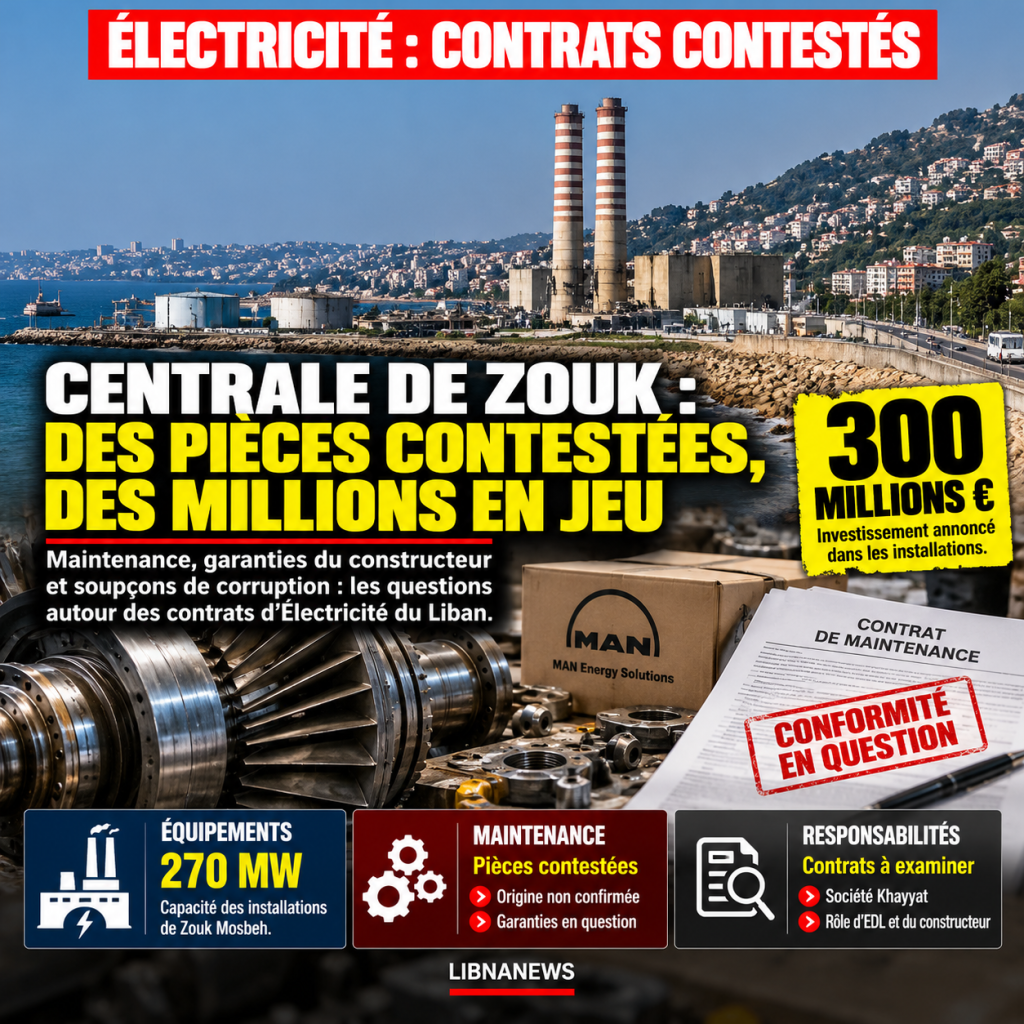
Spare parts not in accordance with German manufacturer’s equipment
The maintenance of the Zuk power plant raises new questions about the quality of the spare parts used, the contracts concluded with private suppliers and the responsibilities for the immobilization of a production group. Khayyat is directly involved in interventions on equipment by the German manufacturer MAN. According to the charges made in this file, some installed parts would not come from the original manufacturer. Their use would have helped to reduce the life of the facilities and jeopardize their operation. The Director General of Electricity of Lebanon, Kamal Hayek, is also at the centre of this case, after expressing reservations about maintenance conditions. The charges relate to equipment which represents a considerable investment for the public establishment, while national electricity production remains insufficient.
25 January 2025 is an important date in this case. A production group was put back into service with a maintenance programme to accompany its operation. This would have revealed problems with the components installed in previous interventions. Some parts would not have been manufactured by MAN, contrary to the expected characteristics for the equipment concerned. Their quality and service life would be lower than the parts supplied directly by the manufacturer. The criticisms also concern the oils used for the operation of the installations. These elements would have contributed to technical difficulties and prolonged immobilization of a production group. However, the exact responsibility for parts and maintenance operations in identified failures remains to be established by independent technical expertise.
A maintenance contract that raises questions about the manufacturer’s guarantees
Khayyat allegedly provided assistance on the Zuk facilities without a general maintenance agreement with MAN. This would be contrary to the contractual requirements applicable to the transactions concerned. The dispute concerns in particular the guarantees offered by the manufacturer and the liability of the undertakings involved in its equipment. The parts supplied directly by MAN would benefit from technical guarantees that the components installed by other suppliers would not necessarily have. This difference relates to the conformity of the equipment, its duration of use and the conditions of support in case of failure. The charges thus call into question not only the choice of suppliers, but also the control procedures applied by Electricity Lebanon before the acceptance of the works.
The issue of guarantees is central to this issue. A maintenance contract may provide for obligations concerning the origin of parts, the qualifications of technicians and procedures for intervention. If these conditions were not met, the responsibilities could involve both the claimant and those who validated the transactions. However, the full contract with Khayyat is not available in the items examined. It is therefore not possible to establish definitively which clauses would have been breached. The known information nevertheless justifies an examination of the authorisations granted to the supplier, the documents of receipt of the work and the guarantees actually provided for the installed components.
Savings to purchase that could cost more to the farm
The price of spare parts is one of the main arguments put forward in the dispute. A part supplied directly by the German manufacturer, with its warranty, could cost three times more than a component purchased from another supplier. Even greater differences are mentioned for certain parts proposed by Asian manufacturers. These price differences can make alternative suppliers financially attractive. However, they are not sufficient to determine the actual cost of a maintenance operation. The duration of use of the components, their compatibility with equipment and the consequences of any failure must also be taken into account. The charges against Zuk are based precisely on the assumption that the savings realized in the purchase of certain parts would have been offset by a faster deterioration of the facilities.
However, the file does not provide detailed invoices to compare actual payments to individual suppliers. Nor does it specify the technical references of the contested documents. This information would be essential to determine whether the installed components were suitable for the equipment and whether their price was commensurate with their quality. A cheaper room is not necessarily defective. Conversely, a component sold with a manufacturer’s warranty is not sufficient to exclude any risk of failure. The question is therefore whether the interventions carried out complied with the contractual obligations and technical requirements of the production groups. It is on these elements that a possible financial injury to electricity in Lebanon could be established.
A group immobilized for almost a year and a half
One of the most worrying concerns the prolonged immobilization of a Zuk production group. The charges refer to a shutdown of about a year and a half, attributed in particular to maintenance problems and the use of disputed components. Such immobilization is a major difficulty for a facility intended to contribute to the national power supply. It reduces the available production capacity and complicates the management of other equipment. However, there is currently no detailed expert report on the exact share of spare parts in this interruption. The causes of a prolonged stay can be multiple and must be determined on the basis of the technical findings made on the group concerned.
The chronology of interventions therefore becomes essential. The dates of maintenance operations should be established, the components replaced should be identified and incidents identified prior to and after the re-service of 25 January 2025 should be reviewed. The operating reports would also identify the time periods during which the group was available and when it could no longer produce. These elements are not detailed in the accessible information. However, the charges raise a management issue: how did a facility representing such an important investment know of a prolonged immobilization, and what steps have been taken to identify its causes?
270 megawatt power plant costing 300 million euros
The equipment concerned represents an announced capacity of 270 megawatts for an investment estimated at 300 million euros. These figures measure financial issues. However, they do not correspond to the amount of the disputed maintenance costs. The EUR 300 million represents the announced cost of the installation and cannot be considered a loss or diversion. On the other hand, the unavailability of a production group can reduce the profitability of such an investment. The consequences depend on the actually immobilized power, the duration of the stops and the operating conditions of the other units.
Zuk’s contribution to the national power supply remains limited. Production of electricity equivalent to about two hours per day is mentioned in the context of the difficulties of the sector. However, this figure does not directly measure the losses associated with the disputed group. To perform this calculation, it would be necessary to know how much energy it could have produced during its immobilization. It would also be necessary to identify the costs incurred for repairs and possible alternatives. These data would help to assess the financial consequences of technical failures. They are not included in the elements currently established.
Objections that go back several years
The contractual dispute would not have arisen only after the technical difficulties encountered in Zuk. Ali Hassan Khalil allegedly refused the contract several times when he exercised ministerial responsibilities. This would go back to a period when Gebran Bassil headed the Ministry of Energy. This chronology suggests that administrative or financial reservations would have been made before the contested interventions. It raises the question of the conditions under which the contract was finally applied.
However, the specific reasons for the refusals attributed to Ali Hassan Khalil are not detailed. There is no administrative document reproducing these decisions to determine whether they concerned the prices, technical guarantees or qualifications of the claimant. Their identification would be important in determining whether subsequent difficulties had been anticipated. It would also help to understand how any objections were dealt with by the authorities concerned. Responsibilities cannot be determined without reconstituting the administrative path of the contract, from its initial review to its execution.
Charges of corruption concerning relations with the German manufacturer
The file also contains particularly serious charges concerning the relationship between Khayyat and MAN. Attempts of corruption reportedly targeted some employees of the German manufacturer. An investigation conducted in Germany reportedly established the payment of bribes and resulted in a decision prohibiting certain commercial relations with the company in question. However, these claims require independent audits. No German court decisions, official investigation reports and manufacturer’s notification are reproduced in the accessible material.
The nature of these charges requires a distinction between suspicions and established facts. If a German investigation has indeed led to sanctions, it would be necessary to identify the competent authority, the persons concerned and the decisions handed down. It should also be determined whether the measures referred to directly applied to maintenance operations in Lebanon. In the absence of these documents, no criminal liability can be asserted. The Khayyat company also did not have a reply reproduced in the available information. The charges cannot therefore be presented as definitive conclusions.
Kamal Hayek at the centre of the Zuk management dispute
The Director General of Electricity of Lebanon, Kamal Hayek, finds himself at the centre of a confrontation concerning the maintenance contracts of the plant. His reservations about certain contractual practices would have resulted in public attacks. The dispute would relate in particular to the conformity of the parts used, the guarantees of the German manufacturer and the conditions for the intervention of Khayyat. The respective responsibilities of the parties remain to be established, in particular with regard to the validation of work and the control of installed equipment. The charges against the claimant alone are not sufficient to determine the decisions made by the officials of the public establishment.
Several administrative issues remain open. Who authorized the use of the disputed parts? What services have verified their compliance? Have the work been technically approved? Were any reservations recorded prior to the group’s return to service? Responses would require review of contracts, maintenance reports and internal electricity documents in Lebanon. They would distinguish technical responsibilities from administrative and financial decisions. At this stage, the known information identifies a conflict around the management of the plant, without allowing for definitive identification of any faults of each.
Controls necessary to establish responsibilities
The first check should cover parts installed on Zuk’s equipment. Their origin, technical references and guarantees would help determine whether they complied with the required characteristics. An expert could also examine their condition after use and look for possible links to the identified failures. The second part would cover maintenance contracts. The obligations imposed on the claimant, the authorizations obtained from the manufacturer and the conditions under which the work was validated should be established. This would allow for the verification of allegations of non-compliance.
A financial check should then compare the services invoiced with the actual interventions. It could determine the cost of the replacement parts, labour costs, and amounts incurred to re-establish the facilities. Examination of immobilization periods would also allow for an assessment of the consequences on electricity production. Finally, allegations of corruption would require consultation with possible decisions taken in Germany and with official exchanges between MAN, Khayyat and Electricity of Lebanon.
The Zuk power plant represents an important investment for a sector facing persistent difficulties. The charges concerning its maintenance raise specific questions about the quality of the work, contractual guarantees and the control of public expenditure. Their seriousness warrants a thorough technical and financial review. However, any responsibilities will have to be established on the basis of contracts, expertise and judicial decisions, not just the accusations made in the public debate.





Comments