

A US demand that goes beyond disarmament
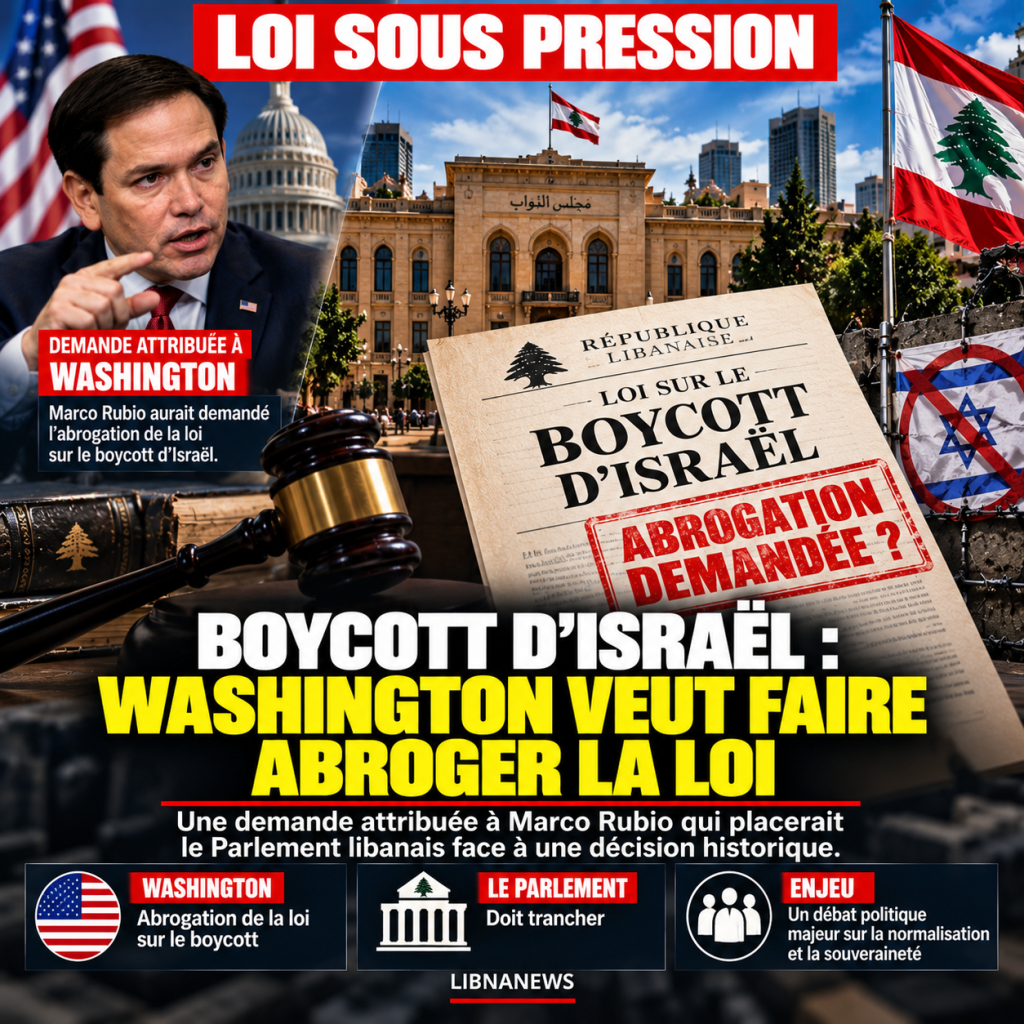
The Lebanese law on Israel’s boycott would have become one of the new objectives of American diplomacy in Beirut. According to information revealed on 20 October 2026, US Secretary of State Marco Rubio reportedly asked President Joseph Aoun to take the steps necessary to repeal it directly. This request was reportedly made in a telephone interview focusing on security issues, Hezbollah activities and Tampa military negotiations. It would introduce a new element into relations between Washington and Beirut. So far, the most sensitive discussions have concerned the disarmament of Hezbollah, the Israeli withdrawal from southern Lebanon and the modalities for implementing the framework agreement. The challenge to boycott legislation would now shift some of the US pressure to parliamentary ground. It would affect a legal framework that has for several decades been in place for relations with Israel and whose amendment would have a political impact beyond trade issues alone.
Marco Rubio’s request would be part of a broader American approach. Washington would like concrete decisions on Hezbollah from the Lebanese authorities, but also changes in institutional relations with Israel. The repeal of the boycott law would be a particularly visible change. It would involve Parliament’s intervention and place the various political groups before an explicit choice. However, the 20 October documents do not reproduce a U.S. bill or a formal commitment by Joseph Aoun to undertake this reform. The information is based on the account of diplomatic discussions whose full content has not been made public. It should therefore be seen as a request attributed to Washington, not as a decision already adopted by the Lebanese institutions. This distinction does not detract from the importance of the file. It simply allows us to situate the debate at its actual stage: that of alleged diplomatic pressure, before any confirmed legislative procedure, in the context of the dinner affair of Antoun Sehnaoui with Israeli Prime Minister Benjamin Netanyahu and his companies working directly with Israeli entities.
Michel Issa to bring the matter to the Members of Parliament
The American Ambassador to Lebanon, Michel Issa, reportedly took over this initiative in his discussions with Lebanese parliamentarians. The information published indicates that he would have addressed the issue of abrogation of the boycott in meetings with Members of Parliament and in some public statements. This would have taken place after the interview between Marco Rubio and Joseph Aoun. It would give American demand a direct parliamentary dimension. The President of the Republic cannot repeal a law alone. A modification of the scheme would require a legislative procedure and the intervention of the competent institutions. The ambassador’s approach would therefore aim at preparing the political ground for possible reform. They could also enable Washington to evaluate the resistance within the various formations represented in the House.
A particular element appears in the information concerning these diplomatic interventions. Michel Issa’s statements were also allegedly related to a controversy involving the Lebanese ambassador in Washington, Nada Moawad. It has reportedly been criticized by jurists about contacts that are presented as contrary to the legal provisions governing relations with Israel. The information available includes exchanges with the Israeli Ambassador to the United States. However, they do not provide a judicial decision establishing an offence. It is therefore appropriate to distinguish the accusations made in this controversy from the facts that would have been legally established. The rapprochement between this case and the steps attributed to Michel Issa nevertheless shows that the legislation on boycott could become a subject of diplomatic confrontation. It would no longer concern only economic exchanges, but also the practices of official representatives and the limits placed on their relations with Israeli officials.
Reform that would force Parliament to take a position
The possible repeal of the boycott law would immediately raise the question of its parliamentary treatment. Such an initiative could not be presented as a mere administrative measure. It would require a precise determination of the provisions to be deleted or amended. However, the information published on 20 October does not contain full legislation. They therefore do not indicate whether Washington would like a complete repeal or a limited modification of certain prohibitions. However, this difference would be decisive for the debate. A targeted reform would not necessarily have the same effects as a general abolition of the scheme. Members should also examine the consequences on the obligations of administrations and on practices currently regulated by legislation. At this stage, there is no detailed proposal for specific legal changes to be put to the vote.
However, the case could lead to important political divisions. Hezbollah defends a position of rejection of steps that could lead to normalization of relations with Israel. Its officials are already denouncing direct negotiations when they believe that they risk legitimizing the occupation or reducing the rights of Lebanon. In particular, the president of the parliamentary bloc of Resistance Loyalty, Mohammad Raad, criticized positions in favour of negotiations which he considered to be contrary to national interests. These statements concern the general political context and are not alone a detailed response to a draft legislation on boycott. Nor is it possible to draw up a verified list of Members who favour or oppose its repeal. They show, however, that the issue may encounter resistance, particularly in the formations that consider the maintenance of legal restrictions as a component of the refusal of normalization with Israel.
Tampa calendar strengthens political reach of demand
The request attributed to Washington comes at a particularly sensitive time. Lebanon and Israel are scheduled to participate in a new military meeting in Tampa, Florida, on 20 October 2026. The Lebanese authorities wish to defend several requirements: the cessation of Israeli attacks, the withdrawal of the occupied territories and the implementation of the commitments provided for in the framework agreement. The issue of Lebanese prisoners is also one of the issues that Beirut intends to take forward. Israel, for its part, favours security guarantees concerning Hezbollah. These differences already complicate the discussions. The introduction of the boycott issue could therefore considerably broaden the scope of US applications. It would move the debate on military arrangements to reduce tensions to a change in the legal framework for relations with Israel.
This would pose an additional challenge to the Lebanese authorities. Joseph Aoun defends the continuation of diplomatic negotiations, which he considers a less costly solution than a new war. However, this approach does not mean that the President accepts an immediate transformation of relations with Israel. The 20 October documents do not mention any presidential commitment to abrogation of the boycott. Nor can they establish that this reform would formally constitute a condition for participation in the Tampa discussions. The applications awarded to Marco Rubio are reported in the same interview, but relate to separate files. It would therefore be excessive to present their reconciliation as evidence of a comprehensive agreement already negotiated. The question remains as to the objectives pursued by Washington and the answers that Lebanese institutions could provide.
Between diplomatic pressure and legislative sovereignty
If the boycott were to be called into question, the Lebanese authorities would face a specific institutional problem. The United States can defend a legislative change in its diplomatic exchanges. However, the decision is the responsibility of the Lebanese institutions. Such an initiative should be considered within the framework of national procedures and given rise to parliamentary debate. It could not result directly from a request made by a foreign ambassador or official. This distinction is the main institutional issue in the case. The information published describes alleged US pressure, but does not demonstrate that the government would have decided to introduce a bill. They do not mention a parliamentary calendar or a commission to examine a reform of the boycott. No vote was announced on this issue in the available material.
The dossier thus reveals a possible extension of the American objectives to Lebanon. In addition to the demands regarding the disarmament of Hezbollah and the security arrangements with Israel, there would be a desire to change the legal framework of relations between the two countries. This approach could have significant political consequences, but its implementation remains uncertain. On 20 October 2026, the information identifies a request attributed to Marco Rubio and the interventions lent to Michel Issa to parliamentarians. They do not confirm that a repeal text has been tabled or that a parliamentary majority is preparing to support it. The next decisive element would therefore be the emergence of an identifiable legislative initiative. It would help to determine whether the diplomatic approaches referred to actually resulted in an institutional procedure, and above all what provisions of Lebanese legislation would be covered.





Comments