

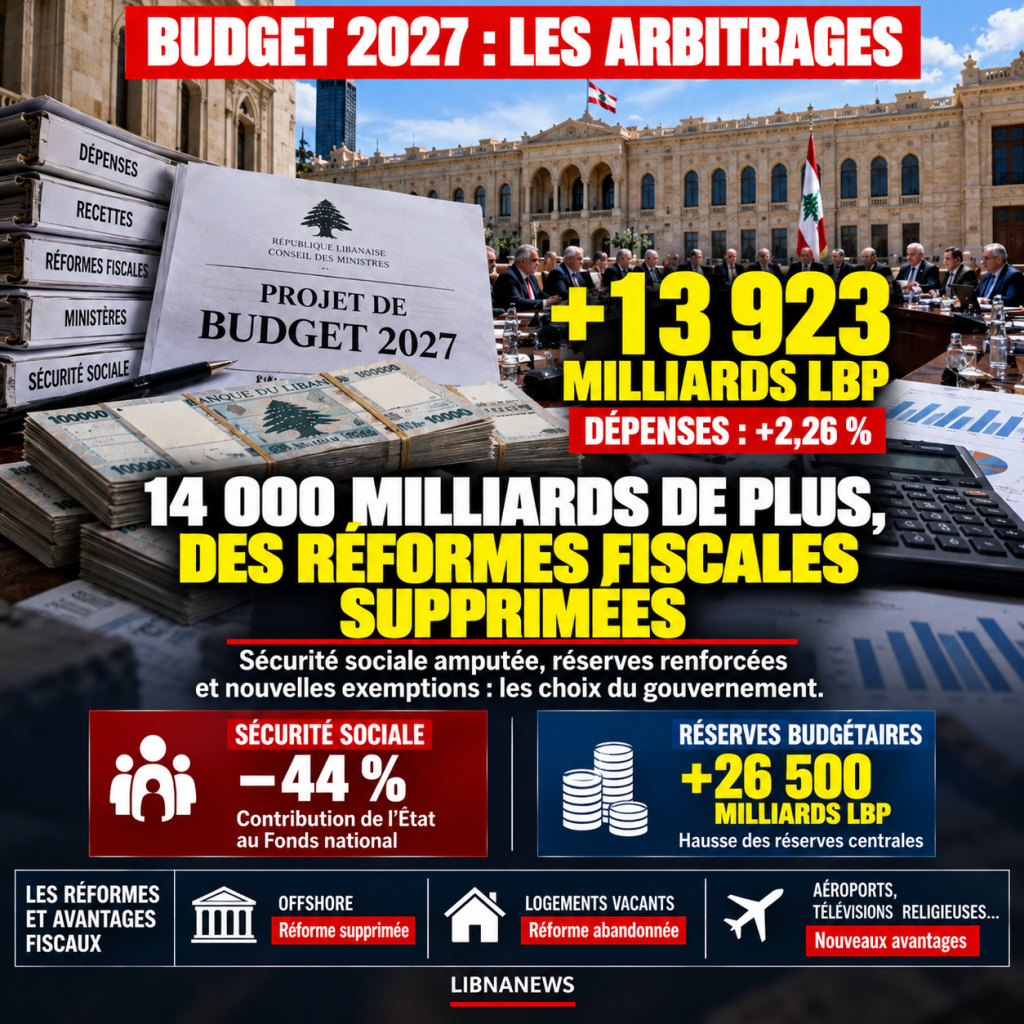
Government increases spending and reduces spending by several departments
The Council of Ministers has substantially changed draft budget 2027 presented by Finance Minister Yassine Jaber. The comparison between the original text and the amended version at the October 1st session reveals several major changes. Expenditure is increasing by almost Pound13,923 billion, while tax measures to expand government revenues are disappearing. In parallel, the Government introduces new exemptions, notably for religious televisions, Qlayaat airport and certain operations related to Beirut airport.
Total expenditure increased from LL 614 945 billion to LL 628 868 billion, an increase of 2.26%. However, this increase does not benefit departments uniformly. Most of the additional appropriations are concentrated in budgetary reserves. They increase by £26,500 billion to about £49,800 billion. The most dramatic change is the allocation reserve, which increases from 5,500 billion to 37,500 billion pounds, or 32,000 billion pounds.
At the same time, several departments are seeing their appropriations decrease. The reductions include public works and transport, social affairs, telecommunications, culture and labour. The latter’s budget is rising from around £17,500 billion to £10,200 billion. The decrease is thus 7,300 billion, or almost 42 per cent of its initial envelope.
These arbitrations significantly alter the distribution of public expenditure. The government increases the central reserves while reducing the appropriations directly allocated to several administrations. The budget documents reviewed do not fully specify the conditions under which the additional reserves will be used.
The financing of social security is severely reduced
The National Social Security Fund is one of the agencies affected by the amendments. The State’s contribution to its expenditure is rising from about 16 500 billion to 9 200 billion pounds. This reduction of $7,300 billion represents almost 44 per cent of the amount originally planned.
A second decrease relates to the repayment of the State’s accumulated debts to the Fund. The planned annual payment, initially set at £3,600 billion, is reduced to £312.1 billion. The reduction thus reached nearly 91%. The amended budget therefore provides for a much lower reimbursement than in the first version.
The funding of the sickness and maternity branch is also being modified. Part of the public contribution shall be withdrawn from the appropriations for social security. However, the corresponding amount is re-incorporated into the budget of the Ministry of Health to finance the purchase of medicines for the insured. This is therefore a transfer of appropriations between two budget destinations.
On the other hand, the primary health care programme is being reduced by around £900 billion. This decrease relates to a separate scheme dedicated to access to basic care.
The social security changes deserve special attention. They combine a reduction in direct contributions, a transfer of funding to the Ministry of Health and a sharp decrease in the repayment of public debts. These decisions do not necessarily have the same accounting or operational consequences.
Offshore companies retain their advantage over inheritance rights
One of the main reforms removed concerns the taxation of offshore companies. In its original version, the Ministry of Finance introduced section 24 to amend the tax treatment of the shares of these companies.
So far, the transfer of ownership of the shares of offshore companies, including by succession, has benefited from exemptions in respect of transfer and inheritance rights and certain associated royalties. The Department proposed to subject these shares to the tax regime applicable to other capital corporations. It also responded to the recommendations of the International Monetary Fund.
The Council of Ministers has completely deleted Article 24. Existing exemptions are therefore preserved in the amended version.
However, articles 22 and 23 were retained. In particular, they allow the companies concerned to fix their capital in dollars or euros and provide for a flat annual tax of £200 million.
The result is precise: the provisions facilitating the operation of these companies are retained, while the measure to approximate their taxation with that of other companies is abandoned.
Vacant housing: a third attempt at abandoned reform
The Government has also abolished Article 37, on the tax treatment of unoccupied residential apartments.
The Department of Finance proposed to limit in time the tax regime applicable to these properties. The duration envisaged was three years for buildings built by developers and one year for other buildings.
The objective was to encourage the sale and rental of housing in order to increase the available housing offer. In particular, the mechanism aimed to prevent some owners from maintaining unoccupied housing on a sustainable basis while benefiting from favourable tax treatment.
The deletion of article 37 put an end to this attempt under the current draft. Two similar initiatives had already been presented in the preparation of the 2017 and 2022 budgets, but were not successful.
The file therefore reveals a continuing difficulty in changing the taxation of vacant housing. The 2027 text provided a new opportunity to introduce a time limit. It disappears from the amended version.
Surpluses in the ports of Tripoli, Saida and Tyre escape the mandatory transfer to the Treasury
Article 62 deleted by the Council of Ministers concerned port revenues. The Ministry of Finance proposed amending section 37 of the Finance Act 2020 to extend to the ports of Tripoli, Saida and Tyre an obligation to transfer financial surpluses to the Treasury.
The mechanism provided for the first deduction of salaries, remuneration and operating expenses. The balance was then transferred to the Consolidated Revenue Fund account and subject to public financial control procedures.
In the explanatory memorandum, the department noted that these ports had significant surpluses. He noted, inter alia, that their income had been received in dollars since 2022. Surplus funds were therefore considered to be public resources to be included in the budget.
The deletion of Article 62 precludes the extension of this mechanism to the three ports concerned. However, the initial text would also have eased the frequency of transfers to the port of Beirut.
The surpluses of the ports of Tripoli, Saida and Tyre will therefore not be subject to this new obligation in the amended budget. The exact amount of resources concerned is not quantified in the items consulted.
Religious TVs: an exemption from VAT and a possibility of retroactive reimbursement
The Council of Ministers introduced two provisions in favour of television establishments belonging to officially recognized religious communities.
Article 44 provides for an exemption from value added tax for their non-commercial religious media activities. This exemption is conditional on the absence of commercial advertising.
Article 49 adds a separate measure. It authorises, on an exceptional basis and for one time only, the filing of an application for reimbursement of all VAT paid since 1 January 2023.
This second provision is particularly important. It is not just about future tax obligations. It also opens up the possibility of recovering sums already paid.
The documents do not specify the total amount of potential refunds. Therefore, they do not allow an estimate of their cost to the Treasury. On the other hand, both sections create an identifiable tax advantage for a specific class of establishments.
Qlayaat: Four years of tax benefits to attract airlines
The amended draft also introduces article 63, on the airport President René Moawad of Qlayaat, in Akkar.
This provision provides benefits for airlines that will open new regular commercial routes to or from that airport. The measures will be implemented from the start of its regular commercial operation.
The scheme provides for a 100% exemption from charges for parking, landing, lighting, use of navigation facilities and services during the first two years. The exemption will then be reduced to 50% in the third and fourth years.
The text also provides for customs exemptions for equipment and systems intended for the safety and operation of the airport. Passenger departure taxes using Qlayaat would be reduced by 50%, subject to the conditions set out in the provision.
These measures are intended to reduce operating costs for companies likely to serve the new airport. However, they constitute revenue which the State would agree to give up temporarily in order to encourage commercial activity.
Beirut airport: financial compensation for Middle East Airlines Group
Article 77 introduces a financial mechanism for two separate companies: Middle East Airlines, a national airline, and Middle East Airports Services, which provides services related to Beirut airport.
The provision allows for compensation between the sums owed by the State to Middle East Airports Services for maintenance, rehabilitation and operation of the airport and the sums owed to the State by Middle East Airlines for charges and charges for use of airport facilities.
The mechanism thus allows for the reconciliation of two categories of receivables. On one side, the State’s financial obligations to the airport service provider are included. On the other hand, the airline charges appear.
This compensation does not necessarily constitute debt cancellation. It enables reciprocal obligations to be settled in accordance with the procedures laid down in the text.
The financial stake will depend on the amounts actually recognised on both sides. These are not specified in the available information. However, Article 77 introduces a special provision concerning financial relations between the State and the two companies.
Maritime properties: additional four months to regularize certain occupations
The Council of Ministers added four articles, numbered from 67 to 70, concerning the occupation of the public maritime domain.
These provisions include a new exceptional period of regularisation. Persons occupying land in the public maritime domain before 1 January 1994, without having submitted an application for regularisation, would have an additional four months to file their case.
At the same time, the text provides for tougher sanctions for more recent irregular occupations. The additional fines could be up to five times the annual occupancy fee.
Offenders may also be required to remove irregular facilities at their own expense.
The scheme therefore combines two orientations. It provides additional time for some former occupants, while strengthening sanctions against more recent offences.
Imports: a reduced levy but transferred to private providers
Another amendment concerns certification of certificates of origin and commercial invoices.
In the initial draft of the Ministry of Finance, article 56 provided for certification by Lebanese consulates with a fee of four per thousand of the value of the goods.
The Government has replaced this provision with article 55. The certification could now be carried out by contracting bodies with the Higher Customs Council, against remuneration not exceeding one per thousand of the value of the goods.
The change therefore reduces the maximum rate of the levy but also modifies its beneficiary. Instead of being collected by consulates for the benefit of public finances, remuneration would be paid to private providers.
Importers could incorporate this cost into their selling prices. The measure would therefore have different consequences for public finances, certification companies and consumers.
Private aircraft and yachts: new charges
The amended budget also provides for new levies on certain luxury activities.
Private aircraft would be subject to an annual charge of between $5,000 and $40,000, depending on their weight. A tax of $1,000 would also be applied to certain international routes carried out by private aircraft in accordance with the conditions laid down in article 72.
Article 71 introduces annual charges on luxury yachts and pleasure craft registered in Lebanon. The amount would vary depending on the length of the boats.
These new revenues are in addition to changes in work permits, administrative certifications, certain insurance activities and fines related to tobacco-free offences.
The government has therefore chosen to increase several targeted levies, while maintaining certain exemptions and abandoning measures to expand the tax base.
The changes to Budget 2027 thus provide a clear framework for arbitration. Offshore companies retain their advantage over inheritance rights. Vacant housing is not covered by the proposed reform. The ports of Tripoli, Saida and Tyre are not integrated into the new surplus transfer mechanism. At the same time, religious televisions receive tax advantages, Qlayaat receives incentives and a compensation mechanism is created for activities related to Beirut airport. Funding for several ministries and social security is declining, while budgetary reserves are increasing sharply.
These provisions are contained in the amended draft considered as at 20 October 2026. They should not be confused with a final finance law.





Comments