

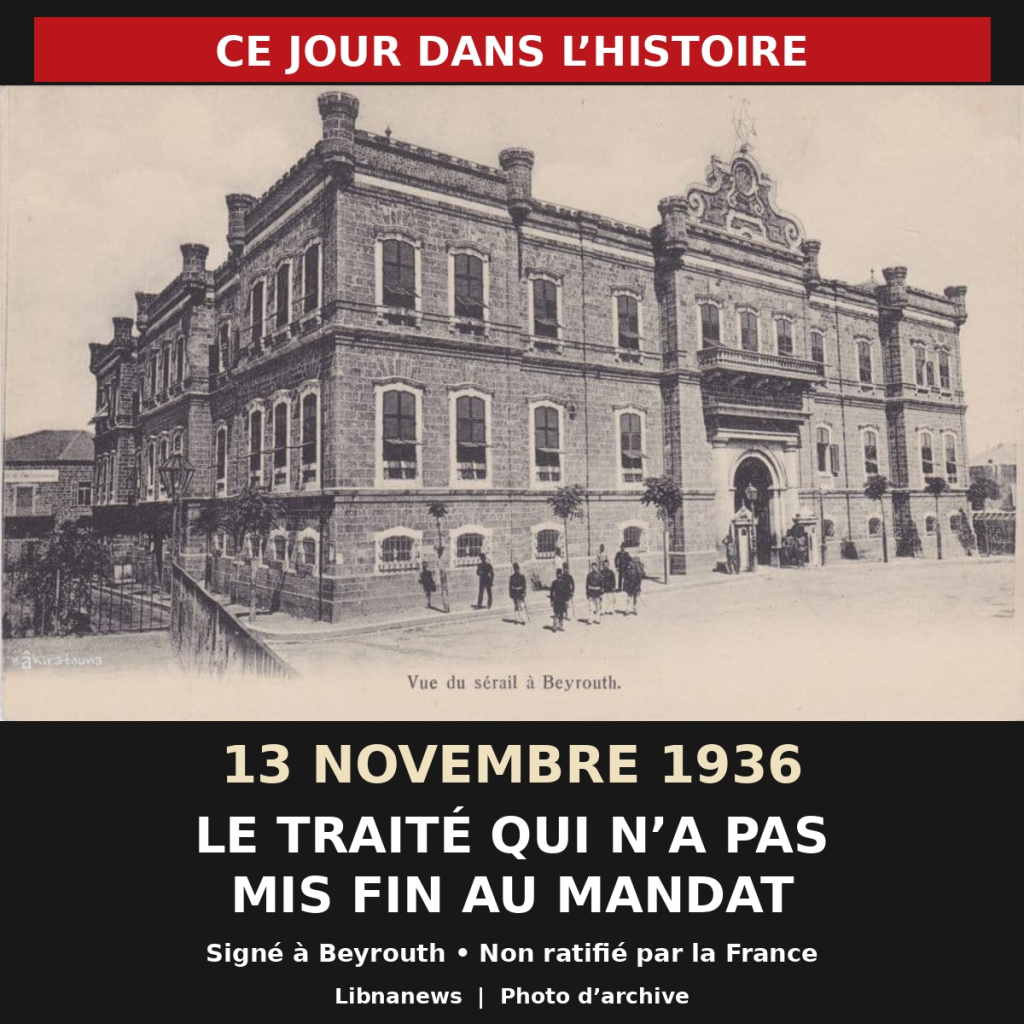
On 13 November 1936, Lebanese President Émile Eddé and French High Commissioner Damien de Martel signed a treaty of friendship and alliance in Beirut. The text should pave the way for the end of the mandate and Lebanon’s admission to the League of Nations. But the French Parliament does not ratify it. Ninety years later, this signature remained a distinct stage of independence acquired in 1943.
The agreement came 16 years after the proclamation of Greater Lebanon. It deals with two related issues: the transfer of sovereignty and the place France would retain in the new political order. Negotiators plan to replace the proxy relationship with an alliance. However, the French military presence remains at the heart of the arrangements.
The Franco-Lebanese Treaty of 1936, in the Syrian wake
In France, the arrival of the Popular Front in power put the Levant’s independence on the agenda. In Syria, nationalist mobilizations led to negotiations with Paris. A first round was held in the spring of 1936, followed by further discussions from July.
On 9 September, Pierre Viénot and Hashem el-Atassi signed the Franco-Syrian treaty. It provides for Syrian independence and unity, as well as entry into the League of Nations. France must maintain military facilities. Two months later, Lebanese negotiations in turn led to an agreement.
In Beirut, however, the question of borders gave the treaty a special scope. Part of the political forces defend an independent Lebanon within the territorial framework of Greater Lebanon. Others want a union with Syria. The future status of the country therefore did not reach consensus, even among those who called for the end of French guardianship.
Border guarantees, military alliance maintained
The Maronite patriarch Antoine Pierre Arida made his requests in February 1936. They include the maintenance of Lebanese borders, the recognition of national sovereignty and the conclusion of a treaty with France. This position combines independence with close relations with Paris, without excluding cooperation with Syria.
The Sahel Congress in October expressed a different orientation. The leaders gathered there defend sovereignty within the framework of Syrian unity, itself linked to an Arab unity project. They see negotiations with France as a step towards this rapprochement. These opposing political positions go through the preparation of the agreement.
The text signed on 13 November is accompanied by a military convention and an exchange of letters. It aims at Lebanon’s admission to the League of Nations, which is intended to enable Lebanon to leave the proxy regime. It also maintains a French military role on Lebanese territory. For the supporters of the Treaty, this presence provides a guarantee outside the country’s existence and borders.
On the other hand, the opponents of a separate Lebanon from Syria see the consolidation of a division that they contest. The French diplomatic archives keep records of reactions to the treaty, particularly in Tripoli, as well as of demonstrations and tensions in Beirut. The agreement therefore commits Lebanon’s internal organization as much as its relations with the proxy power.
Beirut ratifies, Paris does not follow
The Lebanese Chamber approves the treaty. Émile Eddé promulgated the ratification law on November 20, 1936. Its publication is contained in the Official Journal of the Lebanese Republic of 30 November, issue 3365. However, the Lebanese procedure is not sufficient to bring the agreement into force.
In France, the treaties with Syria and Lebanon met with opposition. Military and colonial circles want to preserve French positions in the Levant. Religious circles are concerned about the fate of Christian populations after a withdrawal. The French Parliament does not ratify either text.
The freeze leaves the mandate to stand. When World War II broke out in September 1939, the 1936 agreements did not produce the change in status announced. Therefore, the diplomatic signature and Lebanese approval did not result in the transfer of sovereignty.
Another way towards November 1943
The war then upsets the balance of power in the Levant. The 1941 fighting and the declarations of free France opened a new sequence. The Lebanese authorities continue to claim the powers exercised by the French representatives.
On 8 November 1943, the Chamber abolished the mandate provisions from the Constitution. The arrests of President Bechara al-Khoury, the head of the government Riad al-Solh and several ministers caused a crisis. Their release on 22 November became the date of the national holiday. Seven years after the treaty signed by Eddé and Martel, independence was achieved in a framework other than that negotiated in 1936.





Comments