

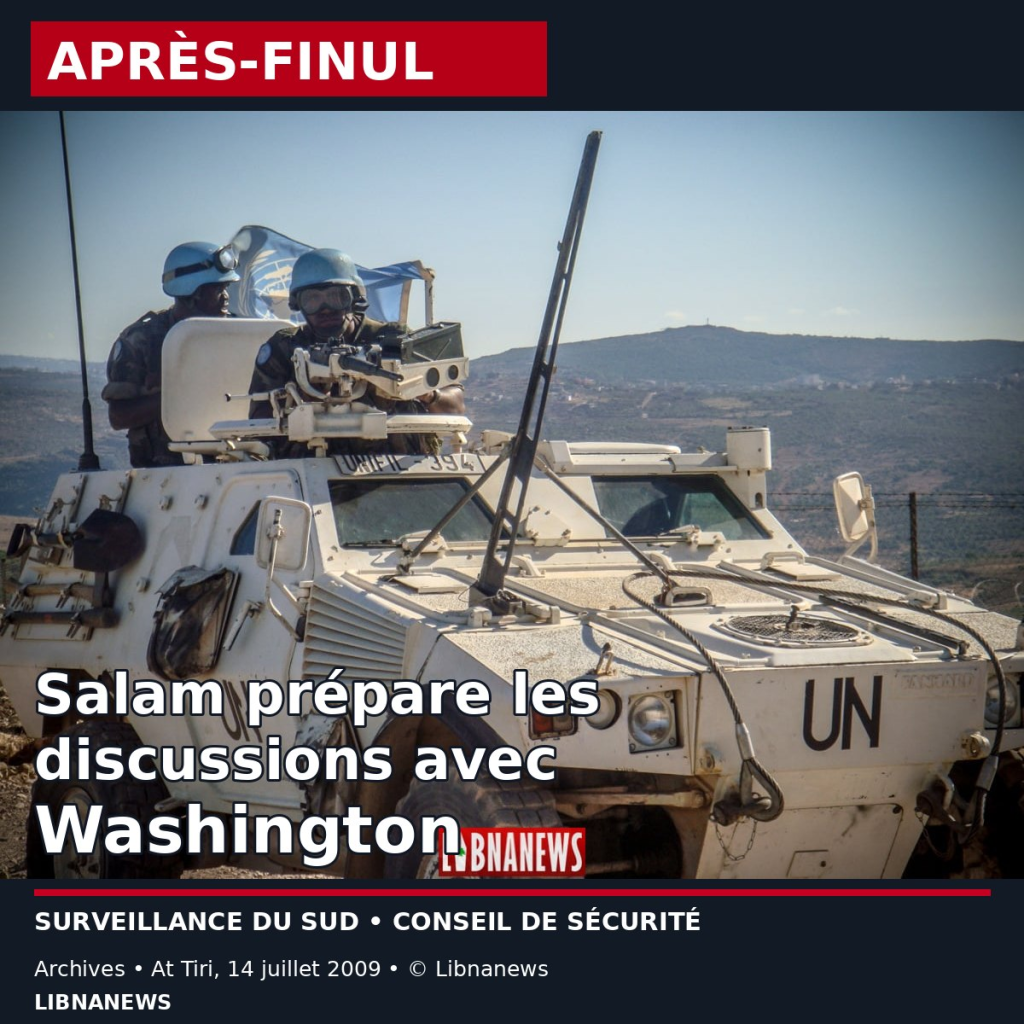
Nawaf Salam is preparing discussions on post-FINUL with Washington. According to a government source quoted on Friday 13 November by a Lebanese daily newspaper, the Prime Minister is stepping up consultations on the mechanism to monitor the South following the departure of the peacekeepers. This source reports two Lebanese refusals: direct coordination between the Lebanese and Israeli armies, and the use of private companies to carry out this mission.
These exchanges precede an expected visit by Mike Waltz, United States representative to the United Nations. The same source announced for Monday, November 16. The Lebanese press refers to a two-day trip on 16 and 17 November. Salam intends to examine the American proposals before clarifying the formula that Beirut will defend.
There are two related negotiations: the functions of the international presence in the South and its diplomatic framework. In addition to the question of the replacement of UNIFIL, a possible Security Council resolution on the new arrangements is added.
After FINUL: the reserves lent to Beirut
According to the government source, Salam discussed the future of the South at length with António Guterres, on the margins of COP31 in Antalya. Their meeting is reflected in the Prime Minister’s travel records of 11 November. The details of their discussions on the rotation of peacekeepers are reported by this source, without a joint report published on these proposals.
The Government would seek to preserve three functions currently performed by UNIFIL: monitoring the ground, reporting incidents and maintaining communications. Reducing escalation would be the other focus of consultations. The desired mechanism must therefore maintain a liaison capacity in a region where military incidents regularly feed contradictory versions.
The source attributes Beirut an opposition to direct contacts between the two armies in the future mechanism. It also reports the rejection of a formula involving private companies. She cites Blackwater as a comparison with the Iraqi experience, without announcing the selection of a company or the conclusion of a contract for Lebanon.
According to this account, Washington favours a broader verification mechanism rather than the renewal of the traditional functioning of UNIFIL. Discussions still need to clarify the civilian or military status of the stakeholders. The source indicates that Salam wishes to hear the explanations of the American emissary on this point.
A Lebanese request to the Security Council?
Another Lebanese newspaper reports on Friday a separate scenario: the United States would like Beirut itself to ask the Security Council to incorporate the framework agreement into a new resolution. The newspaper relies on anonymous information and presents this approach as an envisaged US orientation, not as an application already filed by Lebanon.
In this reading, the Lebanese origin of the request would be diplomatic in scope. Washington could present the project as a response to a state initiative. The newspaper believes that this configuration would make a Russian or Chinese opposition more politically difficult. It does not report any commitment by Moscow or Beijing to support a text.
The Council’s rules remain those of the UN Charter. A resolution on a substantive issue requires at least nine votes in favour and may be blocked by the negative vote of one permanent member. The United States, France, the United Kingdom, Russia and China have that power. Forbearance from a permanent member shall not prevent adoption when the nine-vote threshold is reached.
A Beirut initiative would therefore weigh heavily in political negotiations, without changing those rules. The content of a possible draft, the definition of commitments and the positions of Council members remain at the heart of the discussions.
G7 supports new security architecture
The public positions of Lebanon’s partners already provide some guidance. In their statement issued on 12 November, the G7 Foreign Ministers called for a strong and lasting security architecture after UNIFIL. They place it in support of the Lebanese Armed Forces, in accordance with resolution 1701, and in support of the implementation of the trilateral framework.
Ministers also call for progress in the pilot areas. They combine the verifiable disarmament of Hezbollah, the redeployment of Israeli forces and the deployment of the Lebanese army. They reaffirm their support for the sovereignty and territorial integrity of the country.
During his meeting with Marco Rubio on the margins of this meeting, Jean-Noël Barrot defended the need to avoid a security vacuum. The French report, published on 12 November, mentions work on a security architecture after the withdrawal. It does not specify the strength, command or status of a replacement force.
The planned transition from 31 December
Resolution 2790 sets the end of UNIFIL operations as at 31 December 2026. It then provides for an orderly and secure withdrawal within one year, in consultation with the Government of Lebanon and the contributing countries. During this phase, the mission retains limited functions, including the protection of its personnel and, within its capabilities, a contribution to the protection of civilians.
The text also calls for the Israeli withdrawal of the positions occupied north of the Blue Line and the extension of the Lebanese State authority. It provides for the consideration of options for the further implementation of resolution 1701 following the departure of peacekeepers, including the monitoring of the Blue Line and support for the deployment of the army south of the Litani River.
Mike Waltz’s announced visit is intended to allow Salam to examine the American modalities of this transition. For Beirut, the consultations now focus on the missions to be retained, the actors that would exercise them and the place of the United Nations in the future.





Comments