





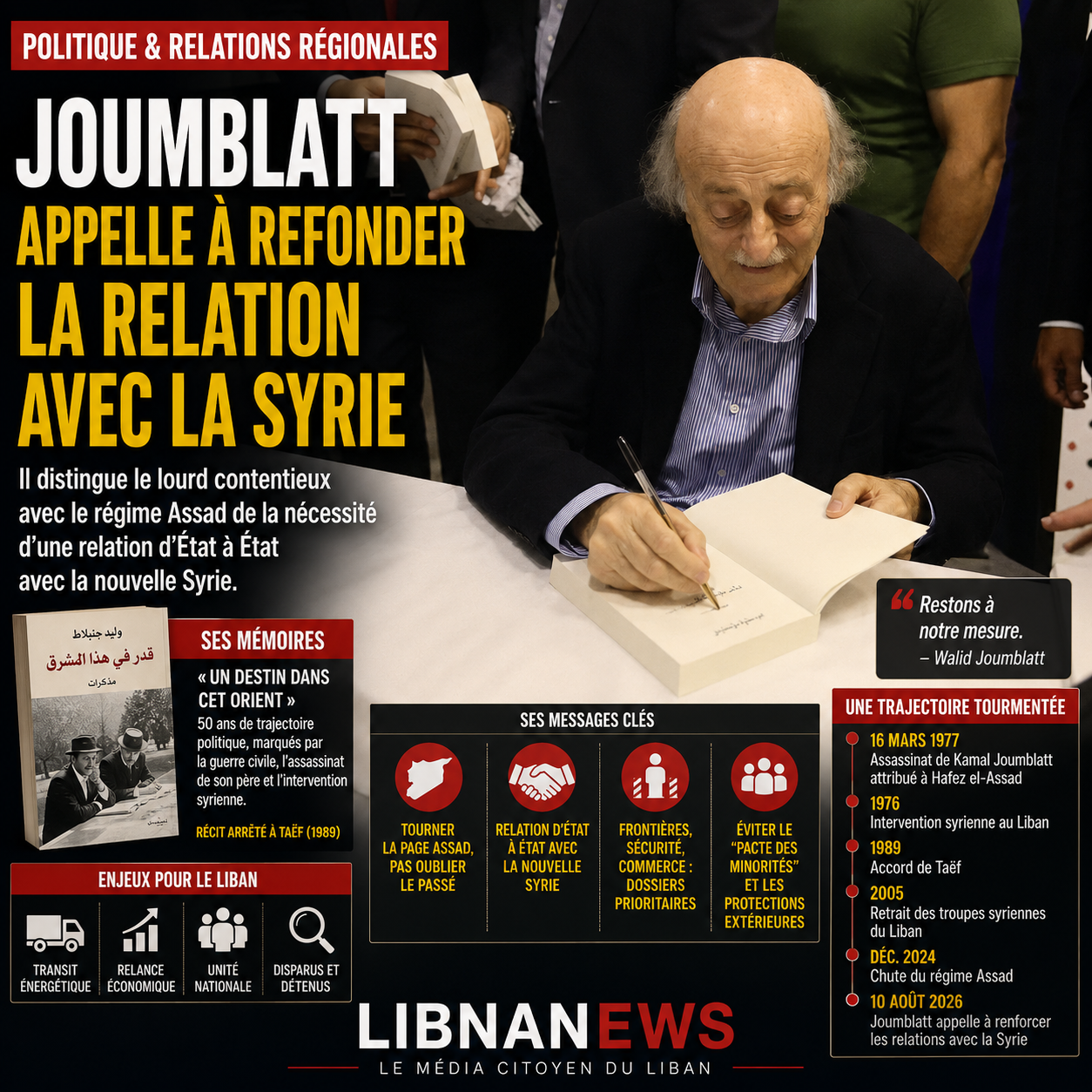
Walid Jumblatt called on Monday, August 10, 2026, to improve and consolidate relations between Lebanon and Syria, considering that a rapprochement with Damascus would directly contribute to strengthening Lebanese national unity. The former president of the Progressive Socialist Party expressed himself at the signing of his memoirs, « A Destiny in this East », dedicated to fifty years of a political trajectory marked by the civil war, Syrian intervention and the assassination of his father Kamal Jumblatt. His statement takes on a particular dimension: he continues to accuse Hafez al-Assad of having murdered his father in 1977 and describes the 1976 Syrian intervention as an operation designed to break the Lebanese National Movement and the autonomy of Palestinian decision-making. But the disappearance of the Assad regime changed the nature of the case. Joumblatt now distinguishes the heavy historical dispute with the Assad dynasty from the need for Lebanon to establish with the new Syria a state-to-state relationship, freed from the guardianship that had structured relations between Beirut and Damascus for decades.
His message is double. On the one hand, he refuses to rewrite the past: the entry of Syrian forces in 1976 remains, in his account, an intervention imposed by the relations of regional forces, and the assassination of Kamal Jumblatt remains associated with the power of Hafez al-Assad. On the other hand, it believes that Lebanon cannot remain locked in this history at a time when Damascus has changed its regime and the two countries must settle concrete issues: border, security, trade, transit, refugees, missing persons, detainees and economic agreements. For Joumblatt, normalisation therefore does not mean forgetfulness or return to the old order. It must serve to stabilize relations between two neighbouring States and to reduce the temptation in Lebanon to seek Community protections from outside powers.
Memories centered on war and stopped in Taëf
Joumblatt explained that he started working on his memoirs three years earlier. He dictated them to Sebastien de Courtois with the help of Marwan Hamade, Ghazi Aridi and Nora Jumblatt. He said he tried to return what he could with fifty years of memories, while recognizing that a single volume did not allow to tell everything. The choice to close the story at the Taif agreement of 1989 is particularly significant. He focuses the book on the period that shaped his political identity: the assassination of his father, his rapid accession to the leadership of the PSP, the civil war, relations with Damascus, the Israeli invasion of 1982, the Mountain War and the compromise that officially ended the conflict.
This choice voluntarily leaves out another essential period: the years of Syrian tutelage after Taif, the rise of the opposition in Damascus, the break with Bashar al-Assad, the assassination of Rafic Hariri in 2005, the 14-Mar movement and the withdrawal of the Syrian army. It also allows to refocus the story on Kamal Jumblatt, whose death is the personal and political tipping point. Walid Jumblatt then suddenly entered a position which he had not prepared under the same conditions as his father. From 1977, he had to lead a community and a party while negotiating with the regime he accused of ordering the assassination.
The charge against Hafez al-Assad remains unchanged
Nearly fifty years after the facts, Jumblatt withdrew nothing from his accusation against Hafez al-Assad. Kamal Jumblatt was murdered on 16 March 1977 with Fouad Rizk and Hafez Ghosn, in the Shuf, near a Syrian post. His son has always attributed this murder to the Damascus regime. Responsibilities have never been established by a final judgement, but Lebanese officials and witnesses have, over the decades, publicly accused Syrian officers. The arrest in Syria in March 2025 of former officer Ibrahim Huweija revived the case, with Walid Jumblatt regularly quoting him among the alleged perpetrators.
During the presentation of his memoirs, Jumblatt put the assassination back in the 1976 confrontation. Kamal Jumblatt was the leader of the Lebanese National Movement, a coalition of the left, nationalist and arabist, allied with Palestinian organizations. He refused the Syrian intervention and considered that the entry of the Damascus army should prevent his camp from turning its military advantage into a political victory. For his son, the intervention and then the assassination are part of the same strategy of controlling Lebanon by Hafez al-Assad. This reading explains why his current call for rapprochement with Syria cannot be presented as reconciliation with the old regime: on the contrary, it is a matter of building a relationship after his disappearance.
1976, the moment when Lebanon becomes the object of the great powers
Jumblatt also referred to the role of Henry Kissinger and Washington’s green light for Hafez al-Assad to intervene in Lebanon. The exact modalities of the arrangements between the United States, Syria and Israel remain debated by historians, but the contacts between these actors and the limits imposed on the Syrian deployment are widely documented. The Syrian intervention had initially prevented the collapse of the Christian camp in front of the National Movement and Palestinian organizations, before being framed in the mechanism of the Arab Deterrence Force.
For Jumblatt, this sequence illustrates above all a Lebanese structural weakness. Local actors were fighting for internal goals while major regional and international capitals were negotiating the limits of their action. Lebanon appeared less as the master of its conflict than as the ground where Syrian, Israeli, American and Palestinian strategies crossed. It is this experience that he mobilizes when he says today that the Lebanese cannot advance or delay the major strategic alliances and that they must « maintain their measure ». Its message is to protect the state rather than pretend to weigh on confrontations beyond its capabilities.
A long coexistence with the regime he accused
Walid Jumblatt’s career, however, shows that he was never able to turn his accusation against Damascus into a permanent political line. After 1977, he had to deal with Syria. During the 1980s, the PSP cooperated with Damascus in several stages of the war. The Mountain War strengthened the military and political position of Jumblatt, who became one of the main leaders of the camp allied to Syria. After Taif, he participated in the post-war political system, largely dominated by Damascus. Its ministers sit in government and its parliamentary bloc is part of the institutional balances built under Syrian tutelage.
This coexistence summarizes the pragmatism of Jumblatt. He never stopped accusing the regime of his father’s death, but he repeatedly chose to deal with him when the balance of forces imposed it. This logic has often been criticized as a political opportunism; It is also linked to its position as a leader of a minority community dependent on complex regional balances. His statement of 2026 takes this idea in another form: it is no longer a matter of dealing with a Syrian tutelage, but of avoiding a permanent hostility in Damascus becoming a line of Lebanese internal fracture.
2004-2005: Breaking with Damascus
The relationship was broken in the early 2000s. Joumblatt gradually moved towards the maintenance of Syrian guardianship and the extension of President Emile Lahoud’s mandate in 2004. The assassination of Rafic Hariri on 14 February 2005 then transformed the confrontation. Jumblatt became one of the figures of the 14th March movement and called for the withdrawal of the Syrian army. Under pressure from Lebanese demonstrations and the international community, the last Syrian troops officially left Lebanon in April 2005.
Military withdrawal did not normalize the relationship. For nearly twenty years, the Syrian question continued to divide the Lebanese parties deeply. One party considered Damascus a permanent threat to sovereignty, while Hezbollah and its allies maintained a strategic relationship with Bashar al-Assad. The Syrian war after 2011 further reinforced this fracture. Hizbullah’s intervention in Syria, the massive arrival of refugees in Lebanon and the partial closure of trade routes have placed Damascus at the heart of Lebanese domestic policy.
The fall of the Assad regime opens a different relationship
The disappearance of Bashar al-Assad’s regime in December 2024 created a rupture that Jumblatt himself sought to seize quickly. He had visited Damascus a few weeks after the fall of power and had met with Ahmed al-Charaa, calling for normalized relations between the two countries and for account to be taken of the crimes of the past. In 2025 and then in 2026, the Lebanese and Syrian authorities gradually resumed official contacts, including on the border, security and economic issues.
The relationship is now rebuilt on a different basis. Nawaf Salam and Ahmed al-Charaa discussed land and maritime boundary delimitation and security coordination. In July 2026, both countries also set up a higher commission for cooperation. Governments have begun to review more than forty agreements inherited from previous decades, including trade, investment, taxation and transit. This evolution gives concrete content to the formula used by Jumblatt: strengthening the relationship with Syria can become an instrument of stabilization if it is based on reciprocity rather than guardianship.
An economic relationship that has become inevitable
The Lebanese interest is obvious. The country shares about 375 kilometres of border with Syria and depends on Syrian territory for most of its land connections with Jordan, Iraq and Gulf markets. The bilateral official trade, which had once approached $800 million a year, had fallen to around $250 million by 2025. The Minister of Economy Amer Bisat now estimates that trade can rise to several billion if agreements, tariffs and roads are reorganized.
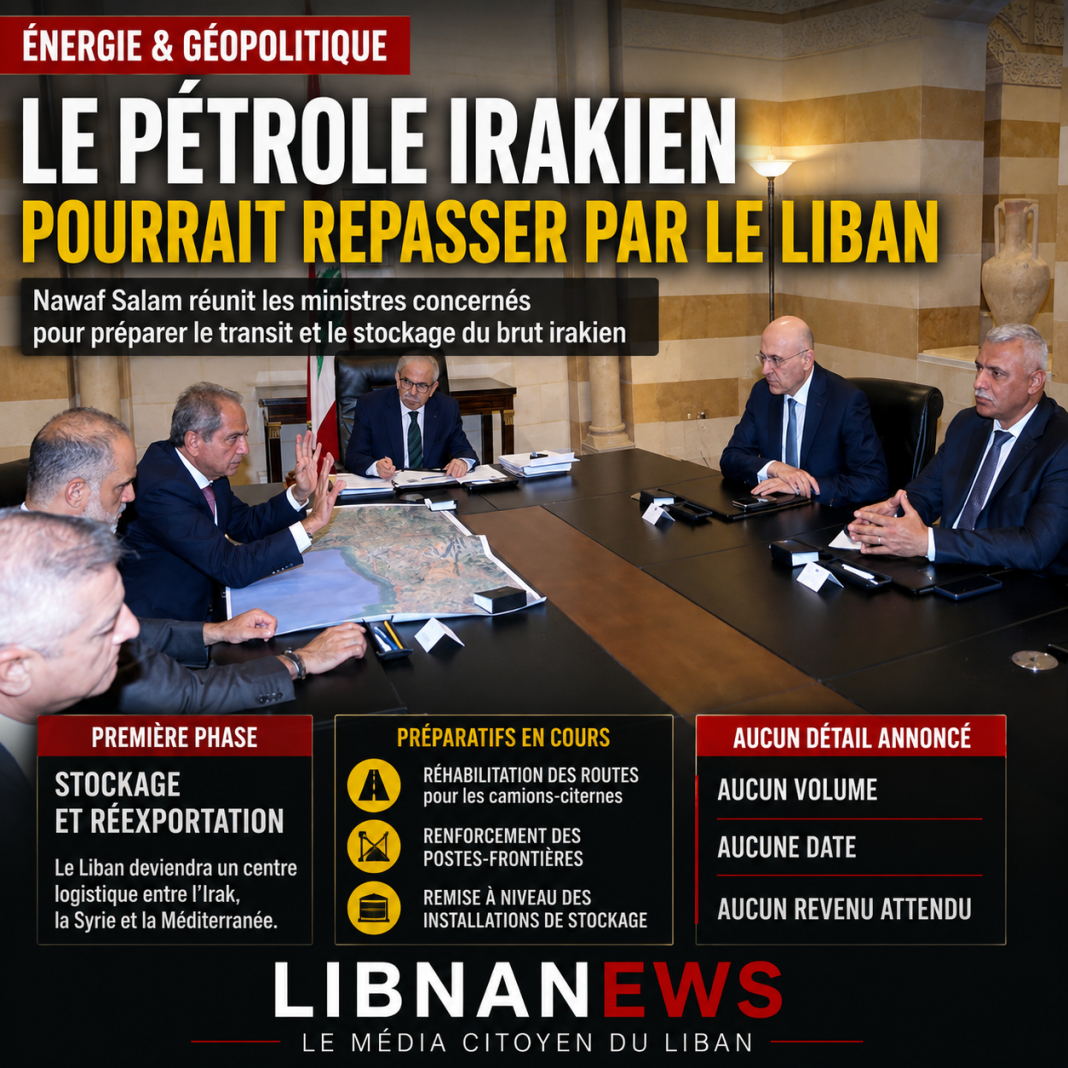
For Lebanese producers, Syria is not just a market. It is mostly a corridor. Agricultural and industrial exports to Iraq, Jordan, Saudi Arabia or the United Arab Emirates depend on a fluid land passage. The rehabilitation of roads and border crossings can therefore have a direct effect on transport costs. The Iraqi oil transit project to Lebanon now adds an additional interest: shipments will have to cross Syria before being stored and then re-exported from Lebanese territory. The rapprochement with Damascus thus becomes a matter of logistics and revenue, not just diplomacy.
The border remains the first test of sovereignty
However, normalization cannot be credible if the border continues to function as a space partially escaping both States. For decades, illegal passages have facilitated the smuggling of fuel, goods, weapons and people. Several areas remain sensitive from the point of view of delimitation, and the 2025 border clashes recalled that the lack of coordination could quickly turn into a security crisis.
For Lebanon, the question is central: improving relations with Syria makes sense only if it strengthens the control of the Lebanese State in its territory. A new relationship that would re-establish parallel networks, security influences or party-to-party arrangements would reprove precisely the mechanisms that Jumblatt now claims to be overcoming. Cooperation must therefore go through the army, customs, general security and ministries, with public agreements and clear responsibility for each administration.
Detainees and missing persons remain an impossible debt to clear
The rapprochement also raises the question of the Lebanese detained or missing in Syria. Families have been waiting for several decades for information on relatives arrested during the civil war or in the years of Syrian presence. The fall of the Assad regime gave rise to hopes of access to previously closed archives, lists and places of detention. This issue remains one of the most sensitive tests of the sincerity of change in Damascus.
Jumblatt’s position on his own father gives particular consistency to this requirement. He calls for a better relationship with Syria without withdrawing his accusation against Hafez al-Assad. The normalisation it defends is therefore not based on oblivion. On the contrary, it implies that issues that were previously impossible to deal with may be between two States that are no longer bound by a guardianship relationship. For the families of the disappeared, the improvement of relationships will only be credible if it produces concrete answers on persons arrested, dead in detention or still missing.
The « minority pact » at the heart of his reading of the Levant
Joumblatt has also developed a warning against what he calls the « minority pact ». The term refers to a view of the Middle East in which minority communities seek security in alliances between them or with outside powers, rather than integrating into common states. He believes that this logic has weighed on the creation and evolution of Lebanon and was reactivated by the collapse of Iraq, the rise of Iranian influence and the strategy of the Assad regime.
He also accuses Israel of continuing to build its regional policy around this community fragmentation, from Lebanon to Syria, Iraq and Iran. This latter statement is part of his political analysis and is not evidence of a formal alliance between these groups. However, it reflects a constant concern in his country: when minorities seek an outside protector, they end up turning their countries into confrontational areas between powers that have much more resources than they do.
The Druzes directly concerned by this strategy
This question is not abstract for Jumblatt. The Druze are present in Lebanon, Syria, Israel and the occupied Golan. Each regional crisis can therefore transform its geographical dispersion into political vulnerability. The events in Sueida have, since the fall of the Assad regime, placed this issue at the centre of the concerns of the Lebanese Druze leadership.
Jumblatt regularly opposed the idea that the security of Syrian Druze could depend on Israeli protection. It considers that such a development would exactly replicate the critical model: a minority community seeking an external guarantor against its own national environment. Its alternative is to integrate the Druze into the States to which they belong and to obtain political and security guarantees from those States. In this context, improving relations between Beirut and Damascus also helps to prevent Lebanese and Syrian Druze from being pushed towards conflicting regional strategies.
Israel targeted, but Jumblatt refuses a new logic of blocks
In targeting Israel, Jumblatt does not propose that Lebanon enter into an opposite regional alliance. This is the consistency of his speech of August 10. He claims that the major strategic alliances exceed the ability of the Lebanese to change them and that the country must first strengthen its own cohesion. His speech therefore did not involve replacing Western or Israeli dependency with a Syrian, Iranian or other dependency.
This caution is the product of fifty years of regional reversals. The Lebanese civil war has successively attracted Syria, Israel, Palestinian organizations, the United States and various Arab powers. After 1990, Syrian tutelage reduced Beirut’s political autonomy. After 2005, the country was divided into competing regional axes. From now on, Jumblatt presents this succession as a demonstration: Lebanon gains nothing from designing itself as a central part of the Middle-Eastern balance of forces.
« Staying to Our Level » as a Strategic Line
The format used in presenting his briefs summarizes this development. « Stay to our measure » means first recognizing the limits of Lebanese power. The country has a limited army, a fragile economy and institutions that remain divided by community membership. Therefore, it cannot reasonably determine the behaviour of the great powers of the region.
For Jumblatt, there is room for manoeuvre within: consolidating the state, reducing community divisions and normalizing relations with neighbours. Syria then becomes less a political axis than a test of this doctrine. Lebanon must be able to maintain economic and security relations with Damascus without becoming dependent again on its services, army or regional choices.
This line also joins the generational change within the PSP. Walid Jumblatt officially left the party presidency in 2023 for his son Taymour. It retains an important influence, but its positions now take the form of a transmission of experience rather than a personal strategy of conquest of power.
Standardization to be judged on specific files
The call to improve relations with Syria will therefore be judged less on statements than on several concrete dossiers. The first is the border: delimitation, security and suppression of illegal crossings. The second concerns missing persons and detainees. The third concerns trade and transit, with the need to replace old unbalanced agreements with transparent mechanisms. The fourth concerns Syrian refugees in Lebanon and the conditions for voluntary, safe and sustainable return.
The fifth issue concerns the absence of political interference. The relationship can only be described as new if Damascus abandons its involvement in appointments, parliamentary alliances, the formation of governments or Lebanese community balances. It was precisely on this ground that the old regime had transformed a relationship between neighbours into a system of dependency. The new Syria must therefore demonstrate that it accepts a sovereign Lebanon, even when its decisions do not correspond to Syrian interests.
Jumblatt tries to separate Syria from the Assad regime
The political heart of his intervention ultimately lies in this distinction. For decades, talking about Syria in Lebanon almost always meant talking about the Assad regime. The military presence, intelligence services and political networks had merged the two concepts into the Lebanese debate. The fall of the dynasty allows for the first time to try to separate them.
Jumblatt, whose family bears one of the wounds most directly associated with the power of Hafez al-Assad, is particularly well placed to formulate this rupture. He does not ask to review the history of the Syrian intervention. He doesn’t withdraw his accusations about his father’s murder. He said, however, that a country could not build its foreign policy only around a dispute with a regime that had disappeared.
The success or failure of this doctrine will now depend on Damascus as well as Beirut. If the new Syrian authorities accept a relationship based on recognized borders, reciprocity and the absence of interference, the idea advocated by Jumblatt can become an element of stabilization. If the old tutoring reflexes reappear, the memory of 1976, 1977 and subsequent decades will immediately return to the centre of the Lebanese debate.
The next chapter does not yet appear in his memoirs
By choosing to stop his book in Taif, Jumblatt leaves out precisely the period during which his relationship with Syria experienced its most dramatic reversals. This chronological silence inadvertently gives more weight to his 2026 remarks: the next chapter is not only that of his memories, but that of a Lebanese-Syrian relationship that remains being rewritten.
The next steps are already identifiable. The bilateral commission set up in July must move forward on economic agreements. Both governments must continue the border and security discussions. Records of missing persons and detainees remain open. Land transit, including Iraqi oil, must test the ability of administrations to work together without returning to the political networks of the past.
Joumblatt therefore proposes less sentimental reconciliation than a change of method. After fifty years in which Syria was in turn a military power, arbitrator, tutor and adversary, he asked that it become a neighbour with whom Lebanon negotiates its interests. The possibility of transforming this formula into reality will now depend on the actions of both States, while the first negotiations on borders, trade and historical issues are still far from complete.