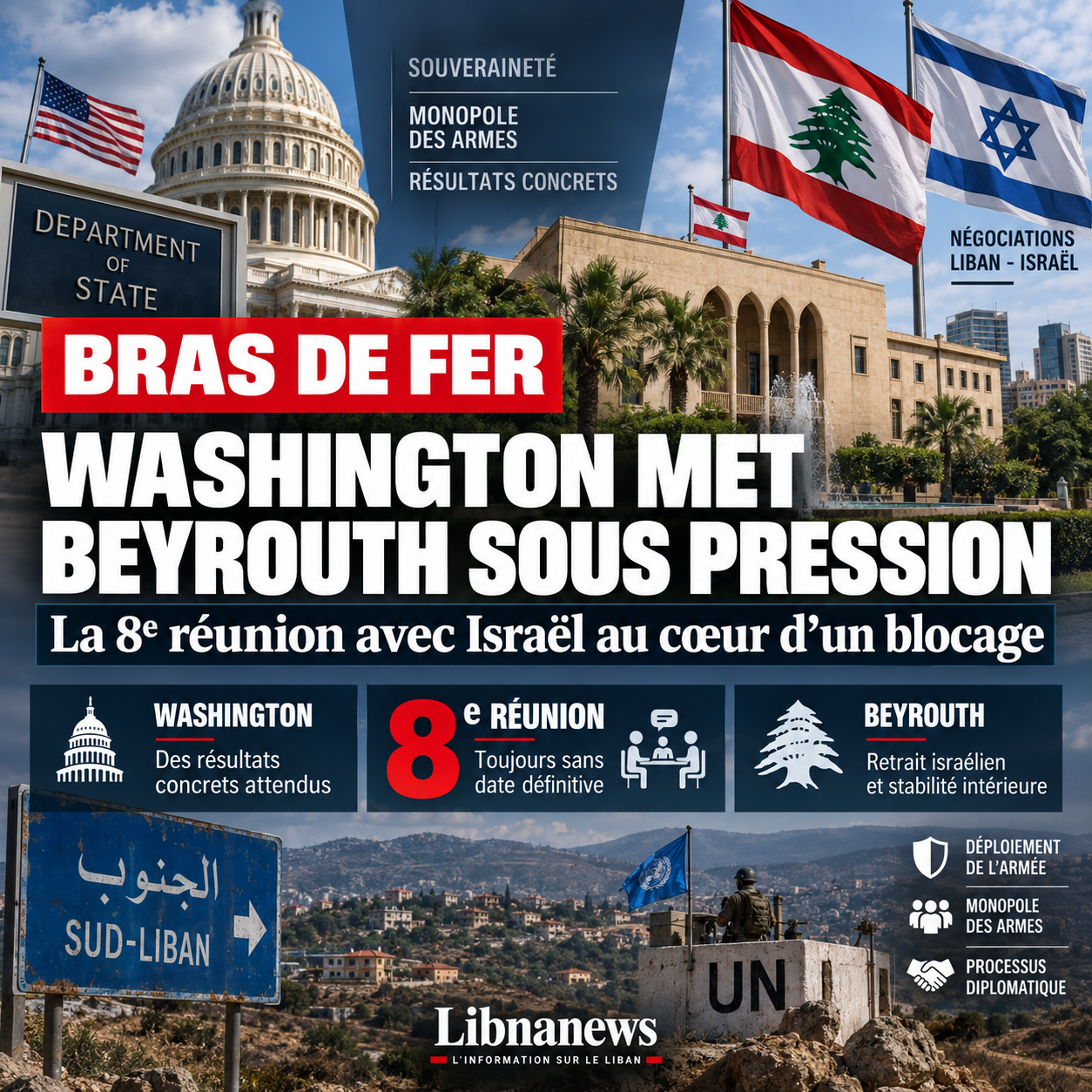
U.S. Pressure Now Beyond Official Statements
Diplomatic exchanges around Lebanon are entering a more delicate phase. Behind the public statements of support for the Lebanese State, discussions in Washington point to more precise demands. They concern the state monopoly of arms, the deployment of the army, the situation in the South and the continuation of negotiations with Israel. A number of information gathered from diplomatic circles thus describes an American administration that is now awaiting concrete results before going further in its support for Beirut.
According to recent visitors to Washington, American officials are questioning, among other things, the practical translation of the Lebanese authorities’ decisions on the arms monopoly. The problem would therefore no longer be confined to formal commitments. It would concern their application in the field. This distinction is essential. It explains some of the difficulties that are now surrounding relations between Beirut and Washington.
The US administration would consider that the positions announced by Lebanon on State authority, the role of the army and weapons should be accompanied by a timetable and verifiable measures. This assessment is reported by sources and does not constitute, in the available documents, an American position formalized in the form of a new ultimatum. It nevertheless shows the nature of the behind-the-scenes discussions.
The Lebanese authorities put another priority on their side: preserving internal stability. The risk of internal confrontations remains a central element of their approach. The State therefore seeks to move forward without provoking a confrontation likely to undermine civil peace. It is precisely this method that seems to be part of the disagreement with Washington.
In the reported exchanges, some US interlocutors distinguish between immediate stability and sustainable restoration of state authority. Their reasoning is that maintaining calm alone cannot be a long-term policy. They believe that sovereignty must also produce tangible changes on the ground. This approach places Beirut in the face of a difficult equation: to strengthen the authority of the State without causing the confrontation that Lebanese officials seek to avoid.
This pressure comes as the army already assumes important responsibilities in the South. It must accompany the return of the inhabitants, maintain security and act in areas affected by military operations. The Lebanese authorities also insist on the continuation of Israeli operations and their consequences. They therefore refuse to allow the question of sovereignty to be addressed solely through Lebanese obligations.
The South at the centre of the Washington-Beirut disagreement
Available information shows that the South has become the main field on which political commitments are assessed. Washington would like to see measurable results. Beirut replied that the situation could not be separated from Israeli operations, the Israeli presence in certain areas and the destruction that complicated the return of the inhabitants.
Another point of disagreement arises around the evaluation of the first experiments conducted in certain areas. According to information reported by visitors to Washington, Israel reported that American officials had been given a negative reading of these experiences. He claimed, inter alia, that Hezbollah members and executives had returned to certain sectors. Lebanon contests this presentation and considers that certain Israeli claims serve to delay diplomatic progress and maintain military pressure.
The dispute is therefore not limited to the facts observed on the ground. It also concerns their interpretation. For Israel, some developments would show that the current mechanisms are not sufficient. For the Lebanese authorities, Israeli accusations cannot be accepted without verification and must not become a pretext for the continuation of operations.
The Lebanese army itself defended its action and rejected the allegations of its role. His command insists on the cohesion of the institution, its presence on the ground and its mission to protect all Lebanese. This is beyond the military dimension. It directly affects the credibility of the State in a phase in which its foreign partners specifically ask it to strengthen its institutions.
The American questions would not be limited to the South. According to the same behind-the-scenes information, questions would also be asked about weapons in the Beirut area. The argument put forward is different: not all these weapons can be justified by confrontation with Israel. This extension of the debate shows that the issue of arms monopoly is seen by Washington as a national issue and not as an exclusively border problem.
Beirut is therefore faced with two simultaneous requests. The first concerns territorial control. The second concerns the resumption of the diplomatic process with Israel. These two cases are now closely linked.
An eighth meeting envisaged but still without a final timetable
The possibility of an eighth meeting between Lebanon and Israel is the other central element of the discussions. There are several reports of a draft new meeting, sometimes presented as a third meeting in Rome. The beginning of October was mentioned. However, there is no evidence that a final date has been set.
This caution is important. The existence of discussions on a new meeting does not mean that it is being held. Negotiations continue and several obstacles remain.
In particular, the aim would be to prevent the negotiating mechanism from falling into a form of paralysis. A new meeting would keep the channel open between the parties and resume the remaining unresolved issues. It would also give the United States the opportunity to continue to act as an intermediary.
However, the Israeli electoral calendar weighs on these discussions. The information gathered from the relevant circles describes an Israeli government that is particularly attentive to the internal political consequences of any concession or measure that may be presented as a setback. The Israeli elections thus become an additional factor in an already complex negotiation.
However, it would be excessive to conclude that the process was suspended until the election. The available sources speak instead of obstacles and uncertainties. They do not establish that a formal freezing decision has been taken.
A meeting at the US State Department between Lebanese and Israeli representatives would also have illustrated the depth of the differences. According to the information reported, the Israeli side submitted a long series of complaints about what it considers to be Lebanese breaches. This reading helps to complicate the organisation of a new session.
On the Lebanese side, the stake is different. Beirut wants the discussions to produce results on issues that directly affect its territory and population. The authorities point to the cessation of operations, the Israeli withdrawal, the return of the inhabitants, the disputed points and the treatment of the question of detainees. They refuse that the process should be reduced to the consideration of Israeli requests only.
The eighth possible meeting is thus taken between two logics. Washington is trying to maintain a mechanism for discussion. Israel emphasizes its security concerns. Lebanon, for its part, calls for concrete counterparts to show that the diplomatic path is actually producing results.
International aid between political support and new requirements
This negotiation adds another lever: international aid. The information gathered in Washington indicates that future support could increasingly be linked to the measures actually taken by the Lebanese authorities. Again, this reported trend should be distinguished from a single official condition which would have been announced by all Lebanese partners.
However, climate change appears in several cases. In preparing international support for the army and security forces, the interest of foreign partners remains real. But the discussions now also concern what the Lebanese State must accomplish itself.
France also seems to have brought its position closer to this logic. Paris supported the idea of an international mobilisation for Lebanon and continues to work on aid to the army. In the information gathered, however, economic aid is increasingly linked to reforms and institution-building.
This development is important for Beirut. For a long time, the international community has often justified its support by the need to avoid the country’s collapse. The logic that appears today is different. The partners still want to preserve stability, but in parallel they demand institutional, economic and security results.
However, Lebanon has arguments. It can recall the increasing responsibilities of the army, the economic difficulties, the destruction in the South and the cost of reconstruction. It may also point out that strengthening the State requires international resources. An institution that is being asked for more needs to be equipped to carry out its tasks.
That is why the debate on aid becomes circular. Partners ask for results before increasing their support. Beirut responded that some results required more support. All of the negotiations now involve overcoming this contradiction.
The meeting with Marco Rubio and the search for a release
Nawaf Salam’s efforts in the United States are particularly important in this context. The Prime Minister seeks to place Lebanon at the centre of regional and international consultations. Its meetings should also allow the direct presentation of Beirut’s position on the situation in the South, the future of the international presence and reconstruction.
The announced meeting with US Secretary of State Marco Rubio is an important moment in this sequence. It is intended to address directly the files on which the discrepancies have accumulated. In particular, the Lebanese objective is to maintain the American commitment to negotiations and to prevent the process from simply being pushed back on the Israeli calendar.
Beirut is also trying to convince Washington that a strategy based exclusively on pressure could produce the opposite effect of the one sought. The Lebanese authorities must take into account a fragile internal balance. An externally imposed acceleration could fuel political tensions as the state seeks to strengthen its authority.
However, Washington has its own priorities. The information reported shows that the US administration wants to measure progress through actions. Maintaining dialogue therefore does not exclude increased pressure.
In this context, the new meeting with Israel becomes a test. If it stands and produces progress, Beirut will be able to defend the idea that diplomacy remains capable of changing the situation on the ground. If delayed as military operations continue, the Lebanese authorities will find it more difficult to justify a negotiating strategy.
The stakes therefore far exceed the date of an eighth sitting. It concerns the credibility of the mechanism itself.
A negotiation where each party demands the first gesture of the other
The main obstacle finally appears in the order of stages. Washington wants concrete Lebanese measures. Israel links its withdrawal and security decisions to developments on the ground. On the contrary, Beirut believes that it is difficult to impose new realities as long as Israeli operations continue and commitments concerning Lebanese territory are not implemented.
Everyone thus awaits a first gesture from the other.
For the Lebanese authorities, an Israeli withdrawal and a reduction in operations would provide the State with a more favourable environment to strengthen its authority. For Israel, the prior strengthening of this authority is a security condition. For Washington, the question is to create a chain to get both.
That is precisely what the eighth meeting should try to unblock. Its importance lies not only in maintaining a diplomatic channel. It must show whether there is still a possibility of organizing parallel measures: Lebanese advances on the ground, Israeli measures in return and American guarantees to prevent a further breakup.
At this stage, the available documents do not indicate that such a compromise has been reached. On the contrary, they show still distant positions and increasing pressure.
Lebanon thus enters a period when its partners no longer appear to be satisfied with the general commitments. At the same time, Lebanese officials want to avoid a demand for acceleration becoming an internal destabilizing factor. Between these two imperatives is now an essential part of the relationship with Washington and the continuation of dialogue with Israel.
The question of the eighth meeting crystallizes this tension. Its possible holding in early October would be a signal of continuity, but not yet a breakthrough. Its prolonged postponement would instead reinforce questions about the future of the process. In both cases, the real indicator will remain the same: the ability of negotiations to produce verifiable changes on the ground, rather than a new sequence of meetings without immediate effect.