Baabda puts prevention of security vacuum first
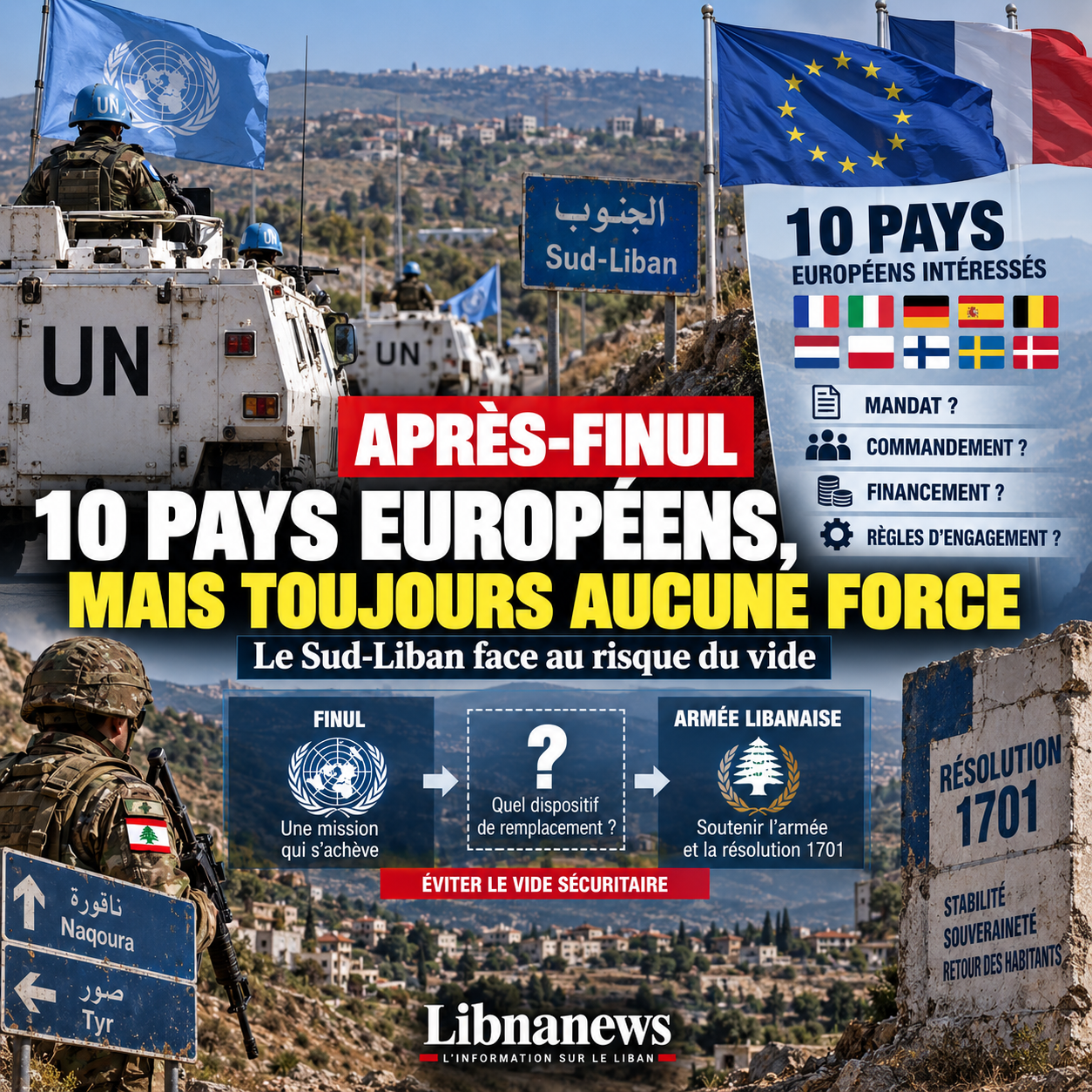
Within a few months of the planned end of the United Nations Interim Force in Lebanon mission, discussions on the successor arrangements are intensifying. However, they have not yet resulted in a definitive formula. Several scenarios are circulating in diplomatic exchanges. A European initiative is being studied. About 10 countries reportedly indicated their willingness to participate. However, neither its mandate nor its composition nor the modalities for its deployment have yet been finalized.
This uncertainty explains the message now being conveyed by the Lebanese authorities: the priority is to prevent the creation of a security vacuum in the South. The President of the Republic, Joseph Aoun, set out this position in his discussions with the British High Representative for Middle East Defence, Edward Ahlgren. The Head of State stated that Lebanon was prepared to host a replacement international force if the maintenance of Finul became impossible.
The envisaged mission should, in Lebanese design, contribute to the further implementation of resolution 1701 and support the army in the exercise of State authority up to internationally recognized borders. The challenge is not only to replace international soldiers with others. The aim is to preserve a security architecture that allows the Lebanese army to continue to receive international support in an area still marked by military operations.
Joseph Aoun warned above all that a disappearance of the Finul without a replacement device would create a dangerous vacuum. This concern takes on a particular dimension as long as the Israeli presence continues in certain areas and operations continue to be carried out in the South.
From this perspective, the question of international force cannot be separated from the return of the inhabitants. Villages affected by the fighting need a minimum of stability to allow the sustainable return of populations. The army must be able to plan its deployment and missions on the basis of a known framework. An indefinite period between the departure of one force and the eventual arrival of another would complicate these two objectives.
A European initiative exists, but no agreement is yet reached
The information gathered in the diplomatic circles refers to an Italian initiative also involving France. About 10 European countries have reportedly indicated their readiness to participate in a new force. This indication gives a political consistency to the project. However, it does not mean that a replacement force already exists.
No final agreement has yet been reached.
The most sensitive issues remain precisely those that will determine the feasibility of the project. Participating countries, their staff, funding and rules of engagement must be established. Above all, it is necessary to define the mandate of the future international presence and its relationship with the Lebanese army.
The question of the transition from the Final to a new mechanism is an additional difficulty. The United Nations force has experience accumulated for decades, facilities, logistics and a thorough knowledge of the ground. A new structure should prevent some of these capabilities from disappearing at the time of transition.
Operational continuity thus becomes almost as important as the composition of the force.
The consultations therefore concern a much more complex arrangement than a simple coalition of voluntary countries. A dozen states may declare themselves ready to contribute. Yet they must agree on the mission they will accept.
This distinction explains the prudence of diplomatic sources. The European project is real at the stage of discussions, but its transformation into a task force still depends on political and military decisions that have not been taken.
France pushes the project, but encounters several obstacles
Paris plays an active role in the discussions. France has been seeking for several months to preserve a significant international presence in Lebanon and to maintain its involvement in the Southern issue. It is also working to support the Lebanese army and has been involved in the preparation of an international mechanism to strengthen the capacities of security institutions.
In particular, Emmanuel Macron insisted that the preparatory work for the military and security support conference should not be delayed. This French mobilisation is accompanied by close exchanges with Italy on the post-Final.
But there are several obstacles.
There is evidence of Israeli opposition to certain options envisaged for the South. The French presence would be particularly sensitive in the discussions. However, it would be premature to infer that a definitive composition has already been rejected, since no complete formula is yet agreed.
Another unknown is the American position. Washington remains an indispensable player in any mechanism designed to operate sustainably in the South. However, the information gathered does not make it possible to conclude that the European project currently under discussion is definitively accepted by the United States.
Time also plays against negotiators. Building a multinational force requires political agreements, but also military preparation. It is necessary to identify units, organize the chain of command, establish rules of engagement, define relations with the Lebanese authorities and prepare logistical means. These decisions cannot be made a few days before a transition.
It is precisely for this reason that Beirut seeks to speed up consultations.
What mandate for the successors of the Blue Helmets?
The mandate is probably the most sensitive issue.
Finul operates within the framework of the United Nations and in accordance with specific resolutions. A successor force could take several forms. The documents available do not yet identify which will be retained.
For Lebanon, the preference expressed remains that of an international presence that helps the army to implement resolution 1701 and consolidate State authority. This formulation preserves the principle that sovereignty belongs to Lebanese institutions. The international force would therefore be intended to support these institutions, not to substitute for them.
Any significant change in prerogatives would immediately raise internal political issues.
Some Lebanese positions have already warned against the transformation of the international mission into a force with more extensive powers in the villages, including search and direct intervention. These concerns demonstrate how the definition of mandate can become a subject of internal confrontation.
The challenge is to strike a balance between operational effectiveness and political acceptability.
Too limited a force could be considered incapable of meeting international expectations. A force with much broader powers could encounter strong opposition in Lebanon and complicate its relationship with local populations.
To this is added the fundamental question of the relationship with the army. The Lebanese authorities present this as the pillar of the future mechanism. The international presence should therefore increase its capabilities and facilitate its deployment, rather than create a parallel security structure.
The army at the centre of the post-Final equation
At the same time, the army command insists on the cohesion of the institution and its ability to continue its missions despite pressure. During a visit to the commandos regiment in Roumieh, General Rodolphe Haykal emphasized the training of specialized units, the moral resistance of the military and their role in protecting all Lebanese.
This communication comes at a time when the army is called upon to assume more responsibility.
The future South will depend largely on its human, financial and material capabilities. A reduction in the international presence without a parallel increase in military resources would create an obvious difficulty. The Lebanese authorities use this argument precisely in their discussions with foreign partners.
A report on the needs of the army and the security forces was presented at a preparatory meeting in Paris. The Lebanese authorities claim to have received encouraging reactions. But again, the transformation of political commitments into effective financing and equipment is the decisive step.
After Finul is therefore directly linked to the Army Support Conference.
Beirut’s logic is to combine two elements: an international presence now a framework for stability and a progressively strengthened Lebanese army. The stated objective is for the State to exercise its full authority, without brutal international withdrawal imposing additional responsibilities without the corresponding means.
Israeli operations complicate preparations for transition
The preparation of a new system takes place while the situation on the ground remains unstable.
Israeli bombings, destruction and military movements continue to be reported in several areas of the South. The Lebanese authorities consider that these operations endanger the return of the inhabitants and complicate the work of the army.
Joseph Aoun also claims that Israel is not complying with the commitments made under the arrangements negotiated with the American mediation. He cites, inter alia, the continuation of operations, the destruction of houses, the questions relating to the disputed points of the Blue Line and the file of Lebanese detainees.
Under these circumstances, the disappearance of an international presence before the border stabilization could increase uncertainty.
The problem is not just military surveillance. The Finul also represents a link channel between the different parties. It helps to address incidents and prevent local events from taking on a larger dimension.
Any replacement structure should therefore probably take over at least part of this function.
The situation of the civilian population further reinforces this need. Several villages remain affected by destruction. Reconstruction, re-use of infrastructure and the return of residents are directly dependent on security developments. Without a stable framework, public and international investment in reconstruction would remain exposed to further destruction.
London enters into consultations on future arrangements
Edward Ahlgren’s visit to Beirut shows that consultations now go beyond the only Franco-Italian axis. The British official discussed with Joseph Aoun and Defence Minister Michel Menassa the challenges Lebanon could face after the end of the Finul mission.
Britain has renewed its support for the Lebanese army and state. The discussions also covered the various options envisaged for the following period.
This involvement does not necessarily mean that London has decided to participate militarily in a future force. There is no evidence to support this. It shows, however, that Western partners seek to anticipate the consequences of the transition.
Germany is also affected by the consultations. Discussions in New York focused on the need to maintain an international presence in the South and support for the army. Cyprus is also one of the interlocutors with whom Lebanon examines possible options.
Beirut thus seeks to build a network of support before final decisions are taken.
This diplomacy responds to a simple concern: do not wait until the last deadline to discover that no alternative is operational.
Ten interested countries do not yet make a force
The announcement of interest from a dozen European countries may give the impression that a solution is close. In fact, it is only a first step.
An international force requires a coherent political and military structure. Participating States should know under which authority their soldiers would be placed. They need to know their missions and the risks they will face. They must also determine under what circumstances they may use force.
Another problem is funding. The Finul is based on the United Nations system. A new coalition might require a different mechanism. The cost of deployment, transportation, bases, equipment and logistical support should be apportioned.
The legal status of soldiers should also be determined.
Finally, the relationship with Israel must be sufficiently clear to enable international units to carry out their mission without being exposed to permanent incidents. The same requirement applies to their relations with actors on the Lebanese side.
This explains why no official can yet present the European project as an acquired succession.
A Race Against the Calendar
The post-Final dossier thus becomes a race against time. The more time frame approaches without a device being defined, the greater the risk of a poorly prepared transition period.
Lebanon is seeking three guarantees. The first concerns the continuity of an international presence. The second concerns material and financial support to the army. The third concerns the creation of security conditions for the return of the inhabitants and the reconstruction of the South.
Foreign partners have their own requirements. They want to know the exact role of the army, the evolution of the arms monopoly and the ability of the authorities to exercise their sovereignty. Some also condition their support for further economic and administrative reforms.
After Finul became the meeting point for several cases that far exceeded the mission of the peacekeepers.
At the same time, the discussion focused on the border, the army, weapons, reconstruction, relations with Israel and international financial support.
For Joseph Aoun, the principle announced remains that there is no vacuum. For European partners, political will is beginning to take shape, but it still needs to be translated into an operational mechanism. Between these two positions remains a series of unresolved issues.
The figure of ten interested European countries is therefore an important political signal. It is not yet a guarantee. As long as the mandate, command, strength, rules of engagement and funding are not established, the South remains confronted with a time frame whose contours remain uncertain.