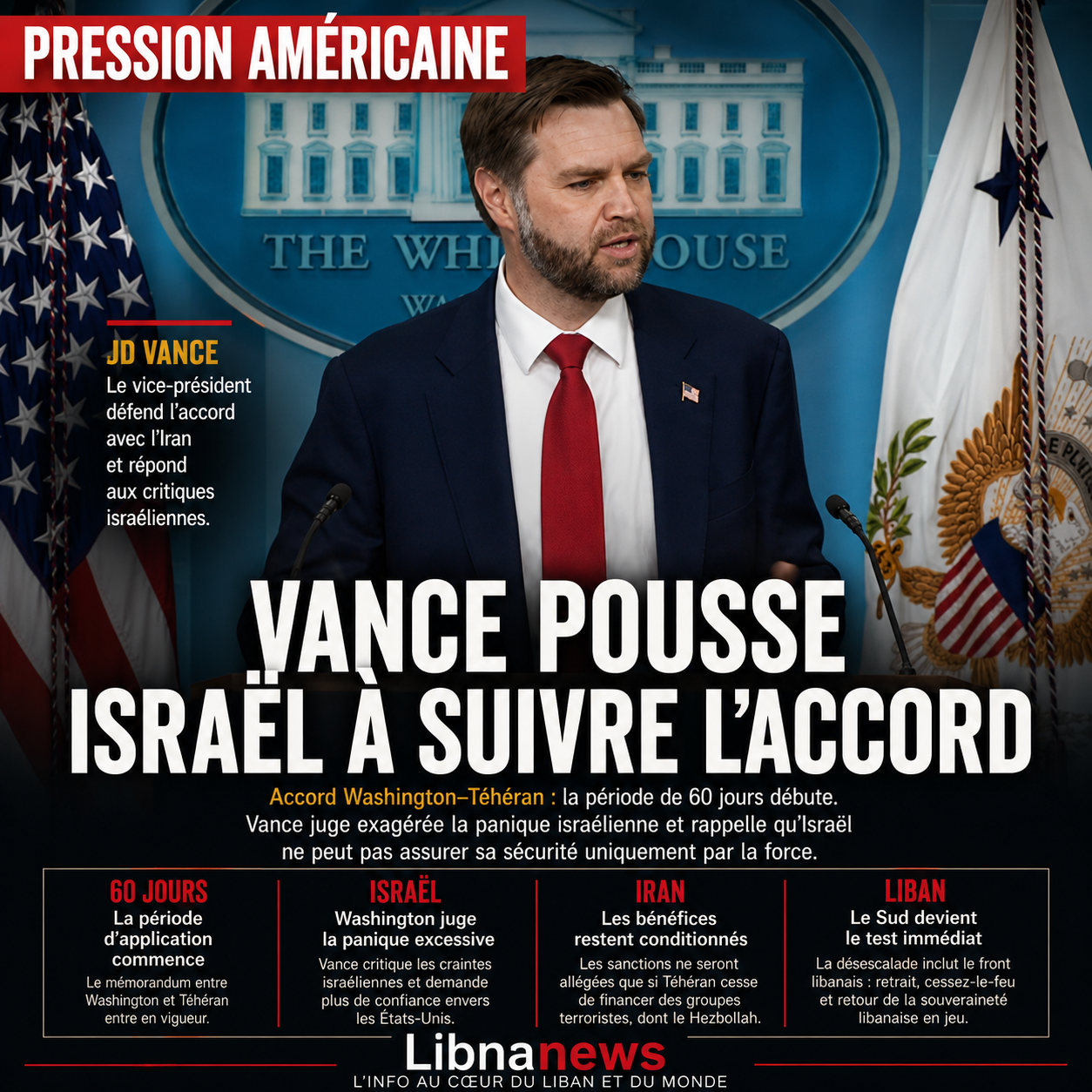
JD Vance defended the agreement between Washington and Tehran on 18 June by responding directly to Israel’s criticisms. The US Vice-President confirmed that the sixty-day period provided for in the memorandum is now beginning, that the United States is already beginning to implement its part of the text, and that Israeli concerns are based, in his view, on an excessive reading of the agreement. Without announcing any sanction against Israel, he sent a clear political message: the Trump administration wants the compromise to move forward, including on its regional implications, and believes that Israel cannot respond to all its security problems by military force alone. Lebanon, quoted in the context of de-escalation, is at the heart of this new pressure.
60 days now open
JD Vance first set the schedule. Asked about the agreement with Iran, he indicated that the 60-day period provided for in the memorandum officially begins on Thursday, 18 June. This clarification is not only administrative. It means that Washington considers the text to be in its implementation phase, although several points remain to be negotiated in the final framework.
The Vice-President also explained that the final negotiations will define the conditions for the continuation. The White House thus insists on the interim nature of the text. The agreement does not fix everything. It opens a period to transform a memorandum of understanding into a more comprehensive arrangement, including on the Hormuz Strait, sanctions, Iranian nuclear power and the regional consequences of the ceasefire.
This formulation allows Washington to respond to two opposing criticisms. To the opponents of the text, the administration says that concessions are not definitive and that the most sensitive subjects remain subject to negotiation. To those who supported rapid de-escalation, she said that the process was under way and that the United States did not retreat from Israeli or Republican objections.
For Lebanon, this sixty-day period becomes a central horizon. The Lebanese front is mentioned in the context of de-escalation. Israel and Hezbollah are not parties to the memorandum. But America’s pressure on Israel, Iranian expectations and Lebanese demands for withdrawal from the South will now come into play. If the agreement is to have a regional effect, South Lebanon will be one of the first test areas.
Washington claims to respect its part of the agreement
JD Vance also wanted to demonstrate that the United States is already implementing the first measures provided for in the Memorandum. According to the Associated Press, he reported that the United States Navy had allowed more than a dozen ships to pass to Iranian ports as part of the gradual lifting of the blockade. He presented this gesture as evidence that Washington respected its initial part of the military agreement.
The Vice-President also mentioned oil flows through the Darmuz Strait. According to the Agency’s reports, more than 12.5 million barrels are said to have passed through the Strait on Wednesday night, while two Iranian oil tankers loaded with 3.8 million barrels of crude oil would have crossed the system without being arrested. For the White House, these figures show that the agreement already has a practical effect on navigation and energy relaxation.
This part of the message targets the markets, allies and opponents of compromise. Washington wants to show that the text is not limited to a political declaration. It is already producing a change in American behaviour in the Gulf. It must also produce, in turn, Iranian changes on sensitive issues, including nuclear power and financing of armed organizations.
Vance therefore presents the agreement as a conditional mechanism. The United States can open maritime routes, reduce pressure and enter into negotiations. But the benefits to Iran will depend on its behaviour. This is one of the points he opposes Israeli critics.
Vance criticises Israeli panic
The hardest part concerns Israel. In an interview published the same day, JD Vance considered that he perceived, in the Israeli system, a strange form of panic around the deal. According to him, some Israeli officials assume that everything in favour of Iran will happen automatically, without Tehran changing its behaviour. He rejected this reading, stating that this is not how the agreement is drafted.
This comment directly targets Israeli officials who denounce a text that is too favourable in Tehran. For Vance, the agreement does not give Iran all the benefits without consideration. It provides for a progressive logic in which economic or diplomatic benefits depend on Iranian commitments. The White House wants to correct the idea that Iran would have obtained an immediate and free victory.
The Vice-President also challenged Israeli accusations that the agreement would strengthen Hezbollah. According to Reuters, he claimed that the United States would not lift the sanctions if Iran continued to fund an organization considered by Washington as a terrorist. This clarification clearly targets Israeli concerns about Hezbollah, as well as American critics who fear that the Iranian funds released will be used to strengthen Tehran’s regional allies.
So the message is double. Vance told Israel that his fears were exaggerated if they implied an unconditional agreement. He told Iran that financing Hezbollah or other armed groups would remain an obstacle to any serious reduction of sanctions. This point is central to Lebanon, since it directly links the agreement with Tehran to the regional role of Hezbollah.
« America earned confidence »
JD Vance also expressed his anger at Israel’s lack of confidence in the United States. He explained finding the Israeli reaction strange because it seems to come from a lack of confidence, while America, according to him, gained the confidence of this part of the world.
The Vice-President recalled that the United States had done much for Israel and its Government. He also rejected the idea that Washington had reached a bad agreement, believing that this accusation was not supported by the facts and did not take into account the depth of the American-Israeli relationship.
This is important because they do not come from an American official traditionally critical of Israel. JD Vance belongs to a republican administration that has long shown strong support for the Hebrew state. His criticism is therefore not that of a political opponent of Israel. It comes from an ally who believes that the Hebrew state should take more account of American interests and the accumulated confidence in the bilateral relationship.
The message sent to Benjamin Netanyahu is clear. Israel can express its reservations. But he cannot treat the American deal with Iran as a betrayal. Washington claims to have defended Israel for the long term and considers that its own reading of regional interest must now be taken seriously.
» We can’t solve everything by killing »
Vance’s most striking sentence is about the use of force. Responding to the harshest Israeli critics, he asked what exactly their proposal was. He recalled that Israel is a country of about nine million inhabitants and that it cannot solve each of its national security problems simply by killing.
This formula has a strong scope. It does not deny threats against Israel. Nor does it say that Israel must never use force. She claims that force cannot be the only strategy. In the Lebanese context, it echoes Donald Trump’s criticism of Israeli bombings of buildings in Lebanon. The U.S. President had suggested that Benjamin Netanyahu could adopt a more measured approach in Lebanon, particularly in his attacks against Hezbollah-related targets.
Vance therefore takes over a line that now seems to be assumed in Washington. Israel retains the right to security, but the United States no longer wants every regional problem to be addressed by military escalation. The agreement with Iran is based precisely on the idea that a war sequence can be converted into negotiations. It is this logic that the most radical Israeli leaders reject.
The reaction of Itamar Ben Gvir shows the depth of the disagreement. Israel’s far right minister replied that the Israeli proposal was to treat the « Nazis of the 21st century » as the United States treated the 20th century. This response confirms that, in part of the Israeli government, the logic remains that of a total confrontation with Iran and its allies.
Israel Invited to Join or Apply Dynamics
JD Vance did not formulate, in the public evidence available, a detailed legal injunction ordering Israel to apply each clause of the memorandum. Israel is not a party to the text signed with Iran. But the political message is clear: Washington wants the agreement to produce its regional effects, and Israel is urged not to sabotage it.
Two days earlier, Vance had already expressed confidence that Israel would eventually become a party to the arrangement. He claimed that the agreement would make Israel safer and make the entire region safer. This idea is reflected in its statements of 18 June: the White House does not present the text as a concession against Israel, but as a framework that must also protect Israel by reducing regional war.
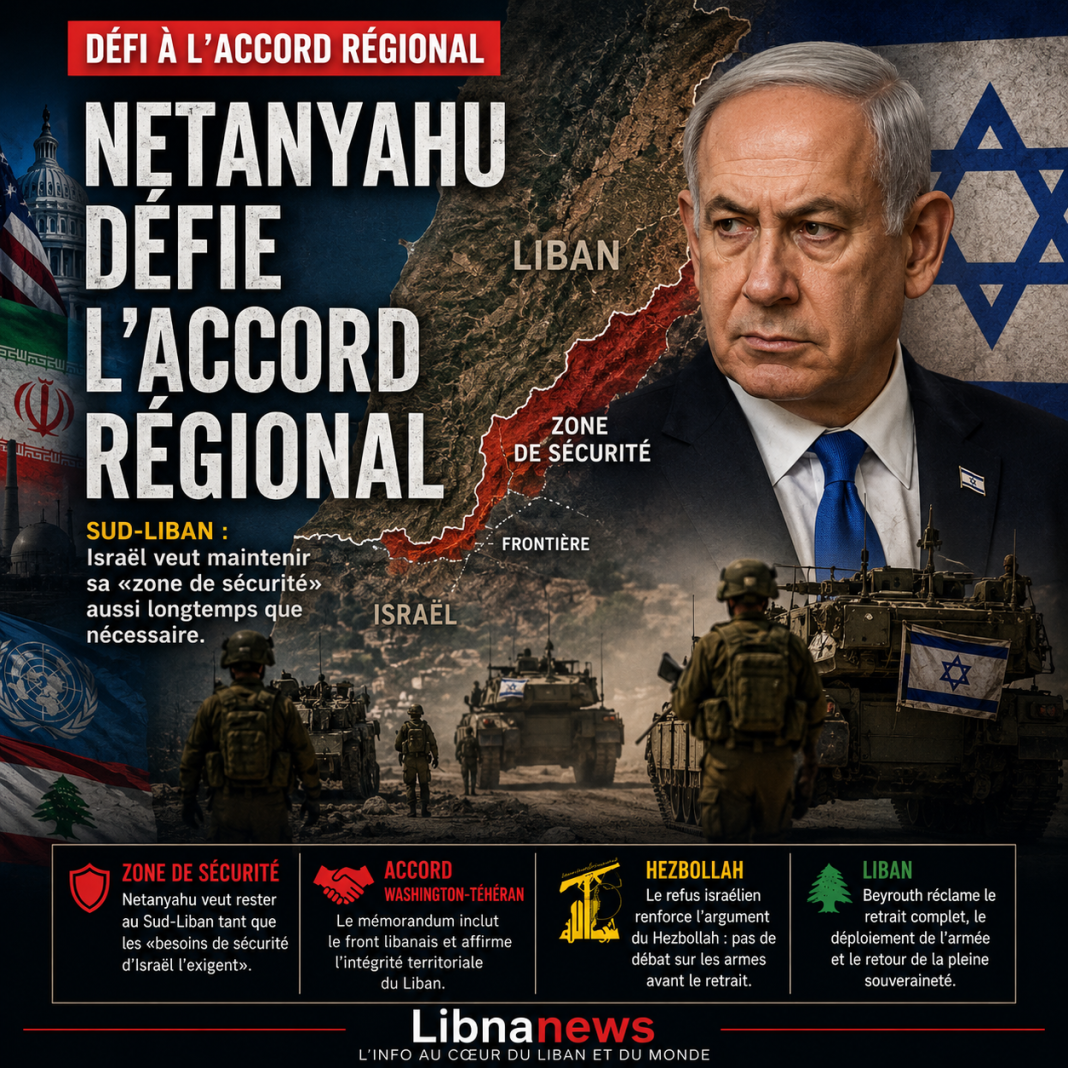
For the Netanyahu government, this position is difficult. Part of the Israeli security apparatus wants to preserve the freedom to strike in Lebanon, maintain a buffer zone and prevent Hezbollah from reconstituting its positions south of the Litani. But Washington believes that the de-escalation schedule must move forward. If Israel maintains its strikes or deployment in southern Lebanon, it may appear as the actor blocking Trump’s agreement.
The pressure therefore remains indirect, but real. Vance says the sixty-day period begins. He says the United States already respects their share. He says that Israeli critics exaggerate the benefits granted to Iran. He says that Israel cannot solve all its problems by killing. The political conclusion is difficult to avoid: Washington expects Israel to become part of the momentum of the agreement, even if it is not a direct signatory.
Lebanon, immediate test ground
Lebanon is the most sensitive area of this divergence. The American-Iranian agreement includes the Lebanese front in regional de-escalation. But Israel maintains positions in the South and continues to assert its right to act against Hezbollah. Hezbollah, on the other hand, refuses any debate on its weapons before the Israeli withdrawal. The Lebanese State demands that no one negotiates in its place and that its sovereignty be respected.
Vance’s comments give Beirut a new argument. If the United States considers that the period of application of the agreement is open, then Lebanon can request that the Lebanese side of de-escalation be taken seriously. This involves stopping the strikes, Israeli withdrawal from the occupied territories, the return of the displaced, the role of the Lebanese army and reconstruction.
But Vance did not give a public Israeli withdrawal calendar. Nor did he announce any sanction in case of Israeli refusal. The message remains political. He reports growing American pressure, without further detailing the instruments. The next round of Lebanese-American-Israeli negotiations in Washington will say whether this pressure is turning into concrete proposals.
The vice president wanted to regain control of the story. For him, the deal is not a free victory for Iran, nor an abandonment of Israel. It is an American tool to stop a war, reopen Hormuz, frame Tehran and prevent regional security from relying solely on force. This line puts Israel directly before a choice: to accompany the agreement, to challenge it without causing it to fail, or to risk a political confrontation with its main ally.
American Clarification Sequence
The press conference and Vance’s interview therefore clarify Washington’s position. The deal is interim, but it starts now. The United States is already implementing certain military and maritime commitments. The benefits for Iran will remain conditional. Israeli criticism is considered excessive. Military force cannot be the only response to threats. Israel must trust the American alliance.
This clarification does not put an end to tensions. She’s making them public. The Netanyahu government must now deal with a Trump administration that asks it to consider an agreement with Tehran. The most radical Israeli ministers reject this logic. Israeli military officials want to preserve freedom of action in Lebanon. The Lebanese are demanding Israeli withdrawal. Iran claims that the end of the southern occupation must be part of the continuation.
Vance did not close the debate. It opened a phase of political pressure. His words reflect a change of tone: Washington no longer only asks Iran to respect the agreement. He also called on Israel to stop treating the agreement as an automatic threat and to recognize that the US strategy now involves negotiation as much as it does by force.
The 60 days announced on June 18 became a period of truth. Iran will have to prove that it is changing its behaviour. Israel will have to decide how far it accepts American dynamics. Lebanon must defend its sovereignty without letting Tehran speak on its behalf. The United States will have to show that its words on de-escalation can be translated into South Lebanon, where the regional agreement will be judged not on statements, but on the cessation of strikes, the withdrawal of Israeli forces and the effective return of the State.