

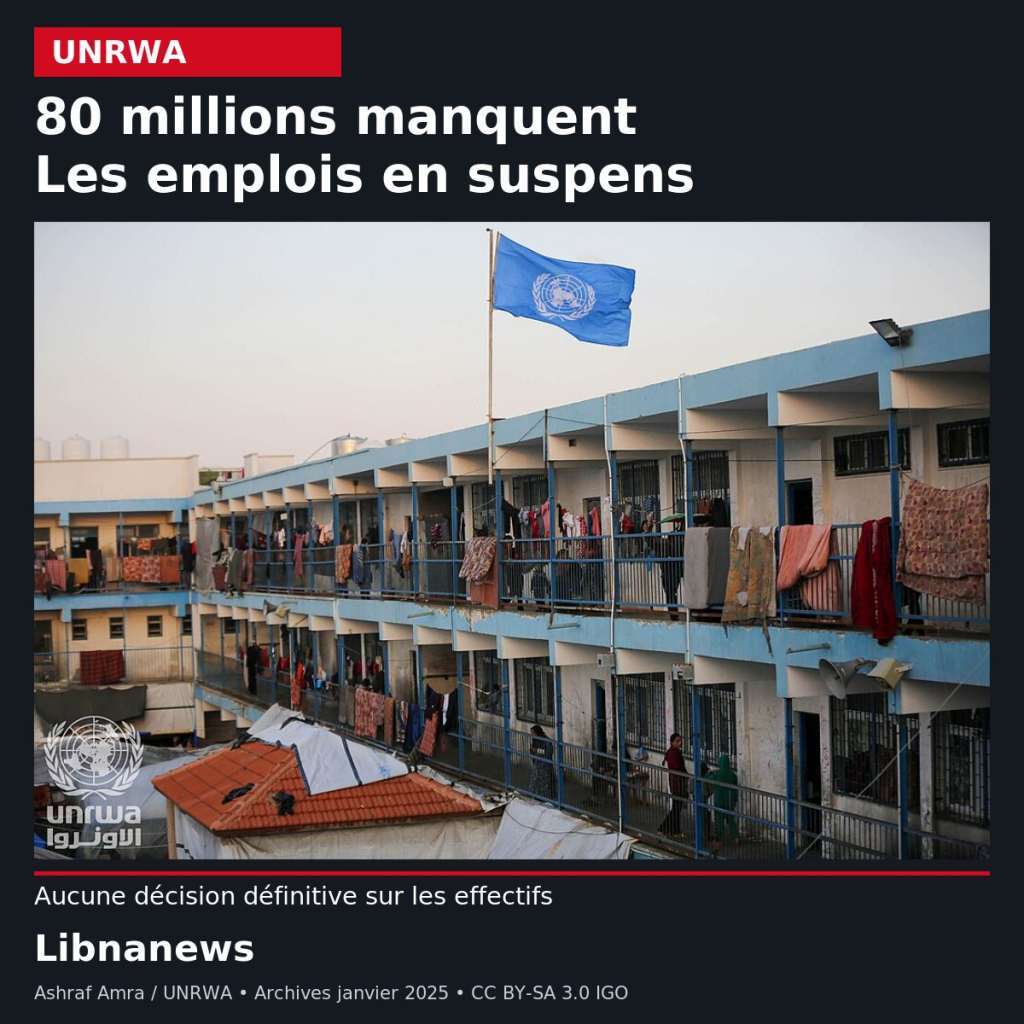
UNRWA is facing a cash deficit of $80 million and is considering adjustments to its operations. But the United Nations Agency for Palestinian Refugees states that no final decision has been taken on its staff or its scope of intervention. This reserve is central while a scenario of several thousand post deletions is circulating.
On 6 November, UN spokesman Stéphane Dujarric reaffirmed the support of António Guterres to the agency and requested full funding for its missions. The alert focuses on the ability to maintain essential services. It does not mean that the United Nations decided to end UNRWA.
UNRWA: an emergency cash flow
The $80 million shortfall is a cash requirement. The Agency distinguishes this immediate difficulty from the accumulated obligations and recurring burdens on its longer-term viability. The two problems come together, but they do not describe exactly the same constraint.
Cash determines the possibility of paying expenses at maturity. A political commitment to the Agency does not automatically become an amount available for its operations. To preserve services, contributions must be sufficient, but also predictable and timely.
UNRWA describes a combination of declining funding, uncertainty about contributions and increasing operational restrictions, particularly in Gaza. She explained that the savings that had been committed had helped to preserve jobs and services. However, it recognizes that the continuing pressure on resources affects the quality of certain services.
Funding and access to land are two distinct constraints. Additional resources alone do not remove the barriers that prevent teams from working. Conversely, the possibility of operating is not sufficient when the necessary resources are lacking.
Employment scenario still under review
Press reports reported a scenario of 7,000 to 8,000 job cuts. This volume is not an official decision. In its reply, the Agency states that several options remain under consideration and that a reduction in staff would only be envisaged in the absence of a viable alternative.
This wording does not permit the announcement of already notified redundancies or the exclusion of any risk to employment. It describes a decision that is still open, dependent on the financial and operational situation. No definitive timetable for abolishing posts is established in the available elements.
The agency has about 28,000 employees, mostly Palestinian. It presents them as the basis of its activities. Their work includes teaching, care and assistance to communities. A possible reduction would therefore have effects that would exceed the salary budget alone.
Since January 2026, UNRWA has mentioned a 20 per cent reduction in the week of service as one of the savings measures already undertaken. This reduction in service time does not correspond to the abolition of 20% of posts. Consolidating the two would give an erroneous picture of the situation of staff.
Five territories, no announced withdrawal from Lebanon
The Agency states that it continues its missions in its five areas of operation: Gaza, the West Bank, Jordan, Lebanon and Syria. It provides education, health, relief and assistance services. The financial crisis therefore affects one regional organisation, even if the constraints differ from one territory to another.
For Lebanon, no specific reduction or closure of service can be announced on the basis of the overall scenario. A range covering the whole agency does not allow a Lebanese share to be calculated. This would require decisions and geographical breakdown that are not established here.
The same caution is required for schools and health structures. The risk of degradation exists in the Agency’s financial alert. It does not arbitrarily identify an institution that would close or a benefit that would disappear on a given date.
The announced consultations with Member States, host countries, partners and refugee communities should contribute to the consideration of options. Their existence does not presume an agreement on the envisaged savings.
The mandate is not confused with funding
UNRWA recalls that its mandate rests with the UN General Assembly. Only the latter has the power to modify or terminate it. The Agency claims to continue its missions in this context, despite the difficulties that limit the resources available.
Thus, a cash crisis does not itself alter the mission entrusted to the institution. However, it may prevent it from being executed in good conditions. It is this gap between mandate and means that the appeal to donors seeks to reduce.
The immediate challenge remains the arrival of sustainable and predictable financing. Future decisions will need to clarify whether the measures under consideration become necessary, on what scope and with what consequences. For the time being, the lack of liquidity is confirmed; abolitions of reported posts are not a final decision.





Comments