

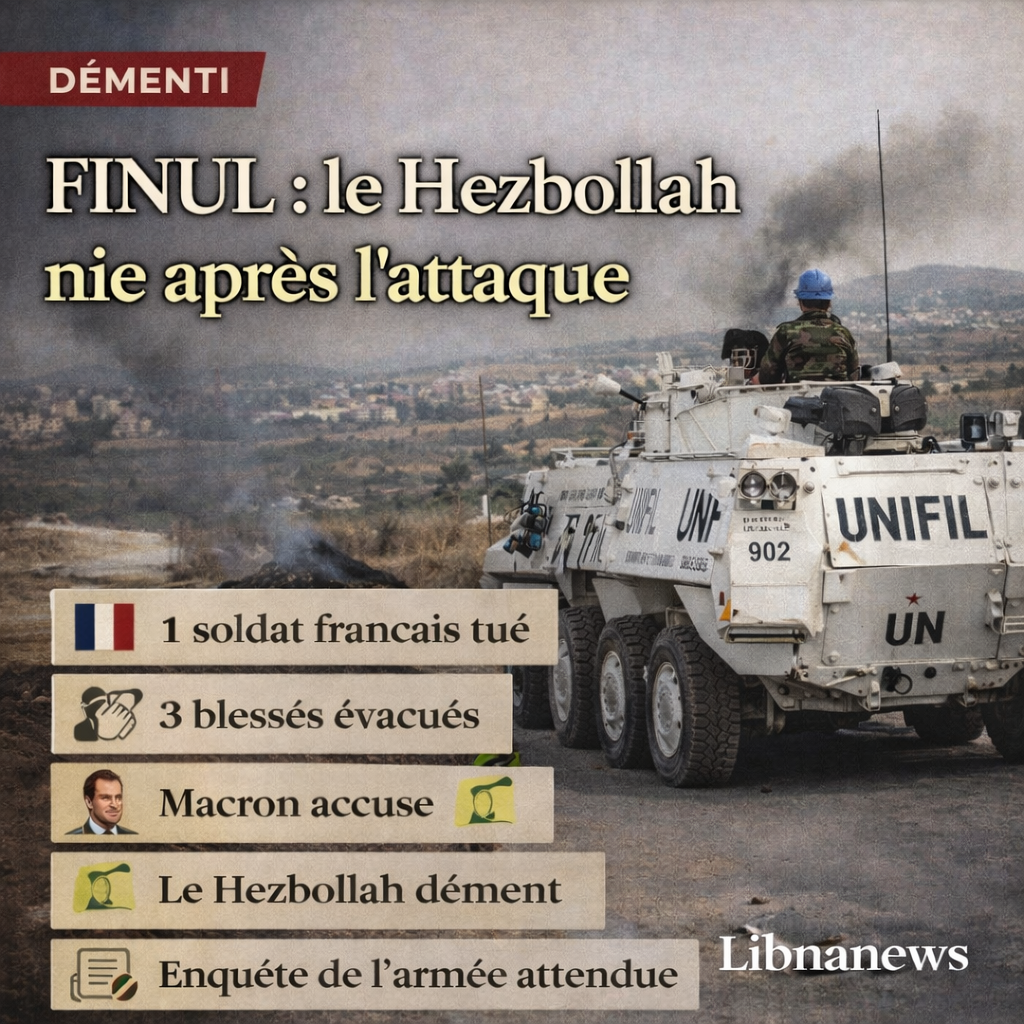
Hezbollah denied any involvement in the attack that killed a French UNIFIL soldier in southern Lebanon, at a time when the matter is taking a major political and diplomatic turn. This denial, published Saturday by the Shiite formation, comes a few hours after the accusations of French President Emmanuel Macron and after the official condemnations from Beirut. The President of the Republic Joseph Aoun and the President of the House Nabih Berri, on their part, denounced the attack on the United Nations mission, while the Lebanese investigation is now expected as an immediate test for the State on the second day of the ceasefire.
The killed soldier is Sergeant-Chief Florian Montorio of the 17th Regiment of Parachute Engineer Montauban. Three other French soldiers were injured in the attack. The tragedy occurred in southern Lebanon, when a UNIFIL patrol was operating in a still very unstable area despite the entry into force of the truce. The death of a French soldier gives an immediate charge to a case that Paris has been following closely for several weeks, but the denial of Hezbollah now prevents simple reading and turns the case into an open confrontation of stories.
So far, the French version dominated public space. Emmanuel Macron claimed that everything led to Hizbullah’s responsibility and called on the Lebanese authorities to arrest the perpetrators. A few hours later, Hezbollah rejected the charge. The movement denied any connection to what it described as « the UNIFIL incident » and called for caution in assigning responsibilities, asking to wait for the findings of the Lebanese army investigation.
This sequence change is not insignificant. This is no longer just a military tragedy affecting a contingent under UN mandate. The affair immediately became a Lebanese political dossier, a sensitive subject in the relationship between Paris and Beirut, and a new point of tension around the role of Hezbollah in the south of the country. The Lebanese government is thus faced with a twofold demand: to protect the relationship with France and the UN, while proving that it can produce a credible version of the facts in a security area where the state authority is still being tested.
Hezbollah denies responsibility
The Hizbullah communiqué was released by the National Information Agency in the morning. The movement denies any relationship with the incident that targeted UNIFIL. He calls for caution in « the launching of judgments and responsibilities » and explicitly refers to the Lebanese army’s investigation to establish the facts. The choice of words is very calibrated. The party is not content to say that it is not involved. He also questioned the speed with which some officials had identified a culprit before the investigation was completed.
This line of defence is important because it places the Lebanese army at the centre of the sequence. By asking to wait for the findings of the military investigation, Hezbollah does not refer to a vague commission or to a mere media controversy. It is based on an institution of the Lebanese State. This allows him to make a double speech. On the one hand, he rejects the French accusation. On the other hand, he avoids placing himself in front of the state apparatus, since he says he expects what the Lebanese military institution will say.
The communiqué also stresses the need to maintain cooperation between the people of the South, the Lebanese Army and UNIFIL. He stressed the importance of coordination between the UN mission and the army in the movement of the international force, especially in the current circumstances. This precision is nothing innocent. Partly it shifts the debate from direct responsibility to field management. Hezbollah suggests that the situation should be read from the operational context and conditions of movement in an area still marked by war.
This positioning can serve several purposes. First of all, it aims to prevent French accusations from being immediately considered as an established fact. It then seeks to prevent the party from automatically being placed in a situation of direct confrontation with the Lebanese State as it attempts to consolidate the ceasefire. Finally, it allows Hezbollah to present itself as a party calling for investigation, not as an actor refusing any procedure in advance.
But this denial doesn’t turn it off. On the contrary, it opens a more delicate stage. Because when a party denies and a foreign head of state accuses, the burden of proof falls even more strongly on the Lebanese investigation. If this one delays, doubt will dominate. If it is considered fuzzy, it will feed the challenge. And if it were to converge with the French reading, the political pressure on Hezbollah would go up a bit.
A fatal attack on the French contingent
Even before the battle of the versions, there are known facts of the drama. Staff Sergeant Florian Montorio was killed in an attack on a French UNIFIL patrol. Three of his comrades were wounded and then evacuated. The French authorities presented the scene as a very short-distance ambush, carried out against soldiers engaged in a mission to open a route to an isolated post for several days by fighting.
This precision is essential. The French patrol was not engaged in an autonomous offensive operation. It was acting within the mandate of the United Nations mission, in an area where roads, accesses and links remained very disrupted after weeks of bombing and confrontation. The mission was to reopen a route to a UNIFIL position. In this context, the attack takes the form of a direct attack on an international peace force, which immediately gives it a much heavier scope than a simple local armed incident.
The French version describes a direct light weapon fire that would have reached the NCO immediately. His comrades tried to rescue him under fire, without being able to revive him. The three injured further expand the gravity of the case. It is not an isolated episode in which only one soldier was hit in a confused context. It is a whole team that was hit during an operational mission.
For Paris, the impact is double. First, there is military mourning, with the name of a non-commissioned officer who fell into a peace operation. Then there is the political effect. When a French soldier is killed in UNIFIL, France sees not only an incident against the United Nations. It also sees this as an infringement of its own commitment, its military presence and the stability it seeks to defend in Lebanon.
The death of Florian Montorio therefore gives the case an immediate depth. It anchors the attack in French military memory and places southern Lebanon at the centre of political attention in Paris. In return, Lebanon finds itself faced with a clear demand: to demonstrate that this death will not remain without truth or follow-up.
Joseph Aoun condemns and promises prosecution
The Lebanese Presidency’s reaction was swift. According to the National Information Agency, Joseph Aoun met with Emmanuel Macron, to whom he offered his condolences after the death of the French soldier. The Head of State described the attack on international soldiers as a condemned and rejected act. He stated above all that Lebanon would not be indulgent in the prosecution of the persons involved.
This formulation marks a will of firmness. The Presidency is not content to deplore an incident or to offer diplomatic condolences. It seeks to show that the Lebanese State regards the attack as a serious attack on an international force legally present on its soil. By promising to prosecute those responsible, Joseph Aoun directly commits the credibility of the state.
His appeal with Emmanuel Macron is also a political gesture designed to preserve the relationship between Beirut and Paris. France plays a central role in international efforts around Lebanon, whether in support of UNIFIL, diplomatic support or stabilization of the South. An attack on the French contingent, followed by a direct accusation by Emmanuel Macron against Hezbollah, could quickly lead to severe bilateral tension. By reacting quickly, Joseph Aoun seeks to avoid this degradation.
The Presidency also links this matter to the post-ceasefire phase. According to the dispatch relayed by the official agency, the interview with Emmanuel Macron also covered the post-treve stage. This means that the drama is not isolated from the rest of the political sequence. It affects the stability of the ceasefire, the security of the ground and the ability of the State to maintain a minimum order as it claims to resume the initiative.
Joseph Aoun’s message is clear: the attack is condemned, France is recognized in mourning, and the Lebanese State intends to display a line of pursuit. But this line will only be judged on the results. In the coming hours, the question will be less whether Beirut condemns, than whether it actually manages to advance a credible investigation.
Nabih Berri condemns in turn
The Speaker of the Chamber, Nabih Berri, also responded, according to the National Information Agency. It condemned the attack on a French unit patrol operating within UNIFIL in southern Lebanon. The dispatch also stated that he had contacted the Commander-General to offer his condolences.
This reaction has a specific political significance. Nabih Berri is not only one of the country’s leading institutional leaders. He is also the leader of the Amal movement and one of the central actors of the Shiite balance in Lebanon. When he condemns an attack on French UNIFIL, his message is therefore read both as an institutional act and as an internal political signal.
The fact that he chose to join the command to offer his condolences adds a personal and official dimension to his reaction. This is not just a comment. It is a high-level political gesture, intended to make it clear that the attack on the French patrol cannot be trivialized.
The condemnation of Nabih Berri complements that of Joseph Aoun and that of the Prime Minister. Together, these reactions represent a consistent Lebanese official position: the attack is rejected, the investigation must be conducted, and Lebanon does not want to appear as a country tolerant of violence against the international mission. In the current context, this coherence is crucial in trying to protect the State from further diplomatic weakening.
But again, the unity of speech will not solve the crisis alone. The real question remains the question of execution. A presidential, governmental and parliamentary condemnation has weight. It will have a lasting effect only if it leads to a process of fact-finding recognized as serious by France, UNIFIL and all Lebanese partners.
Increased pressure on the Lebanese investigation
The denial of Hezbollah changes the function of the investigation. Initially, it was already a clear obligation after the death of a French soldier. Now, the survey is also becoming the only space that can separate now opposing versions. On the one hand, Paris claims that everything suggests a Hezbollah responsibility. On the other hand, the party denies and calls for the investigation of the Lebanese army.
This places the Lebanese authorities in a particularly difficult situation. If the investigation fails, Beirut will be accused of impotence. If it moves too slowly, the suspicion of choking will increase. If it does not produce solid elements, it will give way to a lasting confrontation of narratives. And if it were to confirm the track put forward by Emmanuel Macron, the Lebanese power would find itself facing a new ordeal of sovereignty against a leading armed actor.
At the same time, the UN is closely following developments in the case. UNIFIL cannot afford that a deadly attack on such a large contingent remains unclarified. The security of the entire mission is at stake. A peace force cannot function in an environment where attacks on its patrols are increasing without convincing accountability.
For France, the investigation has become a central point of the immediate relationship with Lebanon. Paris is not just asking for political condemnation. He is waiting for the Lebanese State to show that he can act as a reliable partner, able to deal with an extremely sensitive security issue, even when he touches one of the most powerful actors in the interior.
That is why Hezbollah’s insistence on waiting for the results of the army is in reality a way of shifting the entire political charge on the Lebanese state apparatus. The party protects its immediate position, but it also pushes Beirut to produce an official truth in a land where truth is always difficult to impose.
A truce wavering under the blows of the field
The incident occurs at the worst possible moment for the ceasefire. The truce was only in its first days. It was to provide a respite after a deadly war phase, facilitate the gradual return of civilians and open a political space for the continuation. The death of a French UNIFIL soldier, followed by a direct accusation against Hezbollah and then a formal denial of the movement, immediately casts light on this prospect.
On the ground, it means a simple thing: the South remains dangerous, even under truce. Roads have not become fully safe again. UNIFIL posts remain vulnerable. And military logic did not entirely leave room for a stabilization logic. As long as this reality persists, the ceasefire will appear less like a nascent peace than a high-tension suspension.
For the Lebanese authorities, this complicates everything. They sought to present the current period as a transition to a more controlled order: return of displaced persons, preparation of negotiations, strengthening of the State presence. The attack on the French contingent, and then the political battle that opens around its responsibility, recall that the first emergency still remains immediate security.
France, too, is seeing its position evolve. In a few hours, it moved from support for the ceasefire to direct defence of its contingent struck in a peace mission. This change of registry will inevitably affect the way he deals with the Lebanese case in the coming days. It introduces an emotional, military and political dimension that Paris cannot relegate to the background.
A file that already weighs on the Lebanese scene
The case is also not neutral within Lebanon. As soon as Emmanuel Macron mentioned Hezbollah, and then Hezbollah denied, the file became a revealing of national fracture lines. For those who support a strong state and a total monopoly on arms, the attack confirms the urgency of fully restoring state authority in the South. For Hezbollah’s supporters, the French accusation appears to be a premature or even interested designation in a still confused regional phase.
Joseph Aoun, Nabih Berri and Nawaf Salam each tried in their own way to prevent official Lebanon from being immediately drawn into this divide. All condemned the attack. All called for investigation and prosecution. This convergence is politically useful. It gives the feeling of a State speaking with one voice in the face of a serious incident.
But this facade unit will not be enough to defuse the suite. If the investigation is delayed or if it becomes contested, the divisions will return very quickly. The question will no longer be that of the perpetrator of the attack. It will become the relationship between the State, UNIFIL, France and armed actors in the South. In other words, a military drama can quickly turn into an internal political crisis.
Hezbollah, by publishing its denial via the official agency, clearly chose not to let the French accusation settle alone in the debate. This shows that the party fully measures the potential cost of this case. But it also shows that he knows that the heart of the game will be played less in the statement himself than in what the Lebanese investigation will say, or will not say.
An official version still awaited
At this time, the case remains suspended from a full official version that does not yet exist. There is one death, three injuries, a French accusation, a denial of Hezbollah, an immediate condemnation of the highest Lebanese authorities and a very strong expectation around the investigation. All the elements of a crisis are combined, except for the one that would stabilize it: a recognized public truth.
For Lebanon, the challenge is immense. He must show that he is not only able to express condolences or convictions, but also to establish the facts in an area where public authority remains fragile. For France, the challenge is to defend its contingent without derailing an already precarious diplomatic sequence. For UNIFIL, the challenge is to continue its mission while ensuring the safety of its troops. And for Hezbollah, the challenge now is to face a serious external accusation while protecting itself through the Lebanese official procedure.
The attack that cost Florian Montorio his life, therefore, did not only mourn the French contingent. It opened an additional political front in a region that did not need a new hotbed of tension. Hezbollah’s denial of the cards, but doesn’t close anything. On the contrary, it obliges each of the actors to reposition themselves around one question, now central: who will say, and when, what really happened in southern Lebanon?




