

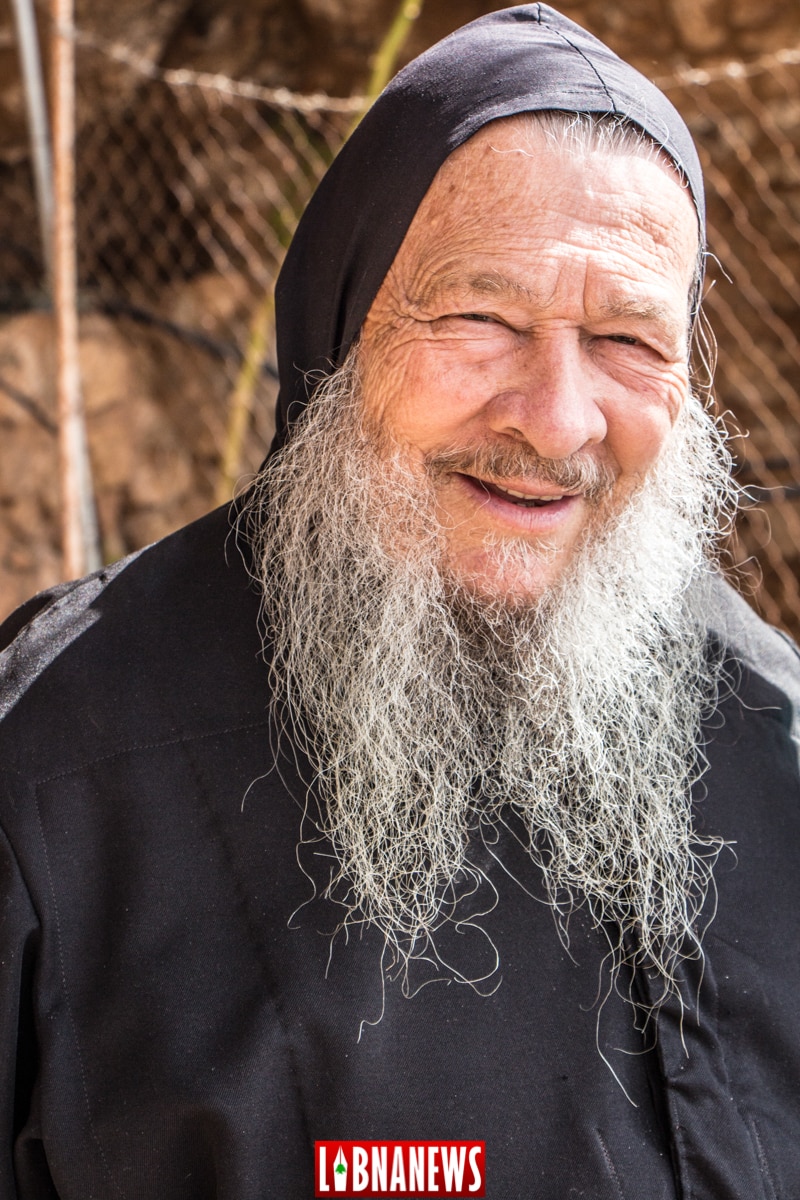
He had come from far away to disappear from the world, but Lebanon had eventually recognized him as one of its own. Father Dario Escobar, a Colombian priest who became a Maronite hermit in the Qannubine Valley, died at the age of 92, after a life under the sign of counting, prayer and a deep attachment to the Lebanese monastic tradition.
Born in Colombia in 1934, Father Dario Escobar had left an existence that could have been comfortable to follow a radically different path. Several accounts of his life remind him that he was from an affluent environment and that he had given up family fortune to enter into orders. His trajectory had led from Latin America to the United States, then to Lebanon, where he had found, in the cliffs of the Holy Valley, the place of a vocation that had become definitive.
A man from Colombia to live in the Holy Valley
The Qadisha is not just a decor. Classified as a UNESCO World Heritage Site with the Cedar Forest of God, it is one of the great spiritual landscapes of Lebanon, marked by rock monasteries, prayer caves, hermitages and the memory of the Christian communities who found refuge there over the centuries.
It was in this valley that Father Dario Escobar had chosen to live. He passed first through the monastery of Kfifan, then through the monastery of St.Antoine de Qozhaya, before settling in the hermitage of Our Lady of Hawqa, near Qannubaine. This progression says a lot of its route: not a tourist or romantic retreat, but a gradual entry into a demanding form of life, made up of silence, voluntary poverty and daily fidelity.
In Hawqa, his name became familiar to the inhabitants, walkers, pilgrims and visiting visitors. Father Dario was not a hermit cut off from all humanity. He lived away, but he welcomed. He prayed a long time, but he spoke willingly. Those who approached described a simple man, sometimes malicious, capable of moving from deep meditation to a humorous remark. National Geographic, who had dedicated a portrait to him in 2017, presented him as a Colombian Maronite monk who had been living in the mountain sanctuary for 17 years.
A chosen poverty, not suffered
In a country often torn by political fractures, economic crises and wars, Father Escobar’s figure had something unusual. He did not seek a forum, influence, or recognition. His message was in a life: leaving excess, reducing needs, living in a place, praying, cultivating, reading, receiving those who went up to him.
This poverty was not a posture. The ancient accounts show him alive in an austere cell, with few objects, a daily scanned by prayer, manual work and reading. In 2009, while he had been living in his hermitage for nine years, he explained that the one who tastes this life « would not want another. » This sentence sums up his inner freedom: giving up at home was not a loss, but a choice.
We must also recall what his presence meant to Lebanon. Father Dario Escobar was not Lebanese by birth. He became faithful. He had adopted the Maronite rite, the valley, its stones, its paths, its silences and its inhabitants. His life told a truth that the country sometimes forgets: Lebanon is not just a territory of crisis. There is also a land of spiritual attraction, able to call to it men from the other side of the world.
The Last Silence of a Watchman
The announcement of his death immediately took on a particular dimension in northern Lebanon. Several Lebanese media reported on the loss of the « recluse of Qannubin », pointing out that the Holy Valley was losing one of its best known figures. The press release states that the prayer for the rest of his soul will be celebrated Wednesday, May 20, 2026 at 4 p.m. at the monastery of St.Antoine the Great of Qozhaya, before his burial in the cemetery of the monastery.
His disappearance not only ends a singular biography. She’s closing a presence. In the valley, some hermits become almost landmarks, such as a bell, a path or a chapel. They don’t make news, but they give the landscape a human density. Father Dario Escobar was one of these discreet presences which recall that a country is also measured by those who pray in silence.
Lebanon, which has often seen its children leave, will have welcomed a man who has come elsewhere to die there. Perhaps this is the heart of his homage. Dario Escobar did not choose Lebanon to succeed. He chose him to disappear. And by disappearing, he leaves a deeper trace than many noisy existences: that of a man who took loneliness, faith and fidelity to a place seriously.
In the stone of Hawqa, in the steep roads of Qannoubine, in the memory of those who visited him, Father Dario will remain as a rare figure: a Colombian who became a hermit of Lebanon, a stranger who became familiar, a man of silence whose life has spoken long after him.




