

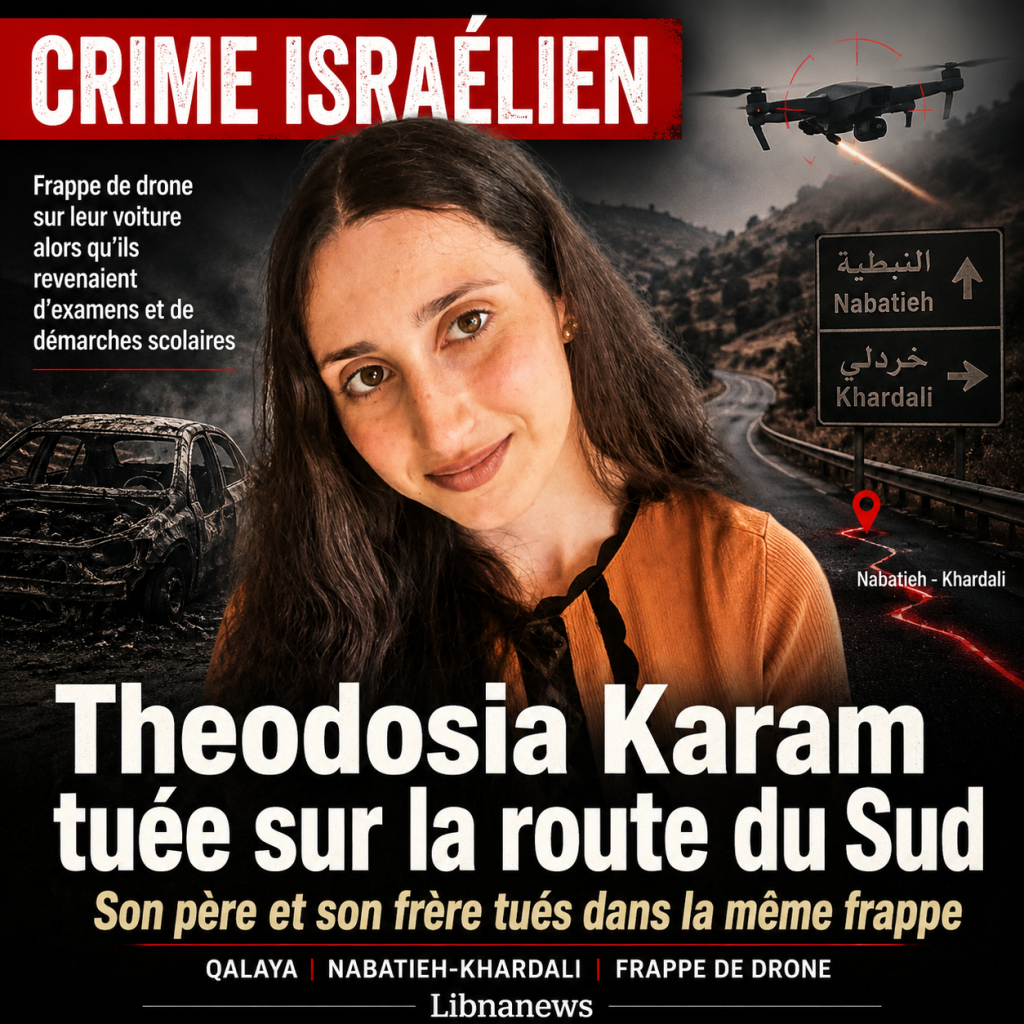
Theodosia Karam became, on Tuesday 2 June, the face of a war that caught up with civilians on ordinary roads in southern Lebanon. A student from Qalaya, she was killed with her father, Dr. James George Karam, a 61-year-old dentist according to relatives, and her 12-year-old brother Tony in a drone strike targeting their car this Monday on the Nabatieh-Khardali road. The family was returning from examinations and school procedures, according to the first evidence reported by Lebanese media and a public agency. The attack came as Washington had just announced a de-escalation between Israel and Hezbollah, without the ground confirming this pause.
Theodosia Karam, a broken trajectory on the road back
The strength of this drama lies first in its simplicity. A student takes an exam. His father is with him. Her younger brother is in the car. The family returned to Qalaya, a town in Marjayoun District. The journey passes through a space which has become dangerous, but which remains an artery of life for the inhabitants of the South. On the Nabatieh-Khardali road, the vehicle is targeted by a drone strike. All three occupants are killed.
The first local stories describe a day that began with academic and academic obligations. Theodosia Karam reportedly left Marjayoun with his father and brother to join a faculty, before returning again. Other information refers to a passage through Saida for examinations and studies. These nuances should be clarified by relatives and authorities. They do not change the central point: the car carried a family, in a civil displacement linked to education.
Father James George Karam was a dentist. The local media portray him as a resident of Qalaya. Relatives raised his age, 61. His daughter Theodosia attended university. His son Tony was still a child. No public information available at the time of writing established a combative function for the victims and there will be none, they were not combatants. This detail is essential because it shifts the reading of the event: it is not just a strike report, but a direct attack on civilian life.
The target car is not an abstract symbol. It embodies what war does to the most ordinary gestures. Going to university, taking an exam, accompanying his children, returning to the village: these acts become decisions at risk. In southern Lebanon, the road is no longer just a traffic space. It becomes a permanent exposure area, where each vehicle can be read by an army as a potential target, and by a family as the last way to stay anchored at home.
Nabatieh-Khardali road, civilian passage and military zone
The Nabatieh-Khardali road occupies a special place in the geography of the South. It connects spaces that matter for traffic between Nabatieh District and Marjayoun Sector. It serves villages, displaced families, businesses, schools and health services. In normal times, it is part of daily logistics. In times of war, it becomes a strategic corridor, monitored, struck, sometimes closed, often feared.
This dual nature explains the gravity of the attack. An army may consider a road to be used for hostile movements. Civilians often do not have another option. They borrow to treat themselves, study, seek food or join relatives. When military logic completely absorbs civilian logic, the risk of tragedy increases. The Karam case illustrates this shift. The family displacement was hit by a war of surveillance and targeted strikes.
For several weeks now, attacks on cars, motorcycles and roads have increased in southern Lebanon. The drone strikes allow a rapid and precise technical response. But their material accuracy does not guarantee the accuracy of identification. The choice of a vehicle as a target requires reliable information, a qualification of the target person and a risk assessment for civilians. When an entire family dies in a car, the question of this chain of decision becomes central.
The strike on the car of the Karams also occurred in a wider bombing sequence. In the same morning, Lebanese media reported further strikes and artillery fire in several areas of the South. Localities in Tyre District and Nabatiyah District were affected. Houses were destroyed. Roads were targeted. This context does not dilute the death of Theodosia Karam. On the contrary, it shows that this death is part of an intensification where the civilian and the military constantly intersect.
An announcement of a truce already contradicted by the field
The death of Theodosia Karam occurred less than 24 hours after a diplomatic sequence presented as decisive. Donald Trump claimed to have obtained, through contacts with Benjamin Netanyahu and high-level representatives related to Hezbollah, a halt to attacks between Israel and the Lebanese movement. The American president had said that Israel would not attack them and that they would not attack Israel. The announcement was to remove the risk of a strike on Beirut and pave the way for a de-escalation.
The field sent another message. Fires, interceptions, strikes and clashes were reported again in the night and in the morning. Israel maintained that its operations in southern Lebanon would continue. Hezbollah continued to present its actions as responses to Israeli progress and attacks on Lebanese territory. Between the political announcement and the actual cessation of hostilities, there was a gap. It was in this gap that the Karam car was hit.
The event reveals a major limitation of the ceasefires proclaimed without a clear mechanism. It is not enough for a leader to announce a break. Chains of command must be ordered, units must cease operations, drones must be recalled, rules of engagement must change, and each camp must understand the cost of a violation. There is no indication in the early hours of Tuesday that such a device was already working. Thus, civilians continued to live under fire, despite statements.
This contradiction is politically explosive. For Washington, the death of a student, her father and her brother weakens the story of a controlled de-escalation. For Beirut, it confirms that the protection of civilians cannot depend on a simple telephone exchange between powers. For Israel, it raises the question of intelligence and the choice of targets. For Hezbollah, it offers an additional argument to deny a truce limited to certain areas, such as Beirut, if roads and villages in the South remain exposed.
Qalaya, Southern village and memory of interior exile
Qalaya is not only the place of origin of the victims. It is a southern town marked by border tensions, displacement, incomplete returns and fear of a long war. Like other villages in Marjayoun District, she lives at the pace of alerts, road cuts, news from relatives and difficult decisions. Leaving means losing an anchor. Staying means accepting danger. Many families navigate between these two imperatives.
The death of the Karams thus affects an entire community. In the villages of the South, the disappearance of a family is not a matter of fact. She reorganizes daily life. Neighbors know the father, comrades know the girl, teachers know the child. Grief becomes collective, because war turns every victim into a possible mirror. Everyone wonders what route could have been his, what examination might have been his child’s, what car could have been targeted.
Education gives this tragedy a special significance. End-of-year exams require travel, even when war makes travel dangerous. Universities and schools sometimes maintain a schedule to preserve a form of normality. Families live up to it, because study remains a promise of the future. But this normality has a cost. In the case of Theodosia Karam, the university did not protect against war. She even included fatal displacement in an educational routine.
This dimension explains the emotion aroused by his name. Theodosia Karam was not a political leader. She wasn’t a military figure. She represented a youth who tried to continue her studies despite strikes, checkpoints, rare essence, sleepless nights and uncertain roads. His death recalls that war not only kills fighters, but not just destroys buildings. It cuts paths, erases possible diplomas, and turns the family future into a death file.
The question of civil qualification
Legal analysis must remain prudent, but it cannot be avoided. In international humanitarian law, parties to a conflict must distinguish between combatants and civilians. They must also assess the proportionality of an attack and take precautions to avoid or limit civilian casualties. A civilian car can become a legitimate target if it transports a person or equipment directly involved in hostilities. But this qualification must be based on serious elements, not on a general presumption related to the road used.
In this case, the information available on the Lebanese side describes three civilian victims: a dentist, his student daughter and his minor son. There is no public input to explain why their vehicle was targeted. No detailed claim by the Israeli army on this precise strike was available in the initial information. This absence alone does not prove the illegality of the attack. However, a verifiable explanation is essential.
Transparency is all the more necessary as drone strikes are often presented as surgical. The argument of technical precision can mask a deeper fragility: the error of identification. A drone can reach exactly the designated vehicle and kill the wrong people. The accuracy of the shooting is not worth the intelligence. This is why the investigation must focus not only on the projectile, but on the decision: who identified the car, on what basis, with what time, and with what knowledge of the presence of a child and establishing the accusations of war crime.
Lebanon also has a responsibility. Its authorities must document victims, preserve evidence, establish the circumstances of the journey, confirm identities and transmit a coherent file to the competent authorities. In a war saturated with competing narratives, rigour is a protection. It prevents the disappearance of names in confusion. It gives families something other than immediate indignation: a beginning of proceedings, even if limited, even slow, even fragile.
A strike on negotiation
The attack schedule worsens its scope. The day before, the United States tried to prevent an Israeli strike on Beirut. Iran was linking further discussions with Washington to a ceasefire on all fronts. Hezbollah refused a truce that would save only the Lebanese capital. Israel claimed to want to continue its operations in the South. The death of Karams gives human content to this strategic debate. It shows what a partial truce actually means.
If Beirut is protected but the roads in the South remain open to strikes, de-escalation will not be seen as a ceasefire. It will be understood as a hierarchy of lives and territories. The capital deserves a red line, but villages and border axes would remain in a grey area where killing indifferently seems to be allowed. She feeds local anger. It gives armed actors arguments to continue.
For Israel, maintaining military pressure in the South is aimed at preventing Hezbollah from rebuilding its capabilities near the border. This logic responds to a strong demand for security in northern Israel. But there is one reality: every strike affecting civilians reduces diplomatic space and reinforces this feeling of injustice. It increases the international cost of the campaign. It complicates the American position. It makes the Lebanese authorities less able to defend a compromise formula before their public opinion.
For Hezbollah, the death of a Qalaya family can be integrated into a narrative of resistance to occupation and strikes. But this account does not answer the central question asked of the Lebanese: how to protect civilians, and not just turn their death into a political argument? The Karam tragedy puts all actors before their responsibilities. She questions Israel about its targets. She asked Hezbollah about the sustainable militarization of the South. It questions the Lebanese State about its ability to impose effective protection.
The civilian daily as a battlefield
The Khardali strike shows that the front is no longer limited to military positions. It travels through examination schedules, family trips, secondary roads and partially emptied villages. The battlefield becomes discontinuous. It arises in a bend, near a bridge, at the entrance of a village, on the return of a faculty. This transformation makes war more difficult for civilians to read. We don’t know exactly where the danger begins or when it stops.
The families of the South must arbitrate permanently. Should we send a child to the exam? Should we go back to the village? Should we take the road early, late, alone or family? Should we stay close to his office, his school, his land, or accept internal exile? These decisions would already be heavy in normal times. Under drones, they become almost impossible. The case of Theodosia Karam shows that a reasonable decision, going through an examination and returning, can result in a total loss.
Lebanese society is receiving this type of tragedy with deep fatigue. Each name adds to other names. Each locality joins an already dense mourning card. The risk is usual. Repeating strikes can turn indignation into background noise. This is precisely what journalistic writing should avoid. Named Theodosia, James and Tony Karam, it is preventing their disappearance in a statistic. It is also a reminder that war is measured in identifiable lives, not just in press releases.
The next item is the full confirmation of identities, ages, the exact route and the circumstances of the attack. The Lebanese authorities will have to say what they can establish. The Israeli army will have to explain whether it claims this strike, what target it was planning and what precautions were taken. The American mediators will have to say whether the announcement of a halt to the shooting really includes the roads of South Lebanon, or whether the civilians will continue to circulate in a truce that does not yet stop the drones.




