

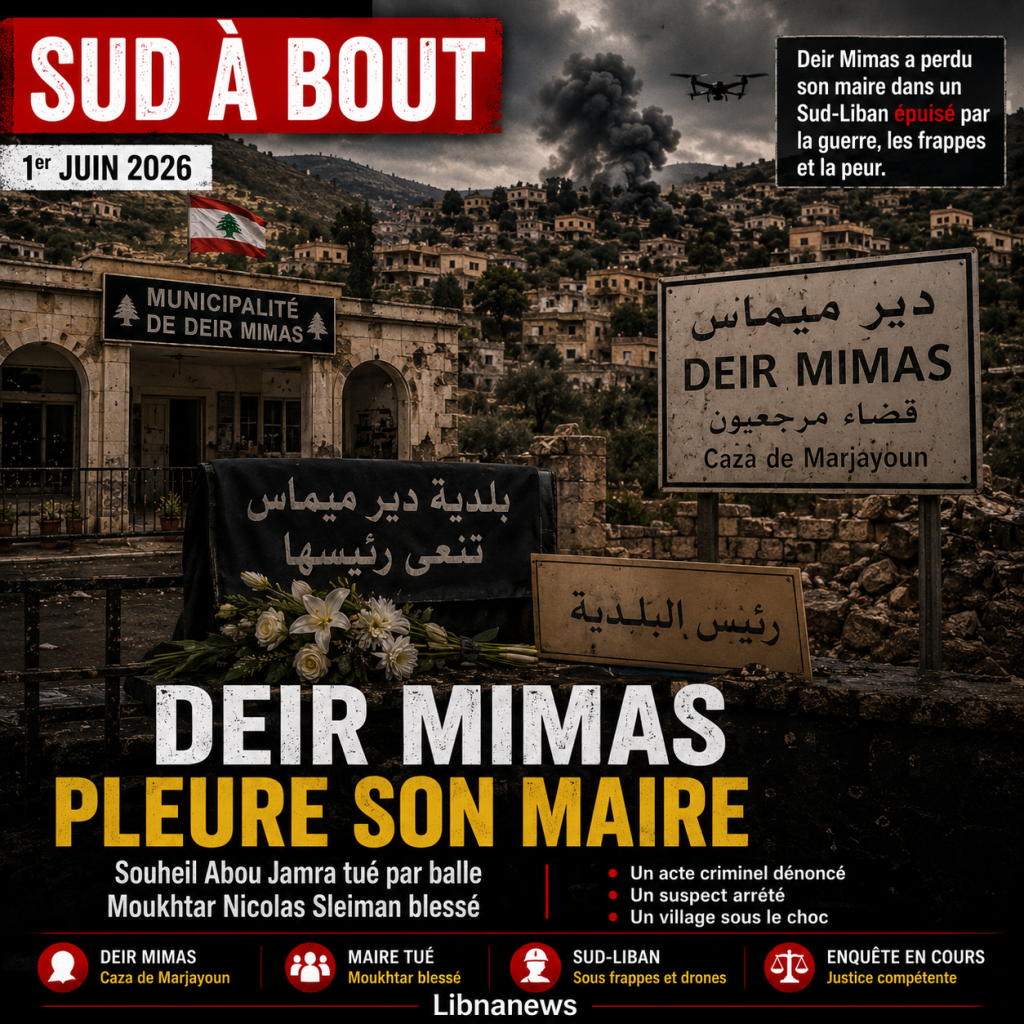
Deir Mimas lost his mayor in an area already worked by fear, bombing and war wear and tear. Souheil Abu Jamra, president of the municipality, was shot dead on 1 June in this town in Marjayoun District. Mukhtar Nicolas Sleiman was wounded. The Lebanese Army announced the arrest of a citizen identified by his initials, F.B., suspected of having opened fire. The municipality denounced a criminal act. The Bechara family, from whom the alleged shooter came according to their own press release, disbanded the act and called for justice to do its job.
Reducing this tragedy to a single fact would be insufficient. The investigation must establish the motive, the exact circumstances and the individual responsibilities. But it does not take place in an ordinary village or in ordinary times. Deir Mimas is located in southern Lebanon, in the heart of an area that has been subjected for months to strikes, fire, drones, displacement and pressure from an Israeli war that exhausts the inhabitants. This war doesn’t justify murder. She doesn’t explain it to herself. However, it makes nerves alive, weakens local mediation and turns each conflict into a more serious risk.
Deir Mimas in shock
The established fact lies first in the military communiqué. On 1 June, a citizen shot Souheil Abu Jamra in Deir Mimas, Marjayoun District. The shooting caused his death and wounded Nicolas Sleiman, the local mukhtar. An army unit intervened, conducted a search and arrested the alleged shooter. The military institution reported that the investigation had begun under the supervision of the competent judiciary. That precision counts. In a locality hit by shock, it sets the legal framework and avoids anger becoming private justice.
The municipality presented its president as a dead man while performing his duty to the inhabitants. His statement denounced in the strongest terms the criminal act and called the population for calm, wisdom and respect for the course of investigations. She also wished a speedy recovery to the wounded mukhtar. This official speech seeks to maintain a line of order at a time when fear, rumours and family affiliations can quickly aggravate the initial shock.
The Bechara family has also published a significant message. She expressed her condolences to the people of Deir Mimas and to the Abu Jamra family. She declared her complete break with the shameful act of Fouzi Bechara, according to the terms of the locally reported statement. It stated that it refused to violate security and civil peace. In a village, this sentence has a precise weight. It attempts to prevent an individual act from being transformed into collective responsibility. She recalls that the suspect will have to answer to the court, not train with him a name, a family or a neighbourhood.
This distinction is indispensable. Lebanese villages are still based on local balance. Relationships, memories of conflicts, local alliances and reputations are moving rapidly. A shooting against a mayor can become, within hours, a matter of families, clans or camps. Risk is not theoretical. In a space already saturated by military tensions, the temptation to designate an entire group behind an act is strong. The Bechara communiqué is breaking this possibility. That of the municipality goes in the same direction by referring the case to the courts.
An investigation without rumor
The analysis must therefore proceed with caution. The motive is not publicly established. The available information refers to an incident whose contours remain to be specified. Some local sources mentioned an individual dispute. Others stressed the opacity of the circumstances. None of these forms is sufficient to close the file. It will be necessary to know where the exchange occurred, what preceded the shooting, what weapon was used, whether witnesses were present, and in what condition the suspect was at the time of the shooting. These issues are investigated. They should not be replaced by assumptions.
But the context is known. Deir Mimas belongs to a South Lebanon where the Israeli war shifted the markers of daily life. In the Marjayoun area, the inhabitants live with drone noise, explosions, monitored roads, precipitated departures and incomplete returns. Nearby localities have suffered strikes, destruction and incursions. The resumption of Beaufort Castle by the Israeli army revived the memory of the southern occupation until 2000. In this geography, every village knows itself close to the front, even when it is not directly targeted at every hour.
Israeli fire is not a distant setting for Deir Mimas. They structure the day. They sometimes decide to open a business, a journey to Marjayoun, a return to the village or a departure to a safer area. Families listen to the news before they get on the road. Local elected officials must respond to concerned residents, damaged buildings, water, electricity, transport and relief needs. The mayor and the mukhtar therefore do not only work within an administrative framework. They work in a village under constant tension.
This is where the expression often heard in the South makes sense: war makes people crazy. It must be understood as a social formula, not as a medical diagnosis. War uses, narrows the horizon, exhausts sleep, increases anger and damages mediation. She doesn’t turn everyone into violent. It does not remove the criminal responsibility of the shooter. But it creates a climate where disputes get tougher, where words rise faster, where permanent fear reduces the ability to retreat. In this climate, a local elected official often becomes the screen on which requests, frustrations and emergencies are projected.
The Israeli War as Daily Pressure
The role of a mayor, in these circumstances, becomes much heavier than what the texts provide. Souheil Abu Jamra was to manage the ordinary files of a municipality, but also the extraordinary of a southern village at war. Roads, water, shelter, aid, damage, returned families, the elderly remaining in the country, and displaced people are a single burden. The mayor is the one called when the state seems far away. It receives complaints, tries to transmit requests, calms conflicts, coordinates with the authorities and embodies local continuity.
The mukhtar Nicolas Sleiman held an equally exposed position. The mukhtar signs, attests, knows the families and serves as an administrative relay. In the villages, it embodies a practical memory of the inhabitants. His wound shows that the shooting hit the heart of the local authority. She didn’t just kill a municipal president. It has reached the point where the village processes its documents, mediations and emergencies. This dimension reinforces the shock. Deir Mimas loses one voice and sees another institutional figure falling under bullets.
The Israeli war adds to this fragility direct pressure on local institutions. When the bombings are repeated, the municipalities become crisis cells without sufficient resources. They must manage the consequences of a war they do not decide. They receive residents who demand repairs, guarantees, an open road, transport, reliable information. They also have to deal with the fear of drones and the possibility of shooting at any time. This daily tension can spill over into local relations, especially when resources are lacking and the central state seems to be absent.
The danger would be to confuse context and causality. The Israeli war weighs on Deir Mimas. She’s ruining lives. It increases instability. But it does not allow, at this stage, to say why the suspect fired. Only the investigation can establish the motive. Journalistic work therefore consists in keeping the two truths together. On the one hand, the alleged perpetrator’s responsibility remains individual. On the other hand, murder occurs in a South that is subjected to deep violence, where war is putting pressure on bodies, nerves and institutions.
South Lebanon under drones, shells and occupation
This reading is all the more necessary as southern Lebanon goes through a phase of escalation. Israel extended its operations beyond certain security lines and struck many areas of the South and East. The results reported in recent days indicate dozens of deaths and injuries in Israeli strikes. Houses were destroyed. Civilians have been displaced. Localities of Marjayoun, Nabatiyah, Tyre and Bint Jbeil lived under drones and shells. In this landscape, Deir Mimas is not isolated. It belongs to a continuity of fear that affects the whole south of the country.
The situation around Beaufort reinforced this feeling. The position dominates a part of the South and refers to a heavy history. For Israel, its recovery is presented as a strategic advantage. For many Lebanese, it awakens the memory of a long occupation, military posts, controlled roads and villages caught between several forces. Deir Mimas, Marjayoun, Qalaya, Khiam and nearby communities live with this memory. When a symbol of the old occupation returns to military news, fear is not only present. It also feeds on the past.
The Christian villages in the Marjayoun and Hasbaya areas are particularly concerned. Several thousand inhabitants, according to recent media reports, remain caught between the refusal to leave their homes and the increase in violence. Some have already experienced internal exile, occupation, closed roads and uncertainty. Their attachment to the village is strong. Leaving means sometimes abandoning a house, olive trees, a business, a church, a family memory. Staying means accepting the risk of shooting. This tension imposes on every domestic decision.
Deir Mimas is also a village of land, olive trees and close family ties. War attacks both material space and moral balance. It destroys infrastructure, but also habits. It turns the road into a safety calculation. She turns the night into sleep. It turns the mayor into a permanent remedy. It turns a dispute into a potentially explosive event, because everyone already lives under pressure. In this context, the murder of Souheil Abu Jamra takes on a broader dimension than the gesture of one man.
Local calm, national justice
The call for calm made by the municipality is therefore not an administrative formula. It is a political and social necessity. The inhabitants must mourn without letting anger overflow. The mayor’s family must obtain justice without the pain being instrumentalized. The suspect’s family must be protected from collective responsibility. The wounded mukhtar must be treated and heard. The army must secure the town. Justice must move quickly, but without haste. Every delay, every rumor, every silence can worsen the trouble.
The speed of arrest announced by the army is a first element of calming. It shows that the state has acted. But the rest will count more. The investigation must be clear. The authorities will have to communicate enough to avoid speculation, without compromising the procedure. Witnesses must be protected. The case must be brought before the competent magistrate. If the motive is personal, you will have to say so. If it is linked to an administrative dispute, it will have to be established. If there are other elements, they will have to be proven. The village will not be able to rebuild on half-truths.
This case also raises a national question. What happens to local elected officials in war-prone areas? Many work without protection, without means and without nets. They absorb people’s demands, the effects of bombing, shortages, anger and fear. They are the first faces of the state, even though they have neither the budgets nor the powers to respond to the scale of the crisis. The death of a mayor in the South recalls this vulnerability. It requires that municipal security be viewed as a public matter, not as a secondary matter.
Finally, we must name the primary responsibility for the climate in which the South lives: the continuation of the Israeli war, the strikes, the firing and the de facto occupation of parts of Lebanese territory keep the inhabitants in constant tension. This does not affect the criminal guilt of the alleged shooter. This does not remove Lebanese responsibilities in the circulation of arms, weak statehood or the management of local conflicts. But it is clear that a society bombed, displaced and threatened no longer functions as a peaceful society.
Deir Mimas expects two answers
The murder of Souheil Abu Jamra must therefore be read in two respects. Judicially, a man is suspected of having fired, and he must be held accountable before the law. Collectively, a village in the South receives this crime at a time when the war has already exhausted its social defences. This double look is necessary to avoid two mistakes. The first would be to excuse the alleged author from the context. The second would be to erase the context and talk about a simple local incident, as if Deir Mimas did not live under drones, shells and fear.
The next challenge will be municipal continuity. The commune will have to operate despite mourning. Signatures, emergencies, exchanges with the district, services to the inhabitants and accompanying the mayor’s family will be required. The health of the mukhtar Nicolas Sleiman will also need to be monitored. His testimony could count in the investigation. Its restoration will count for calming the village. In the coming hours, Deir Mimas will wait for two answers: that of justice on the murder of his mayor, and that of the state on the protection of a South that the Israeli war continues to crush.




