

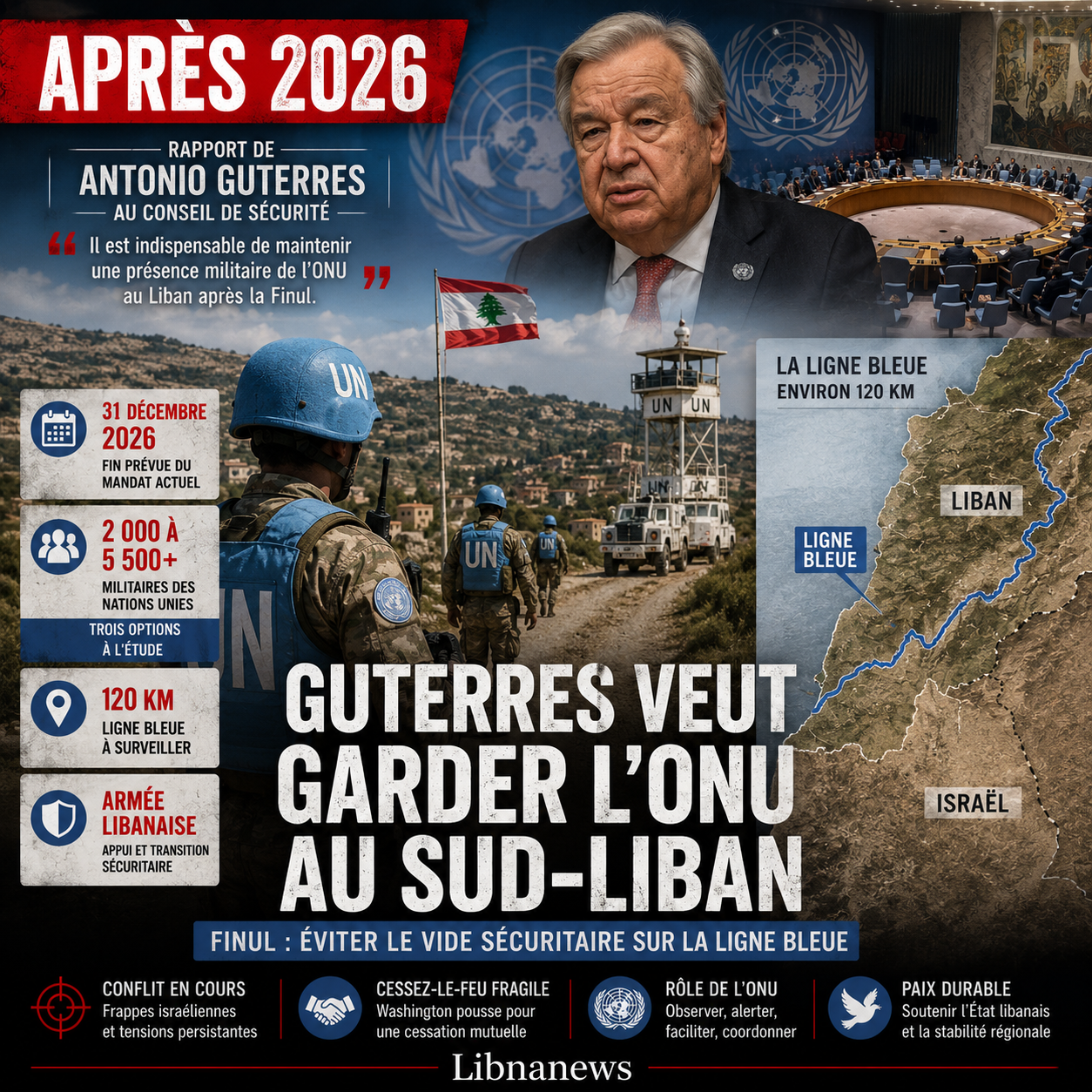
Antonio Guterres’ report to the Security Council puts the Finul at the centre of the Lebanese equation. While the current mission must cease operations on 31 December 2026, the Secretary-General of the United Nations considers it essential to maintain a United Nations military presence in Lebanon. It is not just a matter of keeping blue helmets by habit. The aim is to prevent a security vacuum in the South, as Israel continues its operations, as Hezbollah remains a major armed actor, and as the Lebanese army takes time, resources and international coverage to extend its authority.
The report, consulted by a news agency, proposes three options ranging from around 2,000 to over 5,500 United Nations military personnel. Their mission would be to monitor a ceasefire, support the Lebanese Armed Forces, facilitate de-escalation, dialogue, liaison and coordination. The most robust version would, according to the document, offer the most credible surveillance of the Blue Line, about 120 kilometres long. The minimum version, however, would not cover this entire line without significant technological capabilities. Behind these figures is a strategic question: who will monitor South Lebanon when the Finul officially finishes its mandate?
The announcement takes place in a tense regional sequence. Washington is trying to achieve a mutual cessation of attacks between Israel and Hezbollah. Beirut calls for an end to Israeli strikes and the withdrawal of the occupied areas. Iran links the Lebanese file to the entire regional front. In this context, the Guterres report provides an argument to those who believe that a clear and simple departure from the United Nations would create a major risk. It does not yet slice the final format. However, it affirms a need: without an international presence, the Blue Line would become more difficult to monitor and the ceasefire would be easier to violate.
Final: a provisional mission become central
Finul is a temporary mission that has become structural. Established in 1978, it was originally to confirm the Israeli withdrawal from southern Lebanon, restore peace and help the Lebanese State restore its authority. After the 2006 war, resolution 1701 expanded its role. The mission was to monitor the cessation of hostilities, accompany the deployment of the Lebanese army, coordinate with Israel and Lebanon, and support the establishment of an area between the Blue Line and the Litani, free from any armed presence other than that of the Lebanese State and the Finul.
This mandate has never been fully implemented. Israel has regularly denounced the Finul’s inability to prevent the strengthening of Hezbollah. Lebanon stressed the usefulness of the mission as a buffer, observer and liaison channel. The contributing countries recalled that peacekeepers cannot impose a security architecture alone that the parties refuse to respect. The Finul is neither a substitute army nor an occupying force nor an international Hezbollah police. Its capacity depends on the Security Council, the Lebanese army, the consent of local actors and Israeli restraint.
The 2026 debate is part of this ambiguity. The Security Council decided in August 2025 to extend the Final one last time until 31 December 2026, before an orderly and secure withdrawal in the following year. This decision was reached under strong US and Israeli pressure. Washington believed that the time had come to transfer responsibility for security to the Lebanese Government. Israel considered the mission ineffective against Hezbollah. On the contrary, several States, including France, Italy and China, have warned about the dangers of too rapid a withdrawal.
Guterres’ report does not go back to that decision. It offers a different exit. The idea is not to keep the Finul in its current format, but to provide for a UN military presence after the end of the mission. This shade is important. It enables the Security Council to formally comply with the closure decision, while preventing the disappearance of the mission from leaving South Lebanon without an international mechanism. In diplomatic language, it is a transition. In security language, it is a way to prevent the Blue Line from becoming a blind spot.
Three military scenarios for the post-Final period
The three options presented by Guterres correspond to three levels of ambition. The first, close to 2,000 personnel, would be light. It would allow a limited presence, focusing on liaison, support to the Lebanese army and certain monitoring tasks. But the report stresses that it would not cover the entire Blue Line without additional technological means. This means observation drones, sensors, cameras, radars, secure means of communication and analytical capability. A small force without technology would be visible, but not always useful. A small force with technology could be more effective, but would depend on investment and political authorizations.
The second option would be intermediate. It would seek a balance between cost, mobility and credibility. It would allow a denser presence in sensitive areas, without replicating the full fingerprint of Finul. Such a format could appeal to Member States concerned with reducing peacekeeping expenditures. He could also reassure those who feared that the United Nations would disappear too quickly. But its effectiveness would depend on the definition of priority areas. If the conflict moves, an intermediate force may watch what burns tomorrow yesterday.
The third option, with more than 5,500 military personnel, would be the most credible to monitor the entire Blue Line. It would provide more patrols, posts, reaction capabilities and visible presence. It would also send a clear political signal: the United Nations does not leave South Lebanon at a time when war threatens to settle there for long. But this option would be the most costly and probably the most contested by the United States and Israel. She would also ask the question of the mandate. The greater the strength, the greater the expectations. A robust presence without clear rules can create a security illusion.
The choice cannot therefore be reduced to a number of soldiers. Their exact mission will have to be defined. Watch what? Report to whom? Support the Lebanese army to what point? To accompany an Israeli withdrawal according to what timetable? How to react to violations? Protect civilians or just watch the Blue Line? The report speaks of de-escalation, dialogue, liaison and coordination. These words are cautious. They reflect the desire of the United Nations to remain a facilitator, not to become a belligerent. But the current situation requires more than a symbolic presence.
The Lebanese Army at the centre of the system
The most sensitive point concerns the Lebanese army. All scenarios presented by Guterres are supported by the Lebanese Armed Forces. This is consistent with the logic of resolution 1701: the Lebanese State must be the effective security authority in the South. But this ambition faces two obstacles. The first one is material. The army lacks resources, funding, equipment and surveillance capabilities. The second is political. It must extend its authority in a region where Hezbollah retains an important military, social and political weight, without causing internal confrontation.
United Nations support can help, but it does not replace a national decision. The Lebanese army can patrol, control certain axes, occupy positions and coordinate with the United Nations. It cannot, alone and without political cover, solve the issue of Hezbollah’s weapons. Nor can it prevent Israeli strikes if Washington does not force Israel to respect a ceasefire. That is why the Guterres report links the United Nations military presence to a strengthened political role of its representative in Lebanon. The military dimension is not enough. We need permanent political mediation.
The Blue Line remains the heart of the device. It is not a recognized international frontier in the classical sense. It marks the Israeli withdrawal line verified by the United Nations after 2000 and serves as an operational reference between Israel and Lebanon. For years, every violation, every patrol, every construction, every shot and every crossing has been read through this line. In today’s war, it has become more than a cartographic landmark. It is the front where the possibility of a return to calm is measured.
Guterres insists on the role of the UN as the provisional guardian of the Blue Line. This formula is very meaningful. It means that the United Nations does not claim to settle the border dispute alone. Its mission is to monitor, document, prevent incidents and maintain a minimum level of communication between untrusted parties. In an area where each camp accuses the other of starting, this neutral observation function is valuable. It does not produce peace. It sometimes prevents an incident from becoming an open war.
Israeli withdrawal and Lebanese sovereignty
The problem is that neutrality of observation becomes more difficult when the terrain is disrupted. Recent reports refer to areas occupied or controlled by the Israeli army north of the Blue Line, extensive destruction and restrictions on civilians. Israel justifies its operations by preventing Hezbollah from rebuilding its capabilities. Lebanon sees this as a violation of its sovereignty and an obstacle to any real ceasefire. In this context, a UN force will have to monitor not only the shootings, but also the territorial achievements.
The statement of the Ambassador of Lebanon to the United Nations, Ahmad Arafa, is exactly in line with this logic. He considered that recent developments had increased Lebanon’s urgent need to maintain United Nations and international aid. It linked this assistance to two objectives: to facilitate Israeli withdrawal and to enable the State to deploy its authority throughout its territory. This dual objective summarizes the Lebanese position. Lebanon does not want an international presence to deal indefinitely with a frozen conflict. He wants a presence capable of accompanying an Israeli withdrawal and strengthening the state.
However, there is tension in this position. For part of the international partners, strengthening the state also implies a clear limitation of the military role of Hezbollah. For Hezbollah and its allies, disarmament or a reduction of presence cannot be envisaged as long as Israel is occupying, attacking or threatening. For Israel, an unsecured withdrawal from Hezbollah would be dangerous. For the United Nations, the mandate can only work if the parties accept measurable commitments. Guterres’ report proposes a presence. It does not resolve the political contradiction that has blocked the full implementation of resolution 1701 for nearly twenty years.
The budgetary debate will also weigh on the decision. The United Nations peace operations face significant financial constraints, in particular due to delays in payment by some Member States. A force of more than 5,500 soldiers is expensive. It requires troops, equipment, bases, medical evacuations, logistics and security guarantees. Will the contributing countries agree to send soldiers to a South Lebanon where the peacekeepers have already been caught under fire? The issue is political as well as financial. A credible mission requires States willing to assume the risk.
Washington, Israel and the Security Council
Attacks or incidents against the Finul in recent years have weakened the security of contributors. The mission was criticized by Israel, challenged by local groups, and exposed to fighting between Israel and Hezbollah. Blue helmets were killed or injured in the last phase of war. This reality makes it more difficult to promise a stable international presence. It can also reinforce Guterres’ argument: if the mission was threatened despite its presence, its complete withdrawal would make the situation even less controllable.
The American position will be decisive. By 2025, Washington had supported the last extension only as part of a planned closure. The United States wanted to avoid an automatic renewal of the Finul. They felt that Lebanon should become the only security provider in the South. But the war changed the parameters. If Israeli strikes continue, if a cease-fire remains fragile, and if the Lebanese army cannot hold the entire territory alone, a reduced United Nations presence can become an acceptable compromise. It would allow Washington to say that the Finul is ending, while avoiding an immediate vacuum.
Israel could oppose a scheme which it would consider too favourable to Hezbollah. His recurring criticism relates to the Finul’s inability to prevent the movement’s military presence in the South. But Israel also has an interest in a form of surveillance if it reduces attacks on its north and facilitates verification mechanisms. It will depend on the mandate. A force dedicated only to observing Israeli violations would be rejected by Jerusalem. A force focusing on support to the Lebanese army and control of areas near the Blue Line could be discussed. The compromise will be difficult.
For Hezbollah, a post-Final UN presence can be acceptable if it accompanies an Israeli withdrawal and does not become an instrument of disarmament imposed under foreign pressure. The movement knows that the presence of peacekeepers sometimes limits Israeli freedom of action and provides an international witness. But he fears any mission with a more intrusive mandate against his networks. The formula chosen must therefore avoid two pitfalls: being too weak to reassure Israel and too intrusive to be rejected on the ground. It is the equation that has always limited the Finul.
South Lebanon beyond peacekeeping
Lebanon, for its part, must avoid a defensive reading only. Demanding an international presence is not enough. A credible plan for the deployment of the army, coordination with the United Nations, the restoration of services, the return of internally displaced persons and the reconstruction of villages in the South will need to be presented. Security is not limited to patrols. A village where the school remains closed, where the road is cut off, where the water is missing and where the drones fly over every night does not regain the authority of the State by the mere presence of a white armor. The UN mission must be linked to a civilian effort.
The Guterres report therefore opens a debate that goes beyond the Finul. He asked the question of the post-war period in southern Lebanon. Will the territory be administered by the Lebanese State, monitored by the United Nations and protected by a ceasefire? Or will there remain a grey zone, between Israeli presence, Hezbollah influence, underequipped Lebanese army and limited international mediation? The three options proposed are not only military formats. They draw three visions of the transition: minimal, intermediate or robust.
The Security Council will have to choose in a difficult climate. The United States and Israel will want to avoid reproduction of the ancient Finul. Lebanon will demand protection from the security vacuum. France, Italy and other contributing countries will look at the security conditions of their soldiers. China and several Council members will insist on maintaining a UN role. The countries of the region will follow the link with the discussions on Iran and Hezbollah. Each option will have a diplomatic cost.
She stays on the ground. The people of the South do not expect a perfect architecture. They await the cessation of the strikes, the withdrawal of Israeli forces from the occupied areas, the return of the Lebanese army, the reopening of the roads, the resumption of schools and the end of the nights under drones. A UN force cannot produce all this alone. But his absence would make every step more fragile. This is the meaning of the Guterres report: after 2026, Lebanon will not only need an international symbol. It will need a mechanism to monitor, alert, support and prevent the Blue Line from becoming the starting point of a new war.




