






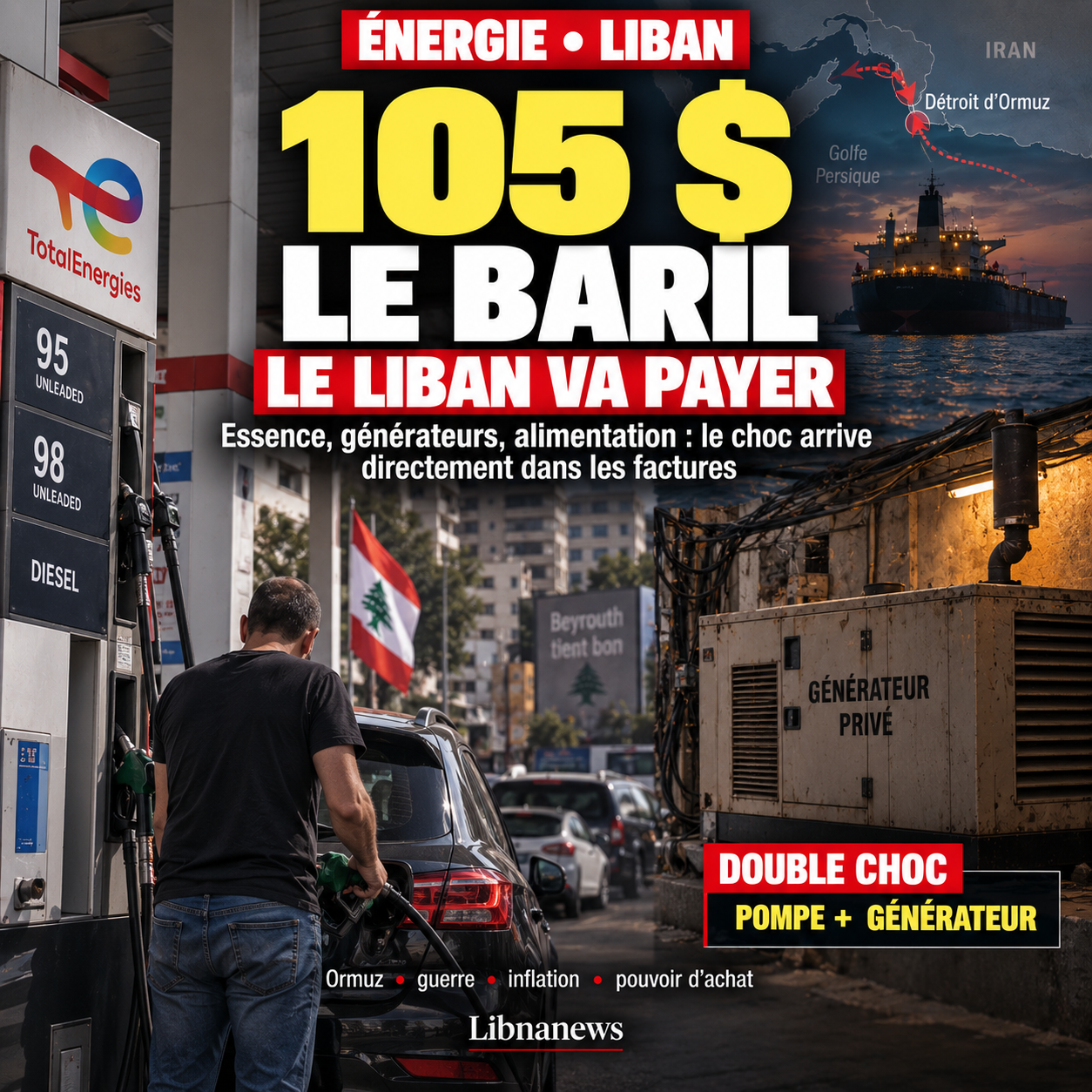
In a few days, oil has crossed a new threshold
Oil shock is no longer a hypothesis. The Brent exceeded $100 per barrel, and then accelerated with heightened tensions between the United States and Iran. It stood at $101.09 on Wednesday, before making further progress. On Thursday, he earned $2.03, or 2 per cent, to reach $105.11 at approximately 1.20 p.m., after receiving $106.50 during the meeting. Another closing reported in the corpus was $106.60, an increase of 3.4 per cent. At the same time, the U.S. gross was $93.64.
This volatility reflects a risk premium directly related to war. The market is not only responsive to global production. It now incorporates the threat to the Strait of Ormuz, the difficulties of navigation, the sanctions against Iran and the extension of the conflict to the Red Sea. Haughty attacks on Saudi Arabia have added a second source of risk. Six ballistic missiles were intercepted while Taef and Yanbu were among the targeted areas. Yet Yanbu is precisely one of the main Saudi solutions for exporting oil through the Red Sea when the Gulf road becomes problematic.
For Lebanon, the issue is much more serious than simply rising gasoline prices. The country imports almost its fossil energy and relies heavily on private generators to generate its electricity. As a result, oil increases simultaneously affect transport, electricity, businesses, businesses and the cost of goods. The shock then passes through food and services.
Most importantly, this increase occurs when households have almost no absorption margins. Cumulative inflation over the first eight months of 2026 is already approaching 17%. Revenues did not regain their pre-crisis purchasing power. The next oil shock would therefore not hit a stabilized economy, but a population, part of which already does not cover its basic needs.
Ormuz and Yanbu: Why the oil risk is exceptional
The current increase is not a mere producer decision. It is based on a physical threat to oil roads.
The Strait of Ormuz concentrates a major part of the Gulf’s energy exports. The information available indicates that navigation remains well below its usual level. The Brent thus bears a higher geopolitical premium than the American crude, precisely because it is much more exposed to the disruptions of the Middle East and international maritime routes.
Yanbu’s situation increases the risk. Saudi Arabia has the East-West pipeline network to transport oil to the Red Sea and bypass Ormuz. Saudi Aramco claims to have three major export routes and to study two additional routes. Its general manager, Amin Nasser, also ensures that the disturbances can be repaired within a few days and discusses the possibility of using the Sumed pipeline linking the Red Sea to the Mediterranean via Egypt.
But the attacks on Yanbu show that the bypass road itself can become a target. The energy risk is therefore shifting from the Gulf to the Red Sea.
This is precisely what the market values. The Brent no longer pays only the risk of a closure of Ormuz. It incorporates the possibility that several routes may be simultaneously threatened.
For Lebanon, which has no control over these events, transmission is mechanical: the higher the cost of imported oil, the greater the cost of its entire energy economy.
The first shock arrives at the pump
On 18 September, even before the new explosions of the Brent, the can of 20 liters of petrol to 95 octanes already cost 2,81 million pounds.
An estimate of the transport needs makes it possible to measure what this represents. A passenger car travels about 12,893 kilometres per year in the model used, or 1,074 kilometres per month. With an average consumption of nine kilometres per litre, it requires approximately 119 litres per month.
At the September 18 tariff, gasoline represents about £16.8 million per month, or nearly $187.
And this figure greatly underestimates the real cost of the car. It does not include insurance, repairs, tires, oil, parking, taxes or depreciation of the vehicle.
A 10 per cent increase in the price of gasoline would increase this single theoretical expenditure from about $187 to 206. An increase of 20% would bring about 224 dollars. This represents an additional $19-37 per month for fuel only.
For a household with two modest incomes, these tens of dollars are no longer marginal. They must be withdrawn from food, care, school or other expenditure.
The second shock arrives in the generator bill
This is where Lebanon stands out for savings with a normal electricity grid. An oil surge strikes the household a second time when he returns home.
The scenario studied takes about 451 kilowatt hours of monthly electricity consumption for a family. With only four hours of public electricity per day, about 128 kilowatt hours are allocated to the state grid and 323 to the generator.
By August 2026, the official rate of generators under 700 metres of altitude was 48,241 pounds per kilowatt hour. Thus, the 323 kilowatt hours of private time are approximately $174. With a fixed subscription fee of ten amperes, the generator’s bill is close to $182. By adding public electricity and some charges, the total is around $204 per month.
In other words, even before the new oil shock, a family can already spend almost $2,450 a year just to have electricity.
The increase in generator fuel is quickly passed on to the kilowatt hour rate. If the oil shock persists, the electric bill will increase in parallel with the car’s.
A household can be struck twice by the same barrel: in the morning to go to work and in the evening to power its refrigerator, lighting or air conditioning.
Transport and electricity already absorb nearly $400
The addition allows to understand the vulnerability.
With a car, about $187 is spent monthly on gasoline. The electric bill for the scenario under study is about $204. The two positions together represent approximately $391 per month.
This amount is considerable when compared to the reference income used in the cost-of-living study. A survey conducted in May 2026 among 2,485 private sector workers, including 1,787 Lebanese, included approximately $560 as the average monthly income of Lebanese workers still active in its sample. This figure is not an official national average wage, but it gives a useful order of magnitude.
Car transport and electricity account for about 70% of this income in the models studied.
And there is still rent, food, water, health and school.
So expensive oil does not come into a budget where households can simply reduce their leisure time. It strikes positions that are already incompressible.
The third shock hides in each goods transported
The effect does not stop at expenditure directly identifiable as energy. Diesel and gasoline are included in the cost of almost all goods.
Trucks transport products from port, warehouses or agricultural areas. Shops use generators. Restaurants refrigerate their food with expensive electricity. Industries finance their own energy. Suppliers then pass on all or part of these expenses to their prices.
Diesel is particularly important. International data from the corpus show that it exceeded $6.50 per gallon in the US market in the context of the conflict. This figure is obviously not the Lebanese price, but it shows the global magnitude of the tension on a fuel essential for transport and equipment.
The Lebanese minimum food basket already costs about $194 per month for four people. It contains mainly bread, rice, bulgur, pasta, potatoes, legumes, oil, sugar and some fruits and vegetables.
Even these very simple products are exposed to energy. They must be produced or imported, transported, stored and sold. A sustainable increase in fuel thus ends up reaching a basket that does not already contain red meat, chicken, cheese or fresh fish.
This is why the oil shock quickly becomes a food shock.
An already deficit family has no margin to absorb the increase
Before the new oil surge, the calculation of the five basic needs of a family of four was already around $1,403 to $1,486 per month.
Indicative housing is $700. Minimum power supply about 194 dollars. Electricity is approaching 204 dollars. Transportation varies according to the scenario and can reach several hundred dollars. Water completes the addition.
School and health are excluded.
Two revenues of $560 give only $1,120. The initial shortfall is therefore between $283 and $366.
This data completely changes the analysis of oil. A further increase of $20 or $30 in fuel is not absorbed by non-existent monthly savings. It directly enlarges the deficit.
The household must then choose: to delay a bill, to further reduce food, to ask for an advance from its employer, to borrow from its family or to postpone care.
The oil shock thus becomes an accelerator of the social crisis.
The State could be tempted to choose between revenue and purchasing power
The increase in energy also comes at the wrong time for public finances. Draft budget 2027 provides for a significant increase in revenue. The additional collection effort mentioned is approaching $840 million.
The problem is that the ability of the administration to achieve this increase is contested. Public sector productivity remains low and households are already severely constrained.
In this context, fuel is an attractive tax base. They are relatively easy to tax and generate revenues quickly.
But recent experience shows the sensitivity of the file. A withdrawal of 300,000 pounds from the petrol can had already provoked a reaction from the transport federations. The government had finally negotiated compensation of £12 million per month for some public drivers using gasoline vehicles.
With oil above $100, any new puncture becomes more difficult politically. The state must arbitrate between its need for revenue and the risk of increasing the pump rise.
The stability of the book will not protect households
The economic danger is all the more important as this inflation can progress without a further fall in the currency.
Since the relative stabilization of the exchange rate around £89,500 per dollar, part of the economic debate has associated monetary stability with price stabilization. Oil shows the limits of this relationship.
Lebanon buys its energy in foreign currency. If the world price of the barrel increases by 20 per cent, exchange rate stability does not cancel that increase. It only prevents an additional depreciation of the pound from adding to it.
Inflation can thus accelerate while the dollar remains stable.
It’s already an issue in 2026. After the extremes of 2020 to 2023, inflation had slowed. However, the cumulative price increase over the first eight months of this year is already around 17%.
A prolonged energy shock would make it even more difficult to return to low inflation.
The real black scenario is a long crisis in Ormuz
The one-time passage of the Brent over 105 dollars is painful. But the real danger for Lebanon would be that this level would last for several months or that a new escalation would still raise prices.
The decisive variable is the Strait of Ormuz. Markets can absorb one-off attacks as long as exports continue. A lasting disruption of flows would change the scale of the problem.
The negotiations between Washington and Tehran thus indirectly become a Lebanese economic issue. Each sign of compromise can reduce the risk premium on oil. Every failure can reinforce it.
Lebanon has virtually no leverage in this negotiation. However, he suffered his direct result.
It is the central vulnerability of the country: its economy imports the geopolitical shock almost immediately, and then multiplys it by its own failures. A state with abundant public electricity would mainly suffer from the increase in fuels. The Lebanese household also pays it in its generator. A country with a public transport network would absorb part of the shock. The Lebanese employee remains largely dependent on the car or expensive private transport.
At more than $105 a barrel, the energy war is no longer distant international information. It goes directly into the family budget. And every additional dollar on oil hit a country where, even before this new increase, two incomes may already be insufficient to cover five basic needs.