The telephone interview between Emmanuel Macron and Nabih Berry comes at a critical moment for South Lebanon. The President of Parliament called for an international mobilization capable of imposing Israeli withdrawal, the deployment of the Lebanese army and the maintenance of UNIFIL. The French President reaffirmed his support for Lebanon’s sovereignty, its armed forces and reconstruction. But this declared convergence masks differences on the security calendar, the disarmament of Hezbollah and the future of a United Nations force whose gradual withdrawal is already scheduled.
The call received by Nabih Berry is not merely a protocol exchange between Beirut and Paris. He intervened while the fate of South Lebanon was being played on several negotiating tables. Discussions focused on the Israeli withdrawal, the deployment of the army, the future of Hezbollah’s weapons, the return of the inhabitants and the role of the United Nations.
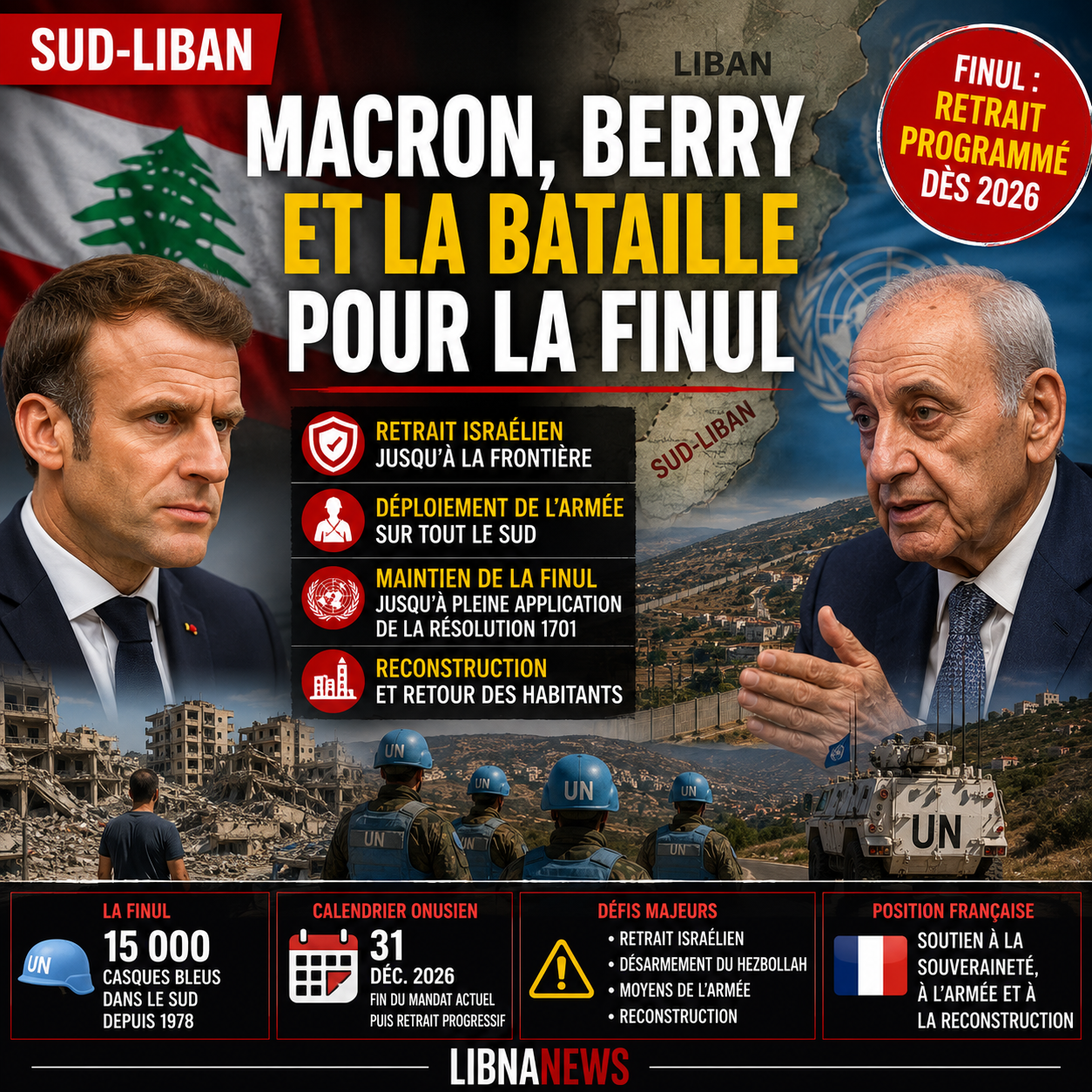
The President of the Lebanese Parliament asked Emmanuel Macron for « exceptional international efforts ». He wants Israel to stop its operations, evacuate the occupied territories and retreat to the international border. It also calls for the maintenance of the United Nations Interim Force in Lebanon (UNIFIL) to support the implementation of resolution 1701.
The French President responded by reaffirming that Lebanon’s stability and sovereignty remained a priority. He referred to support for the Lebanese army, reconstruction and assistance that Paris could mobilize with other partners.
These positions seem to be close. However, they do not resolve any immediate issues. UNIFIL must enter a withdrawal phase after the expiry of its current mandate. Israel makes its disengagement conditional on safeguards against Hezbollah. The Lebanese army still lacks resources. The destroyed villages cannot quickly accommodate their inhabitants.
Berry demands direct pressure on Israel
Nabih Berry placed the Israeli withdrawal at the centre of the interview. He denounced the continuation of military operations and the destruction of southern localities. In his view, the international community must act to compel Israel, not merely to invite the parties to restraint.
This wording applies in particular to Western States with diplomatic or military influence over the Israeli government. France belongs to this group, although its leverage remains lower than that of the United States. Paris is a member of the Security Council and has long played a central role in the texts on Lebanon.
Berry asks that the withdrawal precede or accompany the deployment of the Lebanese army. He refused that Israel would turn its presence into a permanent instrument of pressure. In this reading, the occupation prevents the state from restoring its authority and offers Hezbollah an argument to retain its weapons.
The President of Parliament also insists on the return of the inhabitants. This point gives a civil dimension to his request. Military withdrawal is not enough when roads remain mined, houses are destroyed and essential services are no longer functioning.
Residents began to return to some localities after limited withdrawals. They discovered largely destroyed neighbourhoods and uninhabitable dwellings. The army still needs to secure these areas before normal civilian life resumes.
Berry’s position, however, has political ambiguity. It called for the full implementation of resolution 1701, but it did not only concern Israel. It also provides that the area between the Blue Line and the Litani does not contain any weapons or military authority other than those of the Lebanese State and UNIFIL.
But Berry remains an essential political ally of Hezbollah. It often acts as an intermediary between the Shiite movement, the Lebanese state and foreign mediators. His call for full compliance with the resolution therefore indirectly raises the issue of Hezbollah’s arsenal.
Macron reaffirms the French doctrine in Lebanon
Emmanuel Macron responded by the three traditional elements of the French position: Lebanese sovereignty, support for the army and reconstruction. This doctrine seeks to strengthen the state without causing an internal confrontation that could further destabilize the country.
France regards the Lebanese army as the institution called upon to regain control of the entire territory. In his previous statements, the French President had already presented the armed forces as a pillar of sovereignty and an indispensable actor in the implementation of the ceasefire.
Paris therefore supports the recruitment, training, equipment and financing of the army. This aid responds to a concrete problem. The military must deploy more units in the South while their resources have been weakened by the economic crisis.
The French government also defends the state’s monopoly on arms. A Franco-German position published in July 2026 recalled the support of both countries for the exclusive exercise of force by Lebanese institutions.
This formulation directly concerns Hezbollah. Paris, however, remains cautious about the method. An attempt at forced disarmament could lead to clashes between Lebanese. France therefore favours a combination of political decisions, external pressure and the gradual strengthening of the army.
The relationship with Berry becomes important in this context. The Speaker of Parliament leads the Amal movement and maintains an old alliance with Hezbollah. It can facilitate a compromise, provide guarantees or, on the contrary, block a formula deemed threatening by its side.
Macron’s call therefore aims as much to officially support institutions as to maintain a channel with one of the actors able to influence the field.
UNIFIL in the centre of an unfavourable calendar in Lebanon
Nabih Berry stressed the centrality of UNIFIL ‘ s continued operation. However, his request came after a decision that greatly reduced the prospects for a sustainable mission presence.
The Security Council renewed the mandate of the force until 31 December 2026. This extension was presented as the last before an orderly withdrawal, scheduled for an additional period of approximately one year. The resolution resulted from a compromise between France, which defended the continuity of the mission, and the United States, which was more favourable to its disappearance.
The calendar puts Beirut under pressure. Lebanon is now calling for the maintenance of a force whose exit is already being undertaken at the international level. He will have to convince the members of the Security Council to modify or interpret that mechanism in the light of the situation on the ground.
UNIFIL was established in 1978. His mandate was considerably expanded after the 2006 war. It must monitor the cessation of hostilities, accompany the Lebanese army and assist the parties in implementing resolution 1701. It also reports on violations.
His presence does not guarantee the absence of war. The successive clashes showed. The mission has neither the mandate nor the capabilities to disarm Hezbollah by force. Nor can it compel Israel to withdraw from a position.
Its usefulness lies elsewhere. It maintains liaison channels, patrolling sensitive areas and documenting violations. It also offers an international presence in an area where each incident can trigger an escalation.
The disappearance of UNIFIL would leave the Lebanese army and the Israeli army face to face, with a more limited mediation mechanism. It would also reduce the ability of the United Nations to verify events and challenge conflicting versions.
Why Paris still defends the UN mission
France has a political and military reason to defend UNIFIL. It historically contributes to strength and knows how it works. It has also drafted or negotiated several resolutions on Lebanon.
Paris considers that the mission offers a legitimate framework for the extension of State authority. Too fast a withdrawal would create a vacuum that the Lebanese army could not necessarily fill. It could also strengthen parallel arrangements established by Israel or external mediators.
UNIFIL’s presence also protects the European role in a matter increasingly dominated by Washington. The United States is leading discussions on withdrawals, pilot areas and security guarantees. France risks becoming a mere financial support if the UN framework disappears.
Maintaining the mission allows Paris to retain an institutional position. It also helps to defend an approach based on resolution 1701, rather than a bilateral agreement dictated by the military power ratio.
But the French position met American and Israeli opposition. Israel has long criticized UNIFIL for not preventing Hezbollah from developing its infrastructure south of the Litani River. Washington believes that the Lebanese State must assume direct responsibility for its security.
These criticisms contain a part of reality. UNIFIL did not prevent the rearmament of Hezbollah after 2006. However, it did not have the mandate to systematically search private property or engage in fighting against the movement.
The failure to fully implement resolution 1701 is therefore also a matter for the Lebanese authorities, the lack of a political settlement and Israeli violations. It cannot be attributed solely to the United Nations mission.
Israeli withdrawal remains linked to Hezbollah’s case
Berry presents withdrawal as an international obligation that should not depend on any condition. Israel adopts a different reading. He claims that his departure must be coupled with guarantees preventing the return of Hezbollah.
The discussions supported by Washington are based on progressive logic. Israel is evacuating an area. The Lebanese army is deploying. Hezbollah military installations must be dismantled or placed under state control. Auditors then assess the situation before moving to a new stage.
This system has enabled local experiments to be launched. However, it faces significant difficulties. Hezbollah is not a signatory to the scheme and refuses to abandon its weapons under duress. The Lebanese government does not want to order the army to engage in an internal confrontation.
Israel can use these blockages to delay its withdrawals. Each weapon discovery or disagreement on an infrastructure becomes a reason for military maintenance.
Beirut fears that a presence presented as provisional will turn into a lasting occupation. At the same time, destruction and displacement weaken local communities, making it more difficult to recover.
France is trying to get out of this circular logic. It supports the Israeli withdrawal and the exclusive authority of the State. But it does not have a mechanism to impose both objectives simultaneously.
Can Berry defend resolution 1701 without Hezbollah?
Nabih Berry’s position must be read in the light of his place in the political system. He is not just the President of Parliament. He leads Amal, Hezbollah’s main Shiite partner, and has been a key negotiator for several decades.
This function allows him to speak in Paris, Washington and Lebanese officials while maintaining a channel with Hezbollah leadership. It gives it a real ability to influence compromises.
It also limits the scope of its statements. Berry called for the deployment of the army and the implementation of resolution 1701, but he did not publicly call for the immediate disarmament of Hezbollah.
He considered that priority should be given to Israeli withdrawal. The Shiite movement adopts the same sequence: end of occupation, stop attacks, and then national debate on the defence strategy.
Hezbollah’s opponents defend reverse order. They believe that Israel will not withdraw on a lasting basis without arms guarantees. They accuse Berry and his allies of wanting to use resolution 1701 only against Israel.
Criticism is not without foundation. Selective application of the text cannot produce lasting security. However, asking the Lebanese army to disarm Hezbollah while Israel occupies areas of the territory can also lead to internal confrontation without ensuring withdrawal.
Berry’s role is precisely to negotiate this sequence. His exchange with Macron shows that he is first seeking increased international pressure on Israel. Paris, for its part, also awaits progress on the state monopoly.
Reconstruction as a diplomatic lever
Macron mentioned reconstruction as one of the French priorities. This promise meets the immense needs of the South, but it is also a negotiating instrument.
International donors are unlikely to finance massive reconstruction if fighting can resume a few months later. They will demand security guarantees, institutional control of funds and access to the areas concerned.
France can mobilize European, Arab and international partners. She has experience in supporting conferences in Lebanon. It can also link civil aid to the strengthening of the army and the return of the administration.
This approach involves a risk. Reconstruction can become conditional on security decisions that Beirut cannot quickly implement. The inhabitants would then pay the price of a political conflict that exceeds them.
It can also create inequalities between villages. Areas integrated with pilot schemes could be assisted more quickly. Areas still occupied or considered sensitive would remain on hold.
Berry therefore asks that the withdrawal and return of the inhabitants precede the opening of the site. It seeks to prevent reconstruction from being used as a reward only after Israeli conditions have been satisfied.
The Lebanese army in the centre, but without sufficient resources
The Franco-Lebanese convergence is the clearest on the role of the army. Berry is calling for its deployment to the border. Macron promises to continue his support.
The problem concerns the capacity available. The army must control roads, secure destroyed villages, remove explosives and monitor an extensive territory. It must also prevent the re-emergence of armed positions without entering into war with a part of the population.
His soldiers suffered the loss of purchasing power caused by the crisis. The institution still depends on foreign aid for part of its fuel, equipment and logistics.
A lasting extension of its deployment therefore requires more than declarations. There is a need to finance staff, build posts, provide oversight and ensure continuity of salaries.
France can contribute to this effort. However, it cannot finance it alone. A broader coalition should involve European countries, the United States and several Arab States.
Military aid also raises the question of political command. A strengthened army cannot implement an undetermined strategy. The Government must clarify its doctrine regarding Hezbollah, Israeli violations and verification mechanisms.
Economic reforms introduced in trade
Nabih Berry took the opportunity of the interview to ensure that Parliament was pursuing the reforms necessary for an agreement with the International Monetary Fund. This passage links the security of the South to the financial crisis.
The message aims to reassure Paris. Since 2020, France has supported a reform programme on banks, public finances, governance and the fight against corruption.
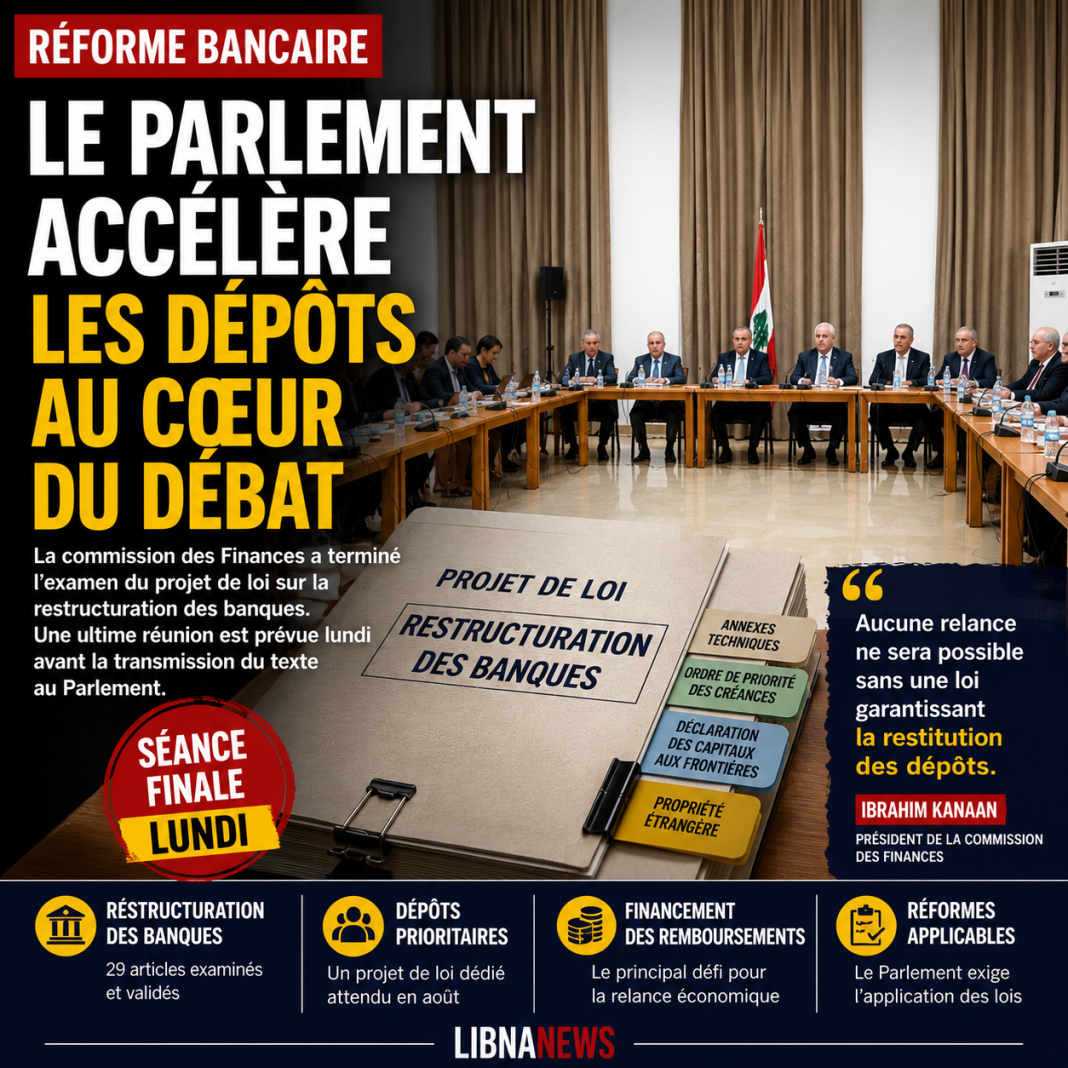
Parliament is currently examining several texts, including bank restructuring. But Lebanon has still not settled the distribution of losses between the State, the Bank of Lebanon, financial institutions and depositors.
Berry’s statement therefore remains general. It does not guarantee prompt adoption of laws or compliance with IMF requests. Nor does it address the problem of their application.
Paris is experiencing this difficulty. The French initiative launched after the explosion of the port of Beirut in 2020 had already obtained reform commitments that were not implemented within the announced deadlines.
French economic support will therefore depend on measurable results. The reconstruction of the South and State aid may be limited if financial governance remains unchanged.
A call that reveals the limits of French diplomacy
The interview between Macron and Berry confirms that France remains present in Lebanon. It does not demonstrate that it can impose a regulation.
Paris has a permanent seat on the Security Council, a historic relationship with Beirut and a military contribution to UNIFIL. It can mobilize funds and maintain channels with almost all Lebanese actors.
However, its influence on Israel remains limited. The United States remains the main military and diplomatic partner of the Israeli Government. Any decisive pressure will therefore largely depend on Washington.
France can defend UNIFIL, but it has already accepted a compromise that is preparing for its disappearance. It can support the army, but it does not immediately replace the thousands of peacekeepers. She can promise reconstruction, but she must convince other donors.
Berry is precisely trying to transform this French presence into international action. He wants Macron to mobilize the Security Council, European partners and the United States.
The French response reaffirms principles without announcing a new binding measure. No Israeli withdrawal schedule has been made public. No decision was announced on the extension of UNIFIL beyond the current mandate.
The next diplomatic battle will therefore focus on two contradictory timetables: the gradual withdrawal of peacekeepers and the still uncertain withdrawal of Israeli forces. Lebanon requests that UNIFIL remain until the full restoration of State authority. The Security Council has already foreseen that it will start leaving when this condition remains far from being fulfilled.