






Iran-USA negotiations have changed their nature. They no longer cover only uranium, sanctions and the Strait of Ormuz. Since mid-June, they also include Lebanon, which has become the most immediate test of regional de-escalation. The new open sequence in Switzerland must transform a still fragile memorandum into a lasting agreement. It promises a halt to military operations on several fronts, including South Lebanon. But it leaves behind three problems: the Israeli presence beyond the border, the military role of Hezbollah and Beirut’s ability to regain control of a crisis that is largely decided outside its territory.
A regional negotiation
Washington and Tehran initially sought to avoid a longer war around Iran’s nuclear programme. The framework discussed over the past few days is beyond this scope. Delegations are working on a final agreement to be concluded within a maximum of 60 days, with the possibility of an extension if both parties agree. Pakistan and Qatari mediators play a central role. They ensure the link between two capitals that remain suspicious, despite the resumption of high-level discussions.
The chosen location, a Swiss hotel complex above Lake Four-Cantons, highlights the diplomatic character of the sequence. The method remains hybrid. There are direct exchanges, messages from mediators, and then technical work. This format saves the face of each camp. Americans can say that they impose a framework. Iranians can say that they negotiate equally. Above all, the two sides avoided a collapse that would cause war to resume.
The memorandum presented as a basis for discussion includes fourteen points. He postponed the most difficult subjects to the final agreement. This is the case with the dismantling or reduction of Iran’s nuclear programme. This is also the case with specific mechanisms for lifting sanctions, monitoring commitments and full reopening of the Strait of Ormuz. This architecture gives diplomats time. It also creates a risk zone. Every inaccuracy can become a crisis.
Iran-USA negotiations and the Lebanese node
The major novelty is the explicit mention of Lebanon. The text presented in the regional press and reproduced by several media refers to an immediate and permanent cessation of military operations on all fronts, including in Lebanon. This wording does not regulate everything. It does not say how the Israeli forces would withdraw. It does not say how Hezbollah would cease its operations. Nor does it provide a detailed timetable for the return of internally displaced persons.
For Beirut, however, the mention remains important. It enshrines Lebanese sovereignty in a compromise between Washington and Tehran. Lebanon no longer appears merely as a confrontation between Israel and Hezbollah. It becomes a clause to be implemented. This difference can serve as a diplomatic lever for President Joseph Aoun, the government of Nawaf Salam and the institutions responsible for negotiating with international partners.
This development is ambiguous. Lebanon did not lead the main negotiation. It suffers the effects, while hoping to gain a benefit. Iran insisted that the Lebanese front enter into the agreement. The United States agreed to discuss an enforcement mechanism. Israel is not a party to the American-Iranian text. This absence creates the main blind spot. A commitment between Washington and Tehran is not enough to stop operations if Tel Aviv believes that it retains freedom of military action.
A mechanism of de-escalation still to be built
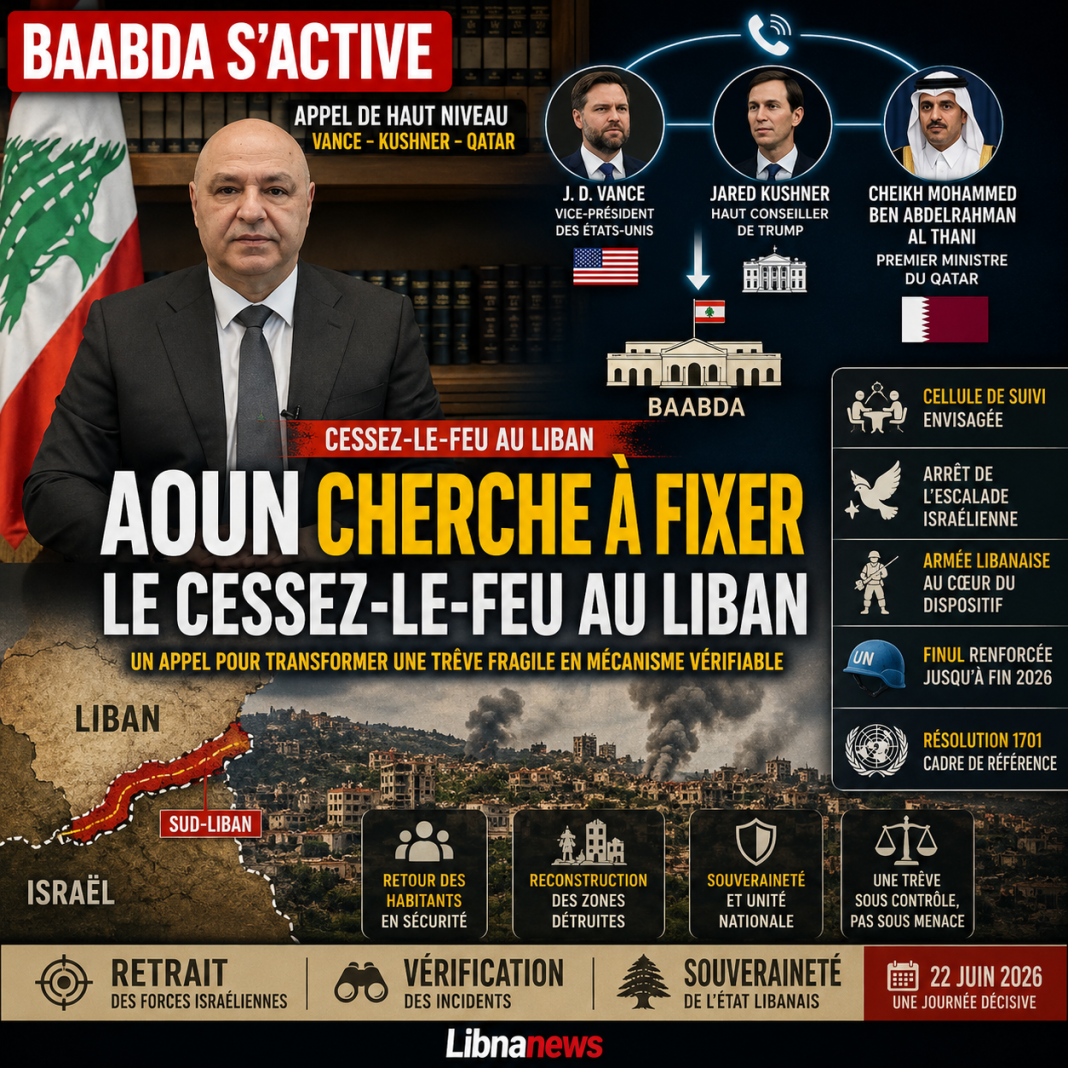
The discussions in Switzerland resulted in the idea of a de-conflict cell dedicated to Lebanon. According to a news agency, it would involve the United States, Iran and the Lebanese government. Its objective would be to check the cessation of operations and to prevent a local incident from destroying the entire process. This type of mechanism is not a peace treaty. It serves as an alarm, communication channel and emergency procedure.
Its effectiveness will depend on three concrete elements. We must first know who sits in Beirut. The president, army, government and parliament do not always have the same political margin against Hezbollah. What constitutes a violation will then have to be defined. A drone strike, aerial reconnaissance, rocket fire, ground incursion or movement of fighters do not trigger the same responses. Finally, it will be necessary to link this cell to the field, where UNIFIL and the Lebanese Armed Forces remain the only institutional frameworks already present.
The cell can therefore reduce risks, but it will not remove the central contradiction. Israel claims to want to protect its northern localities. Hezbollah claims to want to respond to any violations and to deny a lasting Israeli presence in Lebanese territory. The Lebanese State, for its part, demands respect for its sovereignty, while lacking military and financial means to impose its authority alone in the most destroyed areas.
Israel, the non-signator who can fail the text
Israeli behaviour is the first test. Following the entry into force of a ceasefire in Lebanon, strikes were further reported. A news agency reported at least 20 deaths in Israeli strikes on the following Saturday, based on information from the Lebanese national agency. Israel explained targeting Hezbollah-related targets after firing at its troops. The Shiite movement assured that it would respect the truce if Israel also respected it.
The Israeli position is based on a simple idea: the ceasefire must not prevent the army from acting against a threat. The Israeli Defence Minister claimed that the soldiers deployed in Lebanon could act freely to neutralize any danger. He also defended the maintenance of positions in a safe area. This logic collides with the Lebanese reading of the agreement, which emphasizes sovereignty and withdrawal.
This divergence can block the entire Iran-USA process. Tehran now links the stability of Ormuz and the subsequent negotiations to respect for the Lebanese ceasefire. If Israel pursues strikes or maintains a presence too visible in southern Lebanon, Iran may accuse Washington of not controlling its ally. Conversely, if Hezbollah resumes fire, Washington may accuse Tehran of not controlling its regional partners. Lebanon thus becomes the place where everyone measures the sincerity of the other.
Hezbollah between truce, pressure and political calculus
Hezbollah is in a difficult situation. He can present Lebanon’s inclusion as evidence that his front weighed in the negotiations. But it must also manage the human and material cost of a conflict that has ravaged the South and displaced much of its social base. Its leader, Naïm Kassem, warned that Israel would not remain in Lebanon and that the movement would respond to any violation. This sentence sets a red line without announcing an immediate resumption of fighting.
The movement also has to deal with US pressure on its funding and military role. Washington has strengthened its sanctions against officials and networks who have been identified as close to Hezbollah. The message is clear: the regional agreement will not mean a blank for the armed party. The United States wants to dissociate de-escalation from Iran from a lasting strengthening of Hezbollah in Lebanon.
The issue of disarmament remains the most explosive. It is not settled by a sentence in a memorandum. It affects religious balance, the role of the army, security guarantees in the South, relations with Iran and Israel’s perception as a threat. The most realistic short-term formula is therefore not immediate disarmament. Rather, it involves halting fire, verifiable Israeli withdrawal, the deployment of the Lebanese army and a gradual discussion of weapons south of the Litani.
Beirut wants to become an actor again
The Lebanese power is trying not to appear as a mere object of transaction. Joseph Aoun cautiously welcomed the recognition of Lebanese stability in the agreement, without turning his statement into an alignment with Tehran. Nawaf Salam has already warned Iran not to treat Lebanon as an exchange currency. This line targets two audiences. She speaks to Western and Arab partners, who demand a state monopoly on arms. She also talks to the southern Lebanese, who want security, reconstruction and return.
Beirut has some maps. The first is legal. Any unauthorized foreign military presence violates Lebanese sovereignty. The second is diplomatic. Lebanon may request that the territorial integrity clause of the memorandum be translated into calendar, maps and guarantees. The third is institutional. The Lebanese army can become the central stabilization tool again if it receives the necessary logistical, financial and political resources.
But these cards remain fragile. The Lebanese state is emerging from several years of financial crisis. Its administrations lack resources. The army faces a huge mission, between border surveillance, protection of civilians, coordination with UNIFIL and management of mined or destroyed areas. Without external funding and without domestic consensus, the return of the state to the South may remain a more than reality formula.
Resolution 1701 as an essential framework
Resolution 1701 remains the technical and political reference. It provides for the cessation of hostilities, the withdrawal of Israeli forces, the deployment of the Lebanese army in the South and the absence of weapons other than those of the Lebanese State and UNIFIL between the Blue Line and the Litani. UNIFIL also has a role in monitoring, supporting the army and assisting the voluntary and safe return of internally displaced persons.
This framework has existed since 2006. It has never been fully implemented. Israel accuses Hezbollah of maintaining and developing its arsenal in the South. Lebanon accuses Israel of violations on land, air and sea. The new Iran-USA memorandum therefore does not replace resolution 1701. It can only give it new political impetus if the actors agree to translate regional commitments into local procedures.
The difficulty lies in the timing. The mandate of UNIFIL was extended until the end of 2026, with a prospect of a gradual withdrawal in 2027. But South Lebanon needs a robust mechanism in the coming months, not a security vacuum. If the international mission is reduced before the Lebanese army can fully maintain the ground, the risk of recurrence of incidents will increase. This must be part of the technical discussions.
A human balance sheet on negotiation
The war in Lebanon produced a very heavy cost. According to a news agency, nearly 3,800 people have been killed and about 1.2 million more displaced since the conflict spread to the Lebanese front. These figures place Lebanon at the centre of the regional price of confrontation between Washington, Tehran, Israel and their allies. They also explain why the truce cannot be limited to a momentary silence of weapons.
In several villages in the South, the return remains risky. Infrastructure is damaged. Roads, water networks, homes, schools and health centres need rapid assessments. Displaced inhabitants want to return, but local authorities have called for caution in areas still at risk. The noise of the drones and the explosions reported after the ceasefire announcements continue to be deeply distrustful.
This humanitarian dimension can become an element of pressure. Arab, European and American donors will seek guarantees before financing reconstruction. They will want to know who controls the reconstructed areas, what forces will be present and how to avoid aid being captured by partisan networks. Hezbollah, for its part, will seek to retain its social role. The Lebanese State will have to prove that it can coordinate aid without fuelling the divisions.
Ormuz, oil and sanctions: Lebanon in a global market
The link between Lebanon and the Strait of Ormuz may seem indirect. However, it is central to the negotiations. Iran used the maritime threat as a lever. Tehran has linked the lasting reopening of the transition to respect for the truce in Lebanon and the granting of exemptions on its oil exports. The United States wants to secure commercial traffic and avoid an oil surge that can affect the world economy.
The Swiss discussions included a communication line on Ormuz. They also covered exemptions for Iranian oil and petrochemical exports, as well as partial release of frozen assets. After the announcement of progress, crude oil prices declined. This reaction shows that the markets read the Lebanese dossier as an indicator of the strength of the regional agreement.
For Lebanon, the economic challenge is twofold. A sustained reduction in tensions can reduce import costs, stabilize expectations and reopen aid channels. But another breakup would do the opposite. It would introduce energy, exacerbate fiscal difficulties and delay the reconstruction of the South. The country, already weakened by its banking and monetary crisis, has almost no room to absorb a new energy shock.
The decisive 60 days
The sixty-day deadline gives a form to the compromise. It obliges delegations to work quickly. It also avoids the immediate resolution of issues that may cause the talks to fail. Iranian nuclear power remains at the heart of the issue. Washington wants verifiable limits, controls and reduction of the enriched uranium stock. Tehran wants to preserve a civil right to enrichment, obtain guarantees against new sanctions and recover oil revenues.
The difficulty is that each file depends on the others. If the nuclear inspections go ahead but Lebanon is simmering, the agreement can collapse. If the Lebanese ceasefire holds but sanctions do not move, Iran can suspend the continuation. If Ormuz remains unstable, the Gulf markets and allies will put pressure on Washington. If Israel finds the agreement too favourable to Tehran, it can multiply security demands.
In this context, Lebanon is not only a military theatre. He becomes a barometer. A verifiable Israeli withdrawal, the end of the strikes, the cessation of Hezbollah fire and the deployment of the Lebanese army would give concrete proof of de-escalation. Conversely, a single murderous incident can revive the spiral of accusations. Diplomats know that. For this reason, the de-confliction cell has become one of the most concrete results of the Swiss cycle.
What Can Change for Lebanon
The best scenario for Beirut would be a four-step sequence. First, a real truce in the South, without strikes or shots. A controlled Israeli withdrawal, accompanied by UNIFIL and the Lebanese army. Then the gradual return of the displaced, with secure corridors and damage assessments. Finally, a support conference focused on reconstruction, army and local public services.
The intermediate scenario is more likely. He would see a sharp drop in violence, but not an end to the violations. Israel would retain some positions. Hezbollah would limit its fire while keeping its weapons. The Lebanese State would partially return to certain sectors. Donors would release targeted aid, but would refuse massive reconstruction without guarantees. This scenario would reduce human losses without addressing the strategic issue.
The worst case scenario remains a nominal truce. News releases would talk about a ceasefire, but drones, point strikes and counter-attacks would continue. Iran would accuse Washington. Washington would accuse Tehran. Israel would invoke self-defence. Hezbollah would say he’s responding to the occupation. Lebanon would remain stuck between regional commitments and an uncontrolled local reality. The people of the South would then be the first to pay the difference between the text and the land.
The next signs to watch
Several indicators will be used to judge the strength of the Iran-USA negotiations. The first will be the effective silence of weapons in South Lebanon. The second will be the Israeli position on its safe area and on a withdrawal schedule. The third will be the composition of the deconfliction cell and its access to field information. The fourth will be the place given to the Lebanese army in the practical arrangements.
It will also be necessary to follow United States decisions on oil exemptions and Iranian assets. Tehran has linked further discussions to these measures. Washington wants to avoid giving too fast benefits without nuclear and regional counterparts. The file can therefore be extended at any time. The language used by the two capitals will count as much as the acts, because each camp must convince its opinion that the agreement does not resemble a surrender.
For Lebanon, the immediate challenge is to transform a regional clause into local security. This implies a visible withdrawal, a strengthened Lebanese authority, a clear role for UNIFIL and discipline imposed on armed actors. The forthcoming technical meetings must indicate whether Lebanon’s reference in the memorandum becomes a verifiable mechanism or whether it remains a promise suspended above a still tense South.