

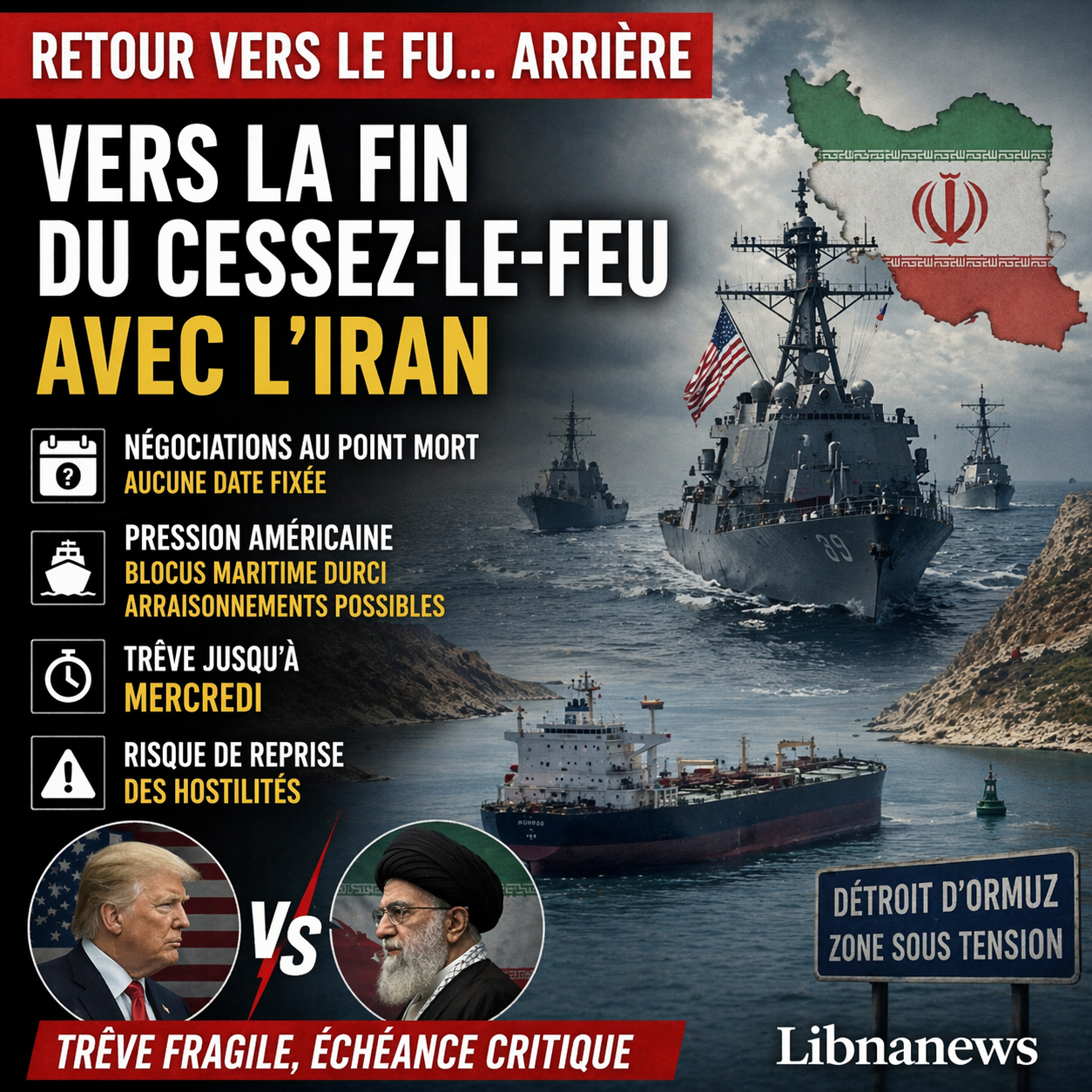
Within a few days of expiry, the ceasefire between Washington and Tehran entered an area of uncertainty. Diplomatic and military signals are no longer in the same direction. On the one hand, the US authorities continue to be optimistic about the possibility of an agreement. On the other hand, the planned negotiations in Pakistan no longer have an agreed date, while military pressure at sea is getting stronger. At this point, the available information confirms one thing above all: there is no longer a clear timetable for a second round of discussions, even as the two-week truce is approaching its end, expected on the night of Tuesday to Wednesday according to the American calendar.
The dispatches received can therefore be partially confirmed, with a significant nuance. Yes, Pakistan and Iran indicate that no date is set for the next round of negotiations. Yes, a U.S. daily says U.S. forces are preparing to board Iran-related ships and seize commercial vessels in the coming days. Yes, Washington remains officially optimistic about the possibility that a tough maritime blockade will serve as a lever to pull an agreement. On the other hand, the formulation that « on Monday » discussions would have been « suspended » goes beyond what is currently confirmed by the strongest sources. What is established is the absence of a fixed date. This amounts, in fact, to emptying the prospect of a round on Monday, but not to cancel an appointment officially confirmed before.
This shade is central, because it says exactly where the sequence is. This is not yet an open break between the two sides. It is a gradual stalemate at the very moment when the truce should theoretically be secured by a new encounter. The further the date of a resumption of the discussions, the more the end of the ceasefire becomes a political and military countdown.
The diplomatic front is no longer in the momentum of the first days. It shifts towards a more ambiguous phase, where each party tries to improve its position before the deadline expires. In this context, the tightening of US naval pressure does not appear as background noise. It becomes the other message from Washington: if negotiations do not quickly structure, the United States will raise the economic and logistical cost to Iran.
No round Monday officially fixed
The first point that can be confirmed concerns Pakistan. As early as 16 April, the spokesman for the Pakistani Ministry of Foreign Affairs indicated that no date had been decided for a second round of discussions between the United States and Iran. Two days later, Iran’s Deputy Foreign Minister, Saeed Khatibzadeh, said in turn that no date was set for the next sequence and that a framework of understanding had to be finalized first. This convergence is important. It means that neither Islamabad nor Tehran today validate the idea of an agreed appointment for Monday.
That is why the word suspension must be carefully used. In practice, the effect is close. A meeting announced in anticipation, then left undated, loses any political consistency. But factually, the available confirmations do not speak of an officially fixed and cancelled session. They’re talking about a second round that hasn’t found its date yet. This lag is important because it avoids turning real uncertainty into a diplomatic break already consumed.
This does not detract from the gravity of the moment. The more blurred the calendar, the closer the truce gets to its term without clear architecture to extend it. A senior Iranian official again said on Friday that he hoped that a preliminary agreement could be reached in the coming days with the help of Pakistan, in order to create the space for an extension of the ceasefire. This said that in Tehran the idea of an extension remained on the table. But 48 hours later, language changed. We’re not talking about an imminent round anymore. We’re talking about a framework of understanding to be finalized before we even set a date.
This development has far-reaching consequences. At the beginning of a truce, the absence of a precise timetable can still be presented as a preparation time. As the deadline approaches, the same absence becomes a symptom of blockage. It means that the parties have not yet agreed on the scope of the discussion, on its format, on its minimum expectations or on the political ground on which they will agree to return.
The logistics factor was certainly highlighted, notably by Donald Trump, who still mentioned the possibility of new direct contacts. But in negotiations of this nature, logistics is almost never alone in question. When two parties really want to see each other quickly, they find a place and a date. The fact that neither Islamabad nor Tehran today want to announce appointments shows that substantive disagreements remain important.
American pressure moves towards the sea
As the diplomatic route slows down, US pressure on Iran increases at sea. This is the second major element confirmed by Friday’s dispatches. According to an American newspaper quoted by a news agency, the US Army is preparing in the coming days to arrest oil tankers linked to Iran and seize commercial ships in international waters. The Agency states that it was unable to independently verify this information. But the mere fact that it is considered serious enough to be repeated in this way says a lot of the moment.
This information is in an already tense context. The United States has put in place a maritime blockade against ships entering or leaving Iranian ports. Washington presents this strategy as an economic lever to force Tehran to accept an agreement. The aim is not only to curb Iranian exports. It is also to make it clear to buyers, insurers, shipowners and intermediaries that the cost of trading with Iran can rise sharply in the coming days.
The shift from a monitoring logic to a possible boarding logic would however change the level of risk. Intercepting ships linked to Iran or seizing commercial vessels on the high seas is a leap of coercion. This is no longer just a military signal. This directly affects freedom of movement, insurance, operator confidence and, beyond that, energy prices. If this scenario is confirmed, the end of the ceasefire will no longer be just a diplomatic issue. It will become an issue of international trade security.
The moment chosen adds to the pressure. Bringing up the maritime threat a few days before the end of the truce amounts to telling Iran that there will be no return to normal without political progress. It also sends a signal to all those who continue to buy, transport or facilitate Iranian trade. The message is not only addressed to Tehran. It targets the entire economic support chain around Iran.
A pressure that also targets China
On this point, we must distinguish what is confirmed from what remains of the order of interpretation. The idea that the US Chief of Staff’s remarks constituted a warning to China does not appear, at this stage, as a citation confirmed by a large agency or by a public official statement. On the other hand, there are several elements that make this plausible.
First, Washington has already clearly hardened its speech on Iranian oil buyers. The US Treasury has warned that buying countries may be subject to secondary sanctions. U.S. officials also indicated that China’s purchase of Iranian crude oil would have to stop if the U.S. pressure worked as planned. A news agency reported that the United States had warned two Chinese banks not to process Iranian money under penalty. She also recalled that China had previously absorbed more than 80 per cent of the oil shipped by Iran.
Second, American military language was formulated in a very broad way. Chief of Staff Dan Caine warned that the United States would actively pursue vessels attempting to provide material support to Iran. Such a sentence refers in theory to any shipowner, charterer or logistics network. But in the reality of Iran’s oil market, it necessarily also affects Asian-related resale and purchasing channels, and therefore China in the first place.
It would therefore be excessive to present as an established fact the sentence that the warning was explicitly addressed to Beijing. On the other hand, it is true that the Chinese dimension is at the heart of the American pressure device. Naval coercion has no strategic meaning if it does not also directly or indirectly affect the trading opportunities of Iranian crude oil. These opportunities go largely through China.
In this phase of the end of the truce, this aspect becomes even more important. Washington is not just putting pressure on Iran at the negotiating table. It also puts pressure on the partners that make Iranian trade possible. This is one way of saying that the lack of agreement would have a cost far beyond the only American-Iranian bilateral relationship.
Ceasefire approaching its tipping point
The third central point is the deadline itself. Donald Trump recalled Friday that without a peace agreement, fighting could resume as early as Wednesday, when the two-week truce concluded on 8 April expires. The timetable is therefore now explicit. The horizon of the night from Tuesday to Wednesday marks the potential tipping point between prolongation, improvised slip or resumption of confrontation.
This reminder is not trivial. It shows that the White House does not consider the truce to be self-extensible. It is not presented as a mechanism that would continue through mere diplomatic inertia. It has an end date, and this date is used as a pressure instrument. The US administration points out that time is playing out against the lack of compromise. The more the days pass without a second structured round, the more the probability of an orderly exit from the truce decreases.
On the Iranian side, language remains more cautious but just as revealing. Tehran states that progress has been made, while saying that a framework for understanding remains to be finalized and that no date can be set before that. At the same time, an Iranian official again indicated on Friday that an extension of the ceasefire remained possible if a preliminary agreement was reached. This combination is characteristic of a fragile end of truce: the two sides still say they want to talk, but they put the rest on conditions that nothing guarantees in the coming hours.
The maritime context reinforces this fragility. The re-imposition of tougher control over the Strait of Ormuz, incidents reported against ships and the lack of full return to normal freedom of navigation show that the environment remains highly unstable. This means that the end of the cease-fire is not only in diplomatic salons. It is also played on water, in energy corridors and in the perception of risk by economic actors.
In other words, the truce is not just a political one. She’s also materially sweating. The more the trade remains disrupted, the more the shipowners hesitate, the more insurance increases and the more economic pressure increases. This climate reduces the margin of error of negotiators. It makes every day without a clear calendar one more day when agreement seems possible in the speech, but more difficult to materialize.
American optimism remains intact on the facade
Despite this, Washington continues to show confidence. For several days, the White House has reiterated that it feels good about the prospects for an agreement. Karoline Leavitt, spokesman for the executive, was still talking about productive and ongoing conversations. Donald Trump, on Friday, claimed to have « very good conversations » with Iran, while refusing to give details.
This optimism can be read in two ways. It may reflect the existence of real substantive exchanges, which are still ongoing, but insufficiently advanced to date. It can also be a communication strategy designed to maintain pressure while avoiding market panic and a perception of failure within a few days of the deadline. Both readings do not necessarily exclude.
What is certain is that American optimism now coexists with much harder signals. The maritime blockade has not been lifted. Threats of secondary sanctions remain on the table. The story of possible boardings is reinforced. And the possibility of a resumption of fighting at the end of the truce is publicly mentioned by the US President himself. So we’re not in the initial phase anymore. We are in an end of ceasefire where hope for compromise and the threat of escalation are advancing in parallel.
This coexistence is precisely what makes the moment so unstable. If the United States were truly convinced that an agreement was within reach, it could reduce military and commercial pressure to facilitate the conclusion. But they do the opposite: they show optimism while preparing for potentially more aggressive measures. This suggests that Washington wants to reach the edge of the deadline with maximum levers, even increasing the risk of slipping.
What one can confirm, and what remains open
At this stage, four points can be considered solid. First, no date is set for the next meeting between the United States and Iran, neither according to Islamabad nor according to Tehran. Then, the two-week ceasefire is very close to its expiry, with a Wednesday horizon according to the timetable mentioned by Donald Trump. Third, American maritime pressure continues to rise, and an American daily reports that the army is preparing for boarding and seizure operations in the coming days. Fourthly, Washington remains officially optimistic about the possibility of an agreement, although this optimism coincides with a very clear tightening of the means of pressure.
However, two points still need to be handled with caution. The first is the idea of a round officially scheduled Monday and then suspended. The public elements available confirm the absence of a date, not the cancellation of a validated appointment. The second is the assertion that the US military signal explicitly targeted China. The pressure on Beijing is undeniable in the logic of the scheme, but the precise formula remains, at this stage, more a coherent interpretation than a fact publicly established by a primary source.
This distinction is not only methodological. It is at the heart of this diplomatic moment. As the ceasefire comes to an end, many things become plausible. Fewer are really confirmed. The risk in such a phase is to make credible expectations for decisions already taken. What emerges from Friday’s cross signals is above all a rise in tension within the truce itself.
Towards an end of truce under strong compulsion
The situation is thus summarized. The cease-fire is approaching its end without a scheduled second round. Iran and Pakistan say no date is set. The United States maintains an optimistic discourse, but prepares or lets filter out additional enforcement measures at sea. The Strait of Ormuz remains a disturbance space. And Donald Trump himself warns that without agreement, fighting could resume as early as Wednesday.
This cluster of clues does not yet make it possible to conclude that the truce will fail. It also does not support an extension. Rather, it draws an end to the ceasefire under heavy pressure, where diplomacy lacks a timetable and where coercion becomes more visible. In this type of sequence, negotiations do not necessarily die in one announcement. They can deteriorate by slipping as the deadline approaches faster than the necessary clarifications.
For the markets, for the shipowners and for the capitals of the region, the problem is now becoming very concrete. If no round is reprogrammed quickly, the truce will enter in its last hours without clearly installed political mechanism to extend it. And if, at the same time, the blockade operations get tougher, the end of the ceasefire will cease to be an abstract diplomatic hypothesis to become an immediate military risk again.




