

Trump Netanyahu: Lebanon as a Fracture
The conversation between Donald Trump and Benjamin Netanyahu is not only worth his verbal violence. It illuminates a moment of rupture in the conduct of the war in Lebanon. On Monday, 1 June, Israel threatened to hit the southern suburbs of Beirut, Hezbollah maintained its line of response, Iran warned that discussions with Washington could be suspended, and the White House tried to take over. In this sequence, the call Trump Netanyahu becomes a symptom: Washington supports Israel, but refuses that the Lebanese war will defeat its regional strategy.
The episode must also be read through Israeli domestic politics. Benjamin Netanyahu governs under electoral pressure, with a weakened coalition and a right that demands to continue the war. A large part of the Jewish Israelis support the continuation of the fighting against Hezbollah, including at the price of friction with Washington. In this climate, the temptation of a prolonged military presence in southern Lebanon is emerging. It is not the subject of full consensus, but it weighs on the Israeli government’s decisions and how it responds to US pressure.
A day of cross threats
The day of 1 June began with a very strong Israeli signal. Benjamin Netanyahu and the Minister of Defence, Israel Katz, ordered the army to prepare strikes against targets in the southern suburbs of Beirut. Israel justified this threat by Hizbullah’s attacks on the north of the country and by repeated ceasefire violations. The political scope was considerable. Dahiyeh, a neighbourhood associated with Hezbollah but also dense urban space, became a potential target again. The Israeli message said Beirut would no longer be preserved if northern Israel remained under fire.
The Israeli Katz formula summarized this doctrine. He essentially claimed that there would be no calm in Beirut without calm in northern Israel. This apparent symmetry is at the heart of the problem. For Israel, it founded deterrence. For Lebanon, it turns capital districts into a military variable. For Washington, it threatens to reverse a conflict still partially contained in a wider regional crisis. A strike on Beirut would not only have targeted Hezbollah infrastructure. It would have caused a political, humanitarian and diplomatic shock.
Hezbollah, for its part, did not want to appear as the applicant for a break limited to its urban bastion. His political relays insisted on a complete ceasefire in Lebanon. Nuance is essential. The movement could accept the idea of a mutual cessation of attacks, but only in a broader sense, including the cessation of Israeli strikes and the withdrawal of occupied areas to the south. He refused a formula where Beirut would be spared while the villages of the South would remain exposed. This is both military calculation and internal legitimacy.
Iran has reinforced this blockade. Tehran linked continued discussions with the United States to the cessation of Israeli operations in Lebanon and Gaza. The Iranian message was based on a simple idea: there would be no regional ceasefire if one of the fronts remained open. For Washington, this position is problematic because it reduces the negotiating margin. The United States is trying to compartmentalize crises. On the contrary, Iran seeks to unify them. Lebanon has become the ground where this method opposition has materialized.
Trump Netanyahu: An anger, but also a calculation
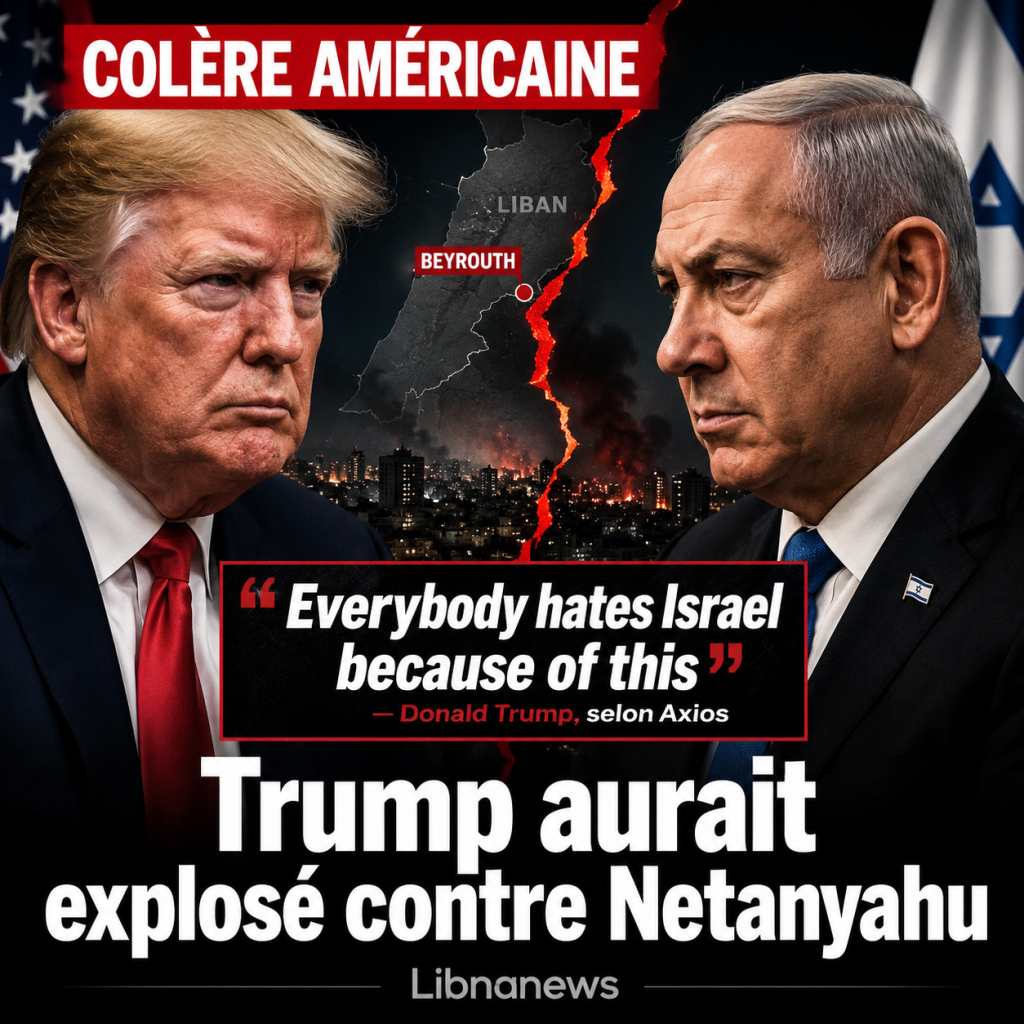
According to Axios, Donald Trump reportedly called Benjamin Netanyahu after understanding that the Israeli threat to Beirut could derail his entire diplomatic mechanism. The appeal was therefore not merely a moral reproof. It was a strategic control act. Trump was not trying to challenge Israel’s right to respond to Hezbollah. It sought to prevent Netanyahu from crossing a threshold that would give Iran a pretext to suspend discussions and strengthen Israel’s international isolation.
The words attributed to Trump are unusual brutality between two allies. According to Axios, an American official summarized his comments in Netanyahu as follows: You-d be in prison if it weren-t for me. I-m saving your ass. Everybody has you now. Everybody hats Israel because of this. You’d be in jail without me. I’m saving your ass. Everyone hates you now. Everyone hates Israel because of this. Another source informed of the appeal states that Trump also said: Direct translation: « What are you doing? »
These sentences were not officially confirmed by the White House or the Netanyahu office. They should therefore be treated as reported. Their analytical interest remains strong. They show that Trump blamed Netanyahu not only for a tactical mistake, but for a political mistake. The heart of his accusation is not only the escalation in Lebanon. He blames him for making Israel more isolated, dependent on Washington and costly to defend. The gross register here serves to mark a domination: Trump reminds Netanyahu that he believes he has protected him, including in the face of his judicial and diplomatic difficulties.
Trump’s public communication has been more controlled. He wrote: Translation: « I had a very productive appeal with Prime Minister Bibi Netanyahu of Israel, and no troops will be in Beirut; All the troops that were en route have already turned back. » He added: Translation: « Likely, through high-level representatives, I had a very good appeal with Hezbollah, and they agreed that all fire would stop — Israel will not attack them, and they will not attack Israel. »
The gap between reported private words and public words is central. In private, Trump reportedly sought to coerce Netanyahu. In public, he presents himself as the maker of a balanced agreement, capable of speaking to Israel and, indirectly, to Hezbollah. This dual posture allows him to preserve the alliance with Israel while claiming personal authority over de-escalation. It also allows him to tell Iran that Washington has slowed Jerusalem, without giving the image of a president who gives way to Tehran.
The Israeli electoral variable
To understand Netanyahu’s resistance, we must look at Israel. The country is entering an unstable political period. The question of early elections was imposed after new parliamentary tensions, in particular on the issue of conscription exemptions for ultra-Orthodox women. The Knesset has moved towards dissolution, and Israeli commentators refer to a possible election in late summer or autumn. In this context, each military decision becomes an electoral message.
Netanyahu cannot afford to appear weak in front of Hezbollah. Its security legitimacy has already been undermined by successive crises. The opposition accuses him of not restoring security to the north. The nationalist right accuses him as soon as he seems to accept a limit set by Washington. The religious and nationalist parties in its coalition want a tough policy. Displaced northern residents demand guarantees before returning. This pressure creates a clear political incentive: to maintain the offensive, to maintain the initiative and to refuse a truce that would resemble an imposed freeze.
Israeli society is not homogeneous, but the available data shows massive support from Jewish respondents for the continuation of the war in Lebanon. A survey by the Israeli Institute of Democracy indicated that in April, 80 per cent of Jewish respondents felt that Israel should continue to fight Hezbollah in Lebanon, even if it created friction with the US administration. Among Arab respondents, the trend was reversed. This internal divide gives Netanyahu a political basis to resist US injunctions, while strengthening the polarization of the debate.
To say that « the Israelis » want to occupy Lebanon would be too general. But it is true that a significant part of Jewish opinion, right-wing elected representatives and the Israeli security debate accepts the idea of an extended military presence in southern Lebanon if it is presented as necessary for the protection of northern Israel. This presence can be described as a security zone, buffer line or de facto occupation. Words vary by actor. The result would be the same for Lebanon: lasting Israeli military control over a portion of the territory.
The temptation of a safe area
The taking or resumption of strategic positions in South Lebanon, particularly around Beaufort, gives this hypothesis concrete content. Beaufort is not just a military point. It is a symbol of the former Israeli occupation, which began in 1982 and ended with the withdrawal of 2000. For part of the Israeli right, this memory proves that the withdrawal allowed Hezbollah to strengthen. For others, it is a reminder of the cost of a war of wear and tear, where Israeli soldiers become targets and where occupation feeds the legitimacy of armed resistance.
The analysis must therefore distinguish two trends. The first wants to prolong the war until it weakens Hezbollah and removes its firing capabilities. Today it is very present in Israeli Jewish opinion. The second accepts, if not wishes, an occupation or a buffer zone in South Lebanon. It is more political and security than popular in the strict sense, but it enjoys a favourable climate, because many Israelis no longer believe in a diplomatic solution capable of guaranteeing security in the north. Both trends are mutually reinforcing. The longer the war lasts, the more the idea of an area held by Israel seems normal.
For Netanyahu, this temptation is useful and dangerous. Useful, because it allows him to show that he does not suffer Hezbollah. Dangerous, because she can lock her in a strategy with no clear outcome. A buffer zone requires troops, supply lines, rules of engagement and permanent exposure to attacks. It can temporarily reassure Israeli communities in the north. It can also transform South Lebanon into a front attrition, as in the 1990s. It is precisely this risk that Washington wants to avoid.
Why Trump braked Netanyahu
Trump’s appeal is explained by this combination of factors. On the ground, Israel wanted to increase pressure. In Tehran, Iran threatened to charge for this pressure in negotiations with the United States. In Washington, Trump wanted to preserve his role as central negotiator. In Jerusalem, Netanyahu needed to show that he was not going back. American anger arises from this incompatibility. Trump needs a disciplined Netanyahu. Netanyahu needs a protective Trump, but not too visible.
The American interest is not identical to the Israeli interest. Israel is seeking to restore local deterrence against Hezbollah. The United States is seeking to prevent uncontrolled regional war. These two objectives can be met, but they diverge as soon as the Israeli method threatens to undermine the dialogue with Iran. A strike on Beirut might have had a limited military effect, but a considerable diplomatic effect. It reportedly placed the United States before the choice of covering Israel or criticizing it publicly. Trump acted before this choice became inevitable.
The sequence also shows that the Trump-Netanyahu relationship is not an automatic alignment relationship. Trump values support for Israel, but he still values his ability to impose a result. In his logic, Netanyahu becomes guilty when he acts as if he could lead Washington into an uncontrolled escalation. The vocabulary attributed to Trump, especially when he says « I He doesn’t speak like a neutral mediator. He speaks as a protector who believes that his protégé compromises the operation.
A fragile truce, not a settlement
Trump’s statement probably pushed back an immediate strike on Beirut. It did not resolve the conflict. Netanyahu maintained that operations in southern Lebanon would continue. Hezbollah refused a limited truce in the capital. Iran continued to link Lebanon to the regional ceasefire. Fires were again reported after the American announcement. The result is less like a ceasefire than a conditional suspension of a climbing threshold.
This distinction is essential. A ceasefire requires a sustained reduction in operations, verification mechanisms and a capacity to sanction violations. Monday’s sequence doesn’t offer that yet. It is based on indirect commitments, contradictory public messages and Trump’s personal pressure. It can work for a few hours or days if everyone wants to avoid the worst. It can also be broken quickly if a drone fire, an Israeli strike or a decision on the ground is interpreted as a rupture.
For Lebanon, the immediate danger is the normalization of a new status quo. Beirut could be temporarily spared, while the South would continue to suffer intense war. Israel could consolidate a security zone by presenting it as provisional. Hezbollah could continue to justify its weapons through occupation and strikes. Iran could keep Lebanon as a negotiating lever with Washington. In this context, Trump Netanyahu is not a parenthesis. It is a reflection of the battle that opens around the political cost of the war and the possible duration of the Israeli occupation in South Lebanon.
A very concrete point will therefore have to be decided in future discussions. Is it just to prevent a strike on Beirut, or to build a cessation of hostilities throughout Lebanese territory? As long as this issue remains open, Netanyahu can talk about continued operations, Hezbollah can refuse a partial truce, Iran can maintain its diplomatic blackmail and Trump can claim success without having a solid mechanism to impose it.




